Bing Yang, Yimiao Zhang, Shun Su, Jintang He, Jianjun Hu, Kaicheng Wang
{"title":"Metagenomic next-generation sequencing identifies tick-carried pathogens on Tarim Red Deer in Southern Xinjiang.","authors":"Bing Yang, Yimiao Zhang, Shun Su, Jintang He, Jianjun Hu, Kaicheng Wang","doi":"10.5455/OVJ.2025.v15.i11.69","DOIUrl":null,"url":null,"abstract":"<p><strong>Background: </strong>Ticks are important vectors for a wide range of pathogens, including viruses, bacteria, and protozoa, that impact both humans and animals. Recent advances in metagenomic sequencing have established it as a powerful tool for uncovering the microbial diversity within ticks, enabling the discovery of previously unrecognized pathogens.</p><p><strong>Aim: </strong>This study aimed to enrich the pathogen database for Tarim red deer in southern Xinjiang and provide experimental data to aid in the diagnosis, prevention, control, and treatment of viral diseases in Tarim red deer.</p><p><strong>Methods: </strong>Metagenomic sequencing was employed to analyze the viral species carried by ticks parasitizing the red tarim deer. Additionally, enzyme-linked immunosorbent assay based antibody testing was conducted on 195 red deer samples from four farms M01, M02, M03, and M04 to detect antibodies against the <i>Orf virus.</i></p><p><strong>Results: </strong>Next-generation sequencing was used to obtain partial sequences of viruses and bacteria, with further analysis focusing on viruses with higher abundance, such as <i>mule deer pox virus</i> and <i>Orf virus</i>. Serological testing for <i>Orf virus</i> antibodies in 195 red deer samples identified 7 positive cases, resulting in a positivity rate of 3.59% (7/195). Positivity rates were 5.26% (4/76) and 6.12% (3/49) for farms M02 and M04, respectively, whereas no seropositive individuals were identified at farms M01 and M03.</p><p><strong>Conclusion: </strong>This study expands the current knowledge of tick-borne pathogens in southern Xinjiang by identifying diverse viral species associated with tick-infested Tarim red deer. The findings confirm the presence of <i>Orf virus</i> in red deer populations, particularly on farms M02 and M04. These results underscore the importance of ongoing surveillance efforts and offer valuable insights into the diversity and geographical distribution of tick-associated viruses within the arid and semi-arid ecosystems of southern Xinjiang.</p>","PeriodicalId":19531,"journal":{"name":"Open Veterinary Journal","volume":"15 11","pages":"6109-6117"},"PeriodicalIF":1.0000,"publicationDate":"2025-11-01","publicationTypes":"Journal Article","fieldsOfStudy":null,"isOpenAccess":false,"openAccessPdf":"https://www.ncbi.nlm.nih.gov/pmc/articles/PMC12861505/pdf/","citationCount":"0","resultStr":null,"platform":"Semanticscholar","paperid":null,"PeriodicalName":"Open Veterinary Journal","FirstCategoryId":"1085","ListUrlMain":"https://doi.org/10.5455/OVJ.2025.v15.i11.69","RegionNum":0,"RegionCategory":null,"ArticlePicture":[],"TitleCN":null,"AbstractTextCN":null,"PMCID":null,"EPubDate":"2025/11/30 0:00:00","PubModel":"Epub","JCR":"Q3","JCRName":"VETERINARY SCIENCES","Score":null,"Total":0}
引用次数: 0
Abstract
Background: Ticks are important vectors for a wide range of pathogens, including viruses, bacteria, and protozoa, that impact both humans and animals. Recent advances in metagenomic sequencing have established it as a powerful tool for uncovering the microbial diversity within ticks, enabling the discovery of previously unrecognized pathogens.
Aim: This study aimed to enrich the pathogen database for Tarim red deer in southern Xinjiang and provide experimental data to aid in the diagnosis, prevention, control, and treatment of viral diseases in Tarim red deer.
Methods: Metagenomic sequencing was employed to analyze the viral species carried by ticks parasitizing the red tarim deer. Additionally, enzyme-linked immunosorbent assay based antibody testing was conducted on 195 red deer samples from four farms M01, M02, M03, and M04 to detect antibodies against the Orf virus.
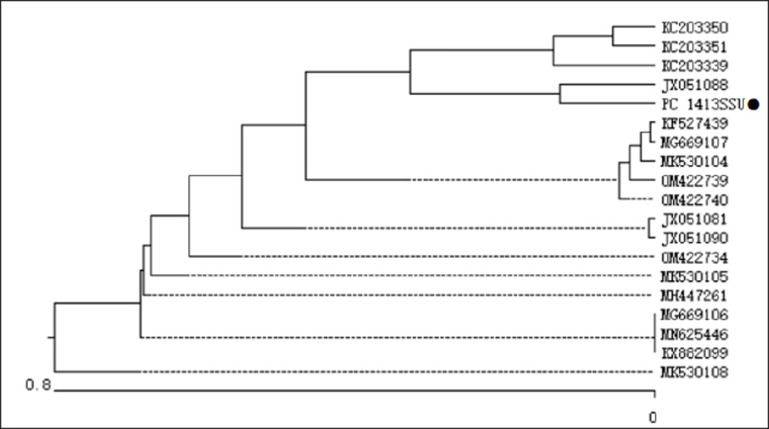
Results: Next-generation sequencing was used to obtain partial sequences of viruses and bacteria, with further analysis focusing on viruses with higher abundance, such as mule deer pox virus and Orf virus. Serological testing for Orf virus antibodies in 195 red deer samples identified 7 positive cases, resulting in a positivity rate of 3.59% (7/195). Positivity rates were 5.26% (4/76) and 6.12% (3/49) for farms M02 and M04, respectively, whereas no seropositive individuals were identified at farms M01 and M03.
Conclusion: This study expands the current knowledge of tick-borne pathogens in southern Xinjiang by identifying diverse viral species associated with tick-infested Tarim red deer. The findings confirm the presence of Orf virus in red deer populations, particularly on farms M02 and M04. These results underscore the importance of ongoing surveillance efforts and offer valuable insights into the diversity and geographical distribution of tick-associated viruses within the arid and semi-arid ecosystems of southern Xinjiang.
期刊介绍:
Open Veterinary Journal is a peer-reviewed international open access online and printed journal that publishes high-quality original research articles. reviews, short communications and case reports dedicated to all aspects of veterinary sciences and its related subjects. Research areas include the following: Infectious diseases of zoonotic/food-borne importance, applied biochemistry, parasitology, endocrinology, microbiology, immunology, pathology, pharmacology, physiology, epidemiology, molecular biology, immunogenetics, surgery, ophthalmology, dermatology, oncology and animal reproduction. All papers are peer-reviewed. Moreover, with the presence of well-qualified group of international referees, the process of publication will be done meticulously and to the highest standards.



 求助内容:
求助内容: 应助结果提醒方式:

 京公网安备 11010802042870号


