
Process intensification in co-production of plant and bacterial cellulose from citrus waste: A review
IF 3.9
3区 工程技术
Q3 ENERGY & FUELS
Chemical Engineering and Processing - Process Intensification
Pub Date : 2026-04-01
Epub Date: 2026-01-30
DOI:10.1016/j.cep.2026.110730
引用次数: 0
Abstract
Bacterial cellulose (BC) offers remarkable properties such as biodegradability and biocompatibility, but its commercialization remains challenging due to high costs. A promising solution involves converting such as citrus waste (CW), into BC alongside other value-added products, enhancing sustainability and reducing expenses. While CW has been studied for plant cellulose extraction and limited BC production, existing reviews focus on pectin, polyphenols, or biofuels, neglecting combined plant cellulose and BC valorization. This review analyzes plant cellulose and BC production from CW, proposing an integrated approach. It evaluates physical, chemical, and biological extraction methods for plant cellulose, comparing efficiency and cost-effectiveness. For BC, key factors such as microbial strains, culture media, and process conditions are examined, with a performance comparison across methods. Challenges in scaling up production are also discussed. The study introduces a circular system: extracting plant cellulose as the primary product and converting residues into BC as a by-product. This dual approach improves sustainability, reduces fruit waste, and aligns with eco-economic goals—a gap unexplored in prior research. By optimizing waste utilization and lowering costs, this integrated model could advance bacterial and plant cellulose production while addressing environmental concerns.
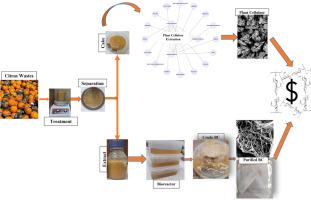
柑橘废弃物植物纤维素与细菌纤维素联产工艺强化研究进展
细菌纤维素(BC)具有生物可降解性和生物相容性等显著特性,但由于成本高,其商业化仍具有挑战性。一个有希望的解决方案是将柑橘废弃物(CW)与其他增值产品一起转化为BC,从而提高可持续性并降低成本。虽然已经对植物纤维素提取和有限的BC生产进行了研究,但现有的综述主要集中在果胶、多酚或生物燃料上,而忽略了植物纤维素和BC的复合增值。本文对植物纤维素和BC的生产进行了分析,并提出了综合的方法。它评估了植物纤维素的物理、化学和生物提取方法,比较了效率和成本效益。对于BC,关键因素如微生物菌株、培养基和工艺条件进行了检查,并对不同方法进行了性能比较。还讨论了扩大生产的挑战。该研究介绍了一个循环系统:提取植物纤维素作为主要产品,将残留物转化为BC作为副产物。这种双重方法提高了可持续性,减少了水果浪费,并与生态经济目标保持一致-这是先前研究中未探索的空白。通过优化废物利用和降低成本,这种集成模型可以促进细菌和植物纤维素生产,同时解决环境问题。
本文章由计算机程序翻译,如有差异,请以英文原文为准。
求助全文
约1分钟内获得全文
求助全文
来源期刊
CiteScore
7.80
自引率
9.30%
发文量
408
审稿时长
49 days
期刊介绍:
Chemical Engineering and Processing: Process Intensification is intended for practicing researchers in industry and academia, working in the field of Process Engineering and related to the subject of Process Intensification.Articles published in the Journal demonstrate how novel discoveries, developments and theories in the field of Process Engineering and in particular Process Intensification may be used for analysis and design of innovative equipment and processing methods with substantially improved sustainability, efficiency and environmental performance.
 求助内容:
求助内容: 应助结果提醒方式:

 京公网安备 11010802042870号


