
Low-cost reinforcement learning framework to optimize micromixer structures and parameters
IF 4.2
3区 工程技术
Q3 ENERGY & FUELS
Chemical Engineering and Processing - Process Intensification
Pub Date : 2026-04-01
Epub Date: 2026-02-03
DOI:10.1016/j.cep.2026.110727
引用次数: 0
Abstract
Micromixers play a crucial role in microfluidic technology. Given the complexity, challenges, and time-consuming nature of their design processes, automating the design and optimization of micromixers is of paramount importance. This study proposes a low-overhead sequential decision-making reinforcement learning framework that addresses the issue of interoperability between various inversion algorithms and finite element simulations, thereby enabling the dynamic optimization of micromixer geometries. The framework integrates ezdxf, Mph, COMSOL, and a custom-designed reward function to facilitate both the geometric and parametric design. The custom-designed reward function enhances the interaction between the reinforcement learning agent and the integrated framework, guiding the decision-making process towards optimal objectives. The effectiveness of the framework was validated through a case involving a parameter space of size 10,800. With mixing index and Mixing Energy Cost as the optimization objectives, the RL process converged after 178 agent–environment interactions, reducing the interaction count by approximately 44.03% relative to genetic algorithms. Furthermore, this framework can be easily adapted, with minimal modifications, for application to other finite element analysis problems.
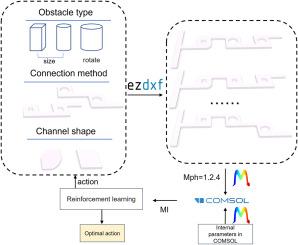
低成本强化学习框架优化微混合器结构和参数
微混合器在微流控技术中起着至关重要的作用。鉴于其设计过程的复杂性,挑战性和耗时性,微混合器的自动化设计和优化至关重要。本研究提出了一个低开销的顺序决策强化学习框架,该框架解决了各种反演算法和有限元模拟之间的互操作性问题,从而实现了微混合器几何形状的动态优化。该框架集成了ezdxf、Mph、COMSOL和定制设计的奖励函数,以促进几何和参数化设计。定制设计的奖励函数增强了强化学习代理与集成框架之间的交互作用,引导决策过程朝着最优目标发展。通过一个参数空间为10,800的实例验证了该框架的有效性。以混合指数和混合能量成本为优化目标,RL过程在agent -环境交互178次后收敛,相对于遗传算法减少了约44.03%的交互次数。此外,这个框架可以很容易地适应,以最小的修改,应用于其他有限元分析问题。
本文章由计算机程序翻译,如有差异,请以英文原文为准。
求助全文
约1分钟内获得全文
求助全文
来源期刊
CiteScore
7.80
自引率
9.30%
发文量
408
审稿时长
49 days
期刊介绍:
Chemical Engineering and Processing: Process Intensification is intended for practicing researchers in industry and academia, working in the field of Process Engineering and related to the subject of Process Intensification.Articles published in the Journal demonstrate how novel discoveries, developments and theories in the field of Process Engineering and in particular Process Intensification may be used for analysis and design of innovative equipment and processing methods with substantially improved sustainability, efficiency and environmental performance.
 求助内容:
求助内容: 应助结果提醒方式:

 京公网安备 11010802042870号


