{"title":"Screening and managing frailty in older nursing home residents with Frail-VIG index: Feasibility, reliability and predictive validity for mortality.","authors":"Cristina Jiménez-Domínguez, Lourdes Rexach-Cano, Carlos Verdejo-Bravo, Manuel Vicente Mejía-Ramírez-Arellano, Carlota Manuela Zárate-Saez, Mª Nieves Vaquero Pinto, Cristina Roldán-Plaza, Nuria Pérez-Panizo, Mª Loreto Álvarez-Nebreda","doi":"10.1016/j.tjfa.2025.100130","DOIUrl":null,"url":null,"abstract":"<p><p>Frailty is prevalent among older nursing home residents, although there is limited evidence regarding frailty screening and management in this setting.</p><p><strong>Objective: </strong>To evaluate the measurement properties of the Frail Index based on the Comprehensive Geriatric Assessment (Frail-VIG).</p><p><strong>Design: </strong>Prospective observational longitudinal study of 571 residents from 3 nursing homes. Frail-VIG scores were calculated at baseline and at 6 and 12 months. Sociodemographic variables were studied. Feasibility was assessed based on simplicity of application and requirements for score calculation. Reliability was evaluated through inter-rater agreement and test-retest assessments. Construct and content validity were examined by comparing it with other frailty indexes. Predictive validity was evaluated using log-rank tests and AUC-ROC curves for mortality prediction.</p><p><strong>Results: </strong>Mean (SD) resident age was 88.2 (6.5) years, and 80.6 % were women. The mortality rate was 11.4 % at 6 months and 20 % at 12 months. Calculating Frail-VIG scores required 5.15 min and no additional space or equipment, and there was low risk of missing data. The inter-rater consistency and score stability over time indicate strong reliability. The Frail-VIG maintains the characteristics of other established frailty indexes and shows strong convergent validity with the FRAIL-NH and CFS scales. Baseline scores have an AUC-ROC curve (confidence interval) of 0.69 (95 % CI, 0.63-0.76) at 6 months and 0.65 (95 % CI, 0.6-0.71) at 12 months.</p><p><strong>Conclusions: </strong>The measurement properties of the Frail-VIG in older nursing home residents validate its use in this population and setting. Its predictive ability for mortality suggests important implications for advanced care planning.</p>","PeriodicalId":51629,"journal":{"name":"Journal of Frailty & Aging","volume":"15 2","pages":"100130"},"PeriodicalIF":3.3000,"publicationDate":"2026-04-01","publicationTypes":"Journal Article","fieldsOfStudy":null,"isOpenAccess":false,"openAccessPdf":"https://www.ncbi.nlm.nih.gov/pmc/articles/PMC12887097/pdf/","citationCount":"0","resultStr":null,"platform":"Semanticscholar","paperid":null,"PeriodicalName":"Journal of Frailty & Aging","FirstCategoryId":"1085","ListUrlMain":"https://doi.org/10.1016/j.tjfa.2025.100130","RegionNum":0,"RegionCategory":null,"ArticlePicture":[],"TitleCN":null,"AbstractTextCN":null,"PMCID":null,"EPubDate":"2026/1/31 0:00:00","PubModel":"Epub","JCR":"Q2","JCRName":"GERIATRICS & GERONTOLOGY","Score":null,"Total":0}
引用次数: 0
Abstract
Frailty is prevalent among older nursing home residents, although there is limited evidence regarding frailty screening and management in this setting.
Objective: To evaluate the measurement properties of the Frail Index based on the Comprehensive Geriatric Assessment (Frail-VIG).
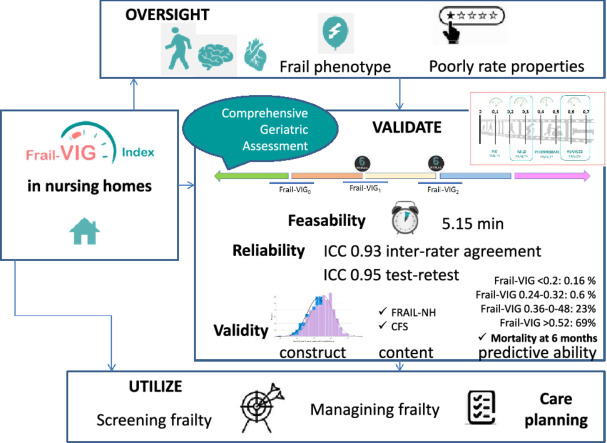
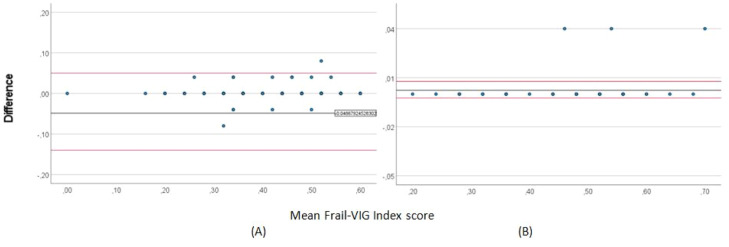
Design: Prospective observational longitudinal study of 571 residents from 3 nursing homes. Frail-VIG scores were calculated at baseline and at 6 and 12 months. Sociodemographic variables were studied. Feasibility was assessed based on simplicity of application and requirements for score calculation. Reliability was evaluated through inter-rater agreement and test-retest assessments. Construct and content validity were examined by comparing it with other frailty indexes. Predictive validity was evaluated using log-rank tests and AUC-ROC curves for mortality prediction.
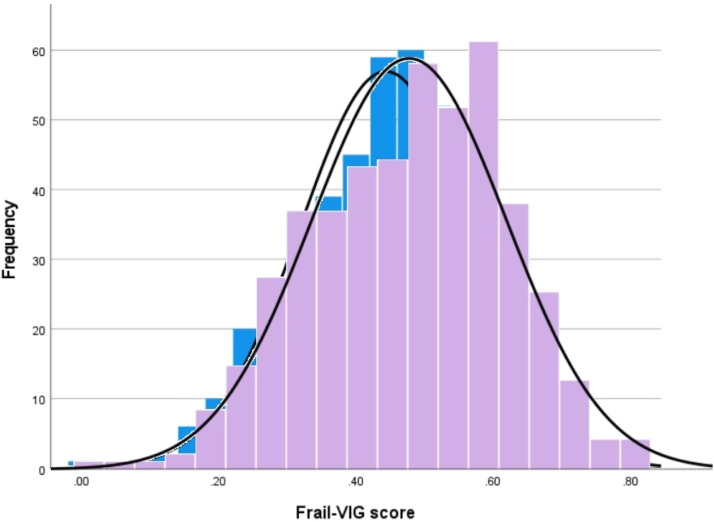
Results: Mean (SD) resident age was 88.2 (6.5) years, and 80.6 % were women. The mortality rate was 11.4 % at 6 months and 20 % at 12 months. Calculating Frail-VIG scores required 5.15 min and no additional space or equipment, and there was low risk of missing data. The inter-rater consistency and score stability over time indicate strong reliability. The Frail-VIG maintains the characteristics of other established frailty indexes and shows strong convergent validity with the FRAIL-NH and CFS scales. Baseline scores have an AUC-ROC curve (confidence interval) of 0.69 (95 % CI, 0.63-0.76) at 6 months and 0.65 (95 % CI, 0.6-0.71) at 12 months.
Conclusions: The measurement properties of the Frail-VIG in older nursing home residents validate its use in this population and setting. Its predictive ability for mortality suggests important implications for advanced care planning.
期刊介绍:
The Journal of Frailty & Aging is a peer-reviewed international journal aimed at presenting articles that are related to research in the area of aging and age-related (sub)clinical conditions. In particular, the journal publishes high-quality papers describing and discussing social, biological, and clinical features underlying the onset and development of frailty in older persons. The Journal of Frailty & Aging is composed by five different sections: - Biology of frailty and aging In this section, the journal presents reports from preclinical studies and experiences focused at identifying, describing, and understanding the subclinical pathophysiological mechanisms at the basis of frailty and aging. - Physical frailty and age-related body composition modifications Studies exploring the physical and functional components of frailty are contained in this section. Moreover, since body composition plays a major role in determining physical frailty and, at the same time, represents the most evident feature of the aging process, special attention is given to studies focused on sarcopenia and obesity at older age. - Neurosciences of frailty and aging The section presents results from studies exploring the cognitive and neurological aspects of frailty and age-related conditions. In particular, papers on neurodegenerative conditions of advanced age are welcomed. - Frailty and aging in clinical practice and public health This journal’s section is devoted at presenting studies on clinical issues of frailty and age-related conditions. This multidisciplinary section particularly welcomes reports from clinicians coming from different backgrounds and specialties dealing with the heterogeneous clinical manifestations of advanced age. Moreover, this part of the journal also contains reports on frailty- and age-related social and public health issues. - Clinical trials and therapeutics This final section contains all the manuscripts presenting data on (pharmacological and non-pharmacological) interventions aimed at preventing, delaying, or treating frailty and age-related conditions.The Journal of Frailty & Aging is a quarterly publication of original papers, review articles, case reports, controversies, letters to the Editor, and book reviews. Manuscripts will be evaluated by the editorial staff and, if suitable, by expert reviewers assigned by the editors. The journal particularly welcomes papers by researchers from different backgrounds and specialities who may want to share their views and experiences on the common themes of frailty and aging.The abstracting and indexing of the Journal of Frailty & Aging is covered by MEDLINE (approval by the National Library of Medicine in February 2016).

 求助内容:
求助内容: 应助结果提醒方式:

 京公网安备 11010802042870号


