Sangmin Park, Sunmi Ma, Jieun Joo, Seunghee Ha, Tae-Jin Yoon, Woojae Han
{"title":"Efficacy of Self-Directed Auditory Rehabilitation in Individuals With Hearing Loss: A Systematic Review and Meta-Analysis.","authors":"Sangmin Park, Sunmi Ma, Jieun Joo, Seunghee Ha, Tae-Jin Yoon, Woojae Han","doi":"10.7874/jao.2025.00591","DOIUrl":null,"url":null,"abstract":"<p><strong>Background and objectives: </strong>Hearing loss negatively affects communication and quality of life. While clinician-led rehabilitation is beneficial, access barriers and poor long-term adherence limit its overall impact. This systematic review evaluated the efficacy of self-directed auditory rehabilitation across the lifespan. Materials and.</p><p><strong>Methods: </strong>A systematic search was conducted using five electronic databases for peer-reviewed studies involving children, adults, and older adults with at least mild hearing loss, who participated in self-directed auditory rehabilitation and reported behavioral, objective, or patient-reported auditory outcomes.</p><p><strong>Results: </strong>Twenty-two studies with 1,851 screened records were included in the synthesis, which encompassed varied populations, devices, and rehabilitation formats. Random-effects meta-analyses showed significant speech recognition improvement in pediatric participants (Cohen's d=1.32, standard error [SE]=0.12, 95% confidence interval [CI]: 1.08-1.56; p<0.05), with effects maintained at 1-3 months. A moderately significant benefit was observed in both adults and older adults (Cohen's d=0.55, SE=0.05, 95% CI: 0.45-0.65). Although publication bias was present in some adult studies, the sensitivity analyses confirmed the robustness of the results.</p><p><strong>Conclusions: </strong>Self-directed auditory rehabilitation produces meaningful and sustained speech recognition benefits in individuals with hearing loss, endorsing its integration as an accessible adjunct to conventional audiologic care. Future studies should refine the program content and reduce intervention variability.</p>","PeriodicalId":44886,"journal":{"name":"Journal of Audiology and Otology","volume":"30 1","pages":"23-33"},"PeriodicalIF":1.4000,"publicationDate":"2026-01-01","publicationTypes":"Journal Article","fieldsOfStudy":null,"isOpenAccess":false,"openAccessPdf":"https://www.ncbi.nlm.nih.gov/pmc/articles/PMC12862174/pdf/","citationCount":"0","resultStr":null,"platform":"Semanticscholar","paperid":null,"PeriodicalName":"Journal of Audiology and Otology","FirstCategoryId":"1085","ListUrlMain":"https://doi.org/10.7874/jao.2025.00591","RegionNum":0,"RegionCategory":null,"ArticlePicture":[],"TitleCN":null,"AbstractTextCN":null,"PMCID":null,"EPubDate":"2026/1/20 0:00:00","PubModel":"Epub","JCR":"Q3","JCRName":"OTORHINOLARYNGOLOGY","Score":null,"Total":0}
引用次数: 0
Abstract
Background and objectives: Hearing loss negatively affects communication and quality of life. While clinician-led rehabilitation is beneficial, access barriers and poor long-term adherence limit its overall impact. This systematic review evaluated the efficacy of self-directed auditory rehabilitation across the lifespan. Materials and.
Methods: A systematic search was conducted using five electronic databases for peer-reviewed studies involving children, adults, and older adults with at least mild hearing loss, who participated in self-directed auditory rehabilitation and reported behavioral, objective, or patient-reported auditory outcomes.
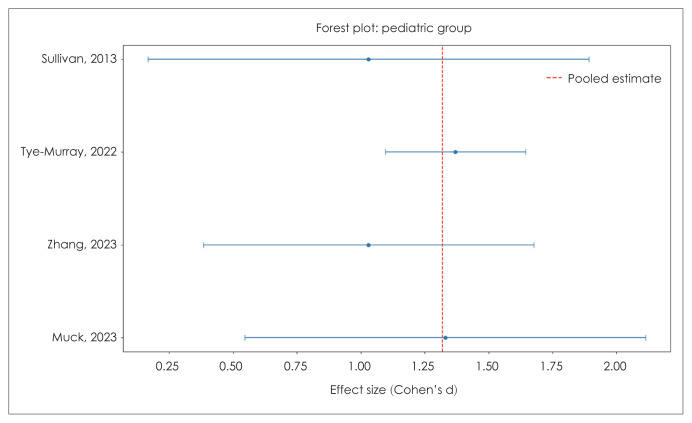
Results: Twenty-two studies with 1,851 screened records were included in the synthesis, which encompassed varied populations, devices, and rehabilitation formats. Random-effects meta-analyses showed significant speech recognition improvement in pediatric participants (Cohen's d=1.32, standard error [SE]=0.12, 95% confidence interval [CI]: 1.08-1.56; p<0.05), with effects maintained at 1-3 months. A moderately significant benefit was observed in both adults and older adults (Cohen's d=0.55, SE=0.05, 95% CI: 0.45-0.65). Although publication bias was present in some adult studies, the sensitivity analyses confirmed the robustness of the results.
Conclusions: Self-directed auditory rehabilitation produces meaningful and sustained speech recognition benefits in individuals with hearing loss, endorsing its integration as an accessible adjunct to conventional audiologic care. Future studies should refine the program content and reduce intervention variability.
期刊介绍:
Journal of Audiology and Otology (JAO) (formerly known as Korean Journal of Audiology) aims to publish the most advanced findings for all aspects of the auditory and vestibular system and diseases of the ear using state-of-the-art techniques and analyses. The journal covers recent trends related to the topics of audiology, otology, and neurotology conducted by professionals, with the goal of providing better possible treatment to people of all ages, from infants to the elderly, who suffer from auditory and/or vestibular disorders and thus, improving their quality of life. This journal encourages the submission of review papers about current professional issues, research papers presenting a scientific base and clinical application, and case papers with unique reports or clinical trials. We also invite letters to the editor and papers related to the manufacture and distribution of medical devices. This journal provides integrated views from otologists, audiologists, and other healthcare practitioners, offering readers high quality scientific and clinical information. This peer-reviewed and open access journal has been the official journal of the Korean Audiological Society since 1997 and of both the Korean Audiological Society and the Korean Otological Society since 2017. It is published in English four times a year in January, April, July, and October.



 求助内容:
求助内容: 应助结果提醒方式:

 京公网安备 11010802042870号


