Burçay Tellioğlu, Esin Akbay Çetin, Handan Sevim Akan, Münir Demir Bajin, Mehmet Ali Onur, Levent Sennaroğlu
{"title":"Dose- and Time-Dependent Halofuginone Cytotoxicity in HaCaT Keratinocytes: Implications for Cholesteatoma.","authors":"Burçay Tellioğlu, Esin Akbay Çetin, Handan Sevim Akan, Münir Demir Bajin, Mehmet Ali Onur, Levent Sennaroğlu","doi":"10.7874/jao.2025.00360","DOIUrl":null,"url":null,"abstract":"<p><strong>Background and objectives: </strong>Cholesteatomas are chronically progressive keratinizing epithelial lesions that locally destroy tissue and erode bone. Surgery is the primary treatment for cholesteatomas; however, tumor recurrence and complications have prompted the search for more effective medical therapies. Halofuginone (HF) inhibits multiple pathways implicated in cholesteatoma pathogenesis. Therefore, the dose- and time-dependent cytotoxic effects of HF on the spontaneously transformed human adult skin keratinocyte (HaCaT) cell line were investigated, and the IC50 values of HF were determined as a preliminary step in evaluating the potential of using HF as a pharmacological treatment for cholesteatoma. Materials and.</p><p><strong>Methods: </strong>An in vitro experiment was conducted using HaCaT cells, which is an immortalized human keratinocyte cell line. Cells were treated with HF at 0.1 μM to 100 μM for 24 and 48 hours. Cell viability was measured via an MTT assay, and the IC50 values were calculated using nonlinear regression analysis.</p><p><strong>Results: </strong>HF treatment substantially dose- and time-dependently reduced HaCaT cell viability. The IC50 values at 24 and 48 hours were 2.74 μM and 0.24 μM, respectively, reflecting a more than ten-fold increase in cytotoxic potency over time. The differences between the treatment groups were significant at both time points (p=0.017 and p=0.001 at 24 and 48 hours, respectively).</p><p><strong>Conclusions: </strong>HF exerts potent cytotoxic effects on keratinocytes, with efficacy increasing with exposure duration. These findings support the further study of HF as a pharmacological agent for modulating epithelial proliferation in cholesteatomas and related disorders.</p>","PeriodicalId":44886,"journal":{"name":"Journal of Audiology and Otology","volume":"30 1","pages":"60-66"},"PeriodicalIF":1.4000,"publicationDate":"2026-01-01","publicationTypes":"Journal Article","fieldsOfStudy":null,"isOpenAccess":false,"openAccessPdf":"https://www.ncbi.nlm.nih.gov/pmc/articles/PMC12862175/pdf/","citationCount":"0","resultStr":null,"platform":"Semanticscholar","paperid":null,"PeriodicalName":"Journal of Audiology and Otology","FirstCategoryId":"1085","ListUrlMain":"https://doi.org/10.7874/jao.2025.00360","RegionNum":0,"RegionCategory":null,"ArticlePicture":[],"TitleCN":null,"AbstractTextCN":null,"PMCID":null,"EPubDate":"2026/1/20 0:00:00","PubModel":"Epub","JCR":"Q3","JCRName":"OTORHINOLARYNGOLOGY","Score":null,"Total":0}
引用次数: 0
Abstract
Background and objectives: Cholesteatomas are chronically progressive keratinizing epithelial lesions that locally destroy tissue and erode bone. Surgery is the primary treatment for cholesteatomas; however, tumor recurrence and complications have prompted the search for more effective medical therapies. Halofuginone (HF) inhibits multiple pathways implicated in cholesteatoma pathogenesis. Therefore, the dose- and time-dependent cytotoxic effects of HF on the spontaneously transformed human adult skin keratinocyte (HaCaT) cell line were investigated, and the IC50 values of HF were determined as a preliminary step in evaluating the potential of using HF as a pharmacological treatment for cholesteatoma. Materials and.
Methods: An in vitro experiment was conducted using HaCaT cells, which is an immortalized human keratinocyte cell line. Cells were treated with HF at 0.1 μM to 100 μM for 24 and 48 hours. Cell viability was measured via an MTT assay, and the IC50 values were calculated using nonlinear regression analysis.
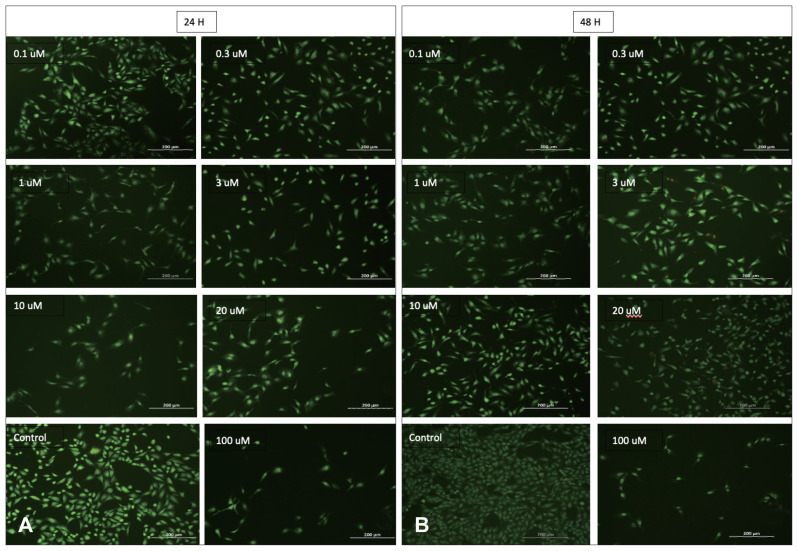
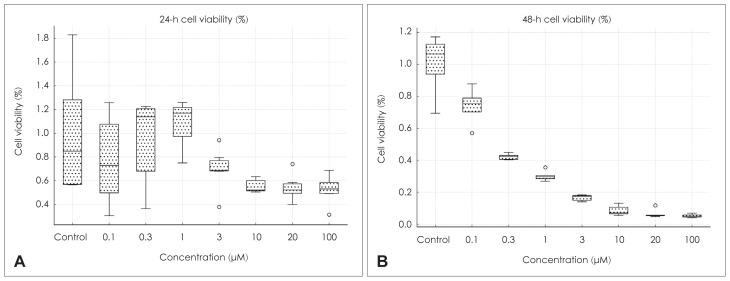
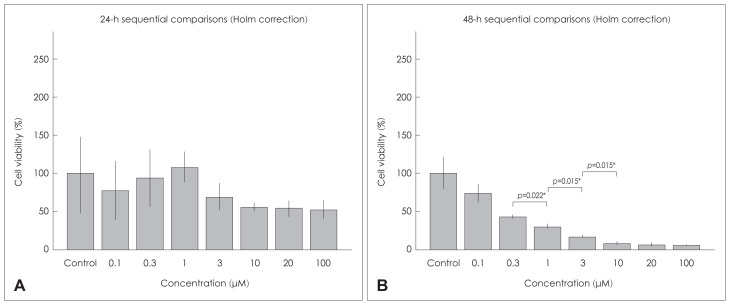
Results: HF treatment substantially dose- and time-dependently reduced HaCaT cell viability. The IC50 values at 24 and 48 hours were 2.74 μM and 0.24 μM, respectively, reflecting a more than ten-fold increase in cytotoxic potency over time. The differences between the treatment groups were significant at both time points (p=0.017 and p=0.001 at 24 and 48 hours, respectively).
Conclusions: HF exerts potent cytotoxic effects on keratinocytes, with efficacy increasing with exposure duration. These findings support the further study of HF as a pharmacological agent for modulating epithelial proliferation in cholesteatomas and related disorders.
期刊介绍:
Journal of Audiology and Otology (JAO) (formerly known as Korean Journal of Audiology) aims to publish the most advanced findings for all aspects of the auditory and vestibular system and diseases of the ear using state-of-the-art techniques and analyses. The journal covers recent trends related to the topics of audiology, otology, and neurotology conducted by professionals, with the goal of providing better possible treatment to people of all ages, from infants to the elderly, who suffer from auditory and/or vestibular disorders and thus, improving their quality of life. This journal encourages the submission of review papers about current professional issues, research papers presenting a scientific base and clinical application, and case papers with unique reports or clinical trials. We also invite letters to the editor and papers related to the manufacture and distribution of medical devices. This journal provides integrated views from otologists, audiologists, and other healthcare practitioners, offering readers high quality scientific and clinical information. This peer-reviewed and open access journal has been the official journal of the Korean Audiological Society since 1997 and of both the Korean Audiological Society and the Korean Otological Society since 2017. It is published in English four times a year in January, April, July, and October.


 求助内容:
求助内容: 应助结果提醒方式:

 京公网安备 11010802042870号


