
Oxidative stress activates HIF-1α to mediate the secretion of CXCL9 and CXCL10 in keratinocytes and trigger the abnormal immune response in vitiligo
IF 3.7
3区 医学
Q2 BIOCHEMISTRY & MOLECULAR BIOLOGY
引用次数: 0
Abstract
Vitiligo, a common autoimmune dermatosis, has a pathogenesis hypothesized to involve oxidative stress-induced immune-mediated melanocyte death. However, the role of oxidative stress in triggering autoimmunity during the early stages of vitiligo, along with its regulatory mechanisms and complex interactions, remains incompletely understood. Keratinocytes, as key initiating cells in vitiligo, secrete various chemokines, primarily C-X-C motif ligand 9 and 10 (CXCL9,10), under oxidative stress to recruit autoreactive immune cells targeting melanocytes. Hypoxia-inducible factor-1α (HIF-1α), a highly conserved transcription factor sensitive to oxidative stress, has been revealed to orchestrate cytokine expression and cellular immune functions. Based on this, the present study investigated the association between oxidative stress and HIF-1α in keratinocytes, and elucidated HIF-1α as a critical molecule bridging oxidative stress and autoimmunity in vitiligo. We initially observed significantly elevated HIF-1α levels in both the serum and depigmented lesions of vitiligo patients. Mechanistically, we demonstrates that HIF-1α serves as a potential biomarker associated with vitiligo progression, and through binding to the respective promoters of CXCL9 and CXCL10, regulates their expression and secretion in keratinocytes at the transcriptional level under oxidative stress, thus motivating peripheral blood mononuclear cells (PBMCs) migration to potential downstream melanocyte damage. HIF-1α activation further amplifies cellular oxidative stress damage in keratinocytes, collectively exacerbating the pathogenesis process of vitiligo. Our fundings suggest that the HIF-1α-CXCL9/10 pathway represents a promising therapeutic target for counteracting abnormal immune activation under oxidative stress in vitiligo.
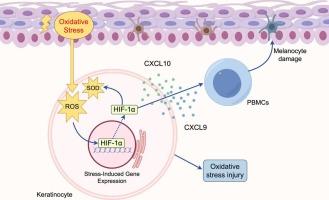
氧化应激激活HIF-1α介导角质形成细胞CXCL9和CXCL10的分泌,引发白癜风异常免疫应答
白癜风是一种常见的自身免疫性皮肤病,其发病机制被认为与氧化应激诱导的免疫介导的黑素细胞死亡有关。然而,氧化应激在白癜风早期触发自身免疫中的作用及其调控机制和复杂的相互作用仍不完全清楚。角化细胞作为白癜风的关键启动细胞,在氧化应激下分泌多种趋化因子,主要是C-X-C基序配体9和10 (CXCL9,10),以募集针对黑素细胞的自身反应性免疫细胞。缺氧诱导因子-1α (HIF-1α)是一种高度保守的对氧化应激敏感的转录因子,已被发现可以协调细胞因子的表达和细胞免疫功能。在此基础上,本研究探讨了氧化应激与角质形成细胞HIF-1α之间的关系,并阐明了HIF-1α在白癜风中是连接氧化应激和自身免疫的关键分子。我们最初观察到白癜风患者血清和脱色病变中HIF-1α水平显著升高。在机制上,我们证明了HIF-1α作为与白癜风进展相关的潜在生物标志物,通过结合CXCL9和CXCL10的启动子,在氧化应激下在转录水平上调节它们在角质形成细胞中的表达和分泌,从而激发外周血单个核细胞(PBMCs)迁移到潜在的下游黑色素细胞损伤。HIF-1α的激活进一步放大了角质形成细胞的氧化应激损伤,共同加剧了白癜风的发病过程。我们的研究表明,HIF-1α-CXCL9/10途径是对抗白癜风氧化应激下异常免疫激活的一个有希望的治疗靶点。
本文章由计算机程序翻译,如有差异,请以英文原文为准。
求助全文
约1分钟内获得全文
求助全文
来源期刊
Cytokine
医学-免疫学
CiteScore
7.60
自引率
2.60%
发文量
262
审稿时长
48 days
期刊介绍:
The journal Cytokine has an open access mirror journal Cytokine: X, sharing the same aims and scope, editorial team, submission system and rigorous peer review.
* Devoted exclusively to the study of the molecular biology, genetics, biochemistry, immunology, genome-wide association studies, pathobiology, diagnostic and clinical applications of all known interleukins, hematopoietic factors, growth factors, cytotoxins, interferons, new cytokines, and chemokines, Cytokine provides comprehensive coverage of cytokines and their mechanisms of actions, 12 times a year by publishing original high quality refereed scientific papers from prominent investigators in both the academic and industrial sectors.
We will publish 3 major types of manuscripts:
1) Original manuscripts describing research results.
2) Basic and clinical reviews describing cytokine actions and regulation.
3) Short commentaries/perspectives on recently published aspects of cytokines, pathogenesis and clinical results.
 求助内容:
求助内容: 应助结果提醒方式:

 京公网安备 11010802042870号


