
Development of an automated one-step radiolabeling procedure for a PSMA-targeted radiotherapeutic for prostate cancer
IF 3
4区 医学
Q1 RADIOLOGY, NUCLEAR MEDICINE & MEDICAL IMAGING
Nuclear medicine and biology
Pub Date : 2026-03-01
Epub Date: 2026-01-23
DOI:10.1016/j.nucmedbio.2026.109607
引用次数: 0
Abstract
Background
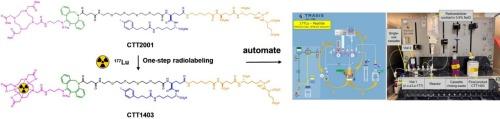
CTT1403 (177Lu-CTT2001), an irreversible phosphoramidate PSMA inhibitor developed by Cancer Targeted Technology, was initially synthesized using a two-step radiolabeling method and has previously been evaluated in first-in-human studies. This two-step approach protected the phosphoramidate pharmacophore—containing a temperature- and pH-labile P![]() N bond—from the harsh conditions required for lutetium-177 (177Lu) chelation. Although the final chemical structure of CTT1403 is identical regardless of the radiolabeling route, it was not clear that CTT2001 could tolerate one-step labeling conditions while preserving PSMA-binding integrity. Therefore, the aim of the study was to develop, optimize, and automate a one-step radiolabeling method for CTT1403 and to confirm that the resulting product is biologically equivalent and exhibits comparable in vitro and in vivo behavior to CTT1403 produced by the original two-step process.
N bond—from the harsh conditions required for lutetium-177 (177Lu) chelation. Although the final chemical structure of CTT1403 is identical regardless of the radiolabeling route, it was not clear that CTT2001 could tolerate one-step labeling conditions while preserving PSMA-binding integrity. Therefore, the aim of the study was to develop, optimize, and automate a one-step radiolabeling method for CTT1403 and to confirm that the resulting product is biologically equivalent and exhibits comparable in vitro and in vivo behavior to CTT1403 produced by the original two-step process.
Methods
CTT2001 was synthesized and radiolabeled with 177Lu using an optimized one-step procedure that was subsequently automated on a Trasis AllinOne synthesizer. Radiochemical purity, stability, cellular uptake/internalization, and biodistribution in PC3-PIP tumor-bearing mice were evaluated.
Results
CTT1403 synthesized via the one-step method demonstrated cellular uptake and internalization in PC3-PIP cells, as well as in vivo biodistribution in PC3-PIP tumor–bearing mice, that were comparable to those of the two-step–labeled product. The one-step procedure was successfully automated on the Trasis All-in-One synthesizer, producing CTT1403 with a radiochemical yield of 86.5 ± 4.27% (n = 3), a molar activity of 30.3 ± 1.11 MBq/nmol, and a radiochemical purity of 97.6 ± 0.80% (n = 3) in a total synthesis time of 38 min. The final product remained stable for at least 24 h at −4 °C and −20 °C.
Conclusions
The one-step radiolabeling method yields CTT1403 that is biologically equivalent to the two-step product and can be reliably produced using fully automated synthesis. This streamlined, efficient, and reproducible approach supports routine clinical manufacturing of CTT1403.
用于前列腺癌psma靶向放射治疗的自动化一步放射标记程序的开发。
背景:CTT1403 (177Lu-CTT2001)是一种不可逆的磷酰胺类PSMA抑制剂,由Cancer Targeted Technology公司开发,最初采用两步放射性标记法合成,此前已在首次人体研究中进行了评估。这种两步法保护了含有温度和ph不稳定PN键的酰胺类药物团免受镥-177 (177Lu)螯合所需的恶劣条件的影响。尽管CTT1403的最终化学结构是相同的,无论放射性标记途径如何,但不清楚CTT2001是否能够承受一步标记条件,同时保持psma结合的完整性。因此,本研究的目的是开发、优化和自动化CTT1403的一步放射性标记方法,并确认所得产品具有生物等效性,并表现出与原始两步工艺生产的CTT1403相当的体外和体内行为。方法:采用优化的一步法合成CTT2001,并用177Lu进行放射性标记,随后在Trasis AllinOne合成器上自动进行。评估PC3-PIP荷瘤小鼠的放射化学纯度、稳定性、细胞摄取/内化和生物分布。结果:一步法合成的CTT1403在PC3-PIP细胞中表现出细胞摄取和内化,以及在PC3-PIP荷瘤小鼠体内的生物分布,与两步标记的产物相当。在Trasis All-in-One合成器上自动合成CTT1403, CTT1403的放射化学产率为86.5±4.27% (n = 3),摩尔活性为30.3±1.11 MBq/nmol,放射化学纯度为97.6±0.80% (n = 3),总合成时间为38 min。最终产物在-4°C和-20°C下保持稳定至少24小时。结论:一步放射性标记法得到的CTT1403与两步产物具有生物等效性,并且可以使用全自动合成可靠地生产。这种简化、高效和可重复的方法支持CTT1403的常规临床生产。
本文章由计算机程序翻译,如有差异,请以英文原文为准。
求助全文
约1分钟内获得全文
求助全文
来源期刊
Nuclear medicine and biology
医学-核医学
CiteScore
6.00
自引率
9.70%
发文量
479
审稿时长
51 days
期刊介绍:
Nuclear Medicine and Biology publishes original research addressing all aspects of radiopharmaceutical science: synthesis, in vitro and ex vivo studies, in vivo biodistribution by dissection or imaging, radiopharmacology, radiopharmacy, and translational clinical studies of new targeted radiotracers. The importance of the target to an unmet clinical need should be the first consideration. If the synthesis of a new radiopharmaceutical is submitted without in vitro or in vivo data, then the uniqueness of the chemistry must be emphasized.
These multidisciplinary studies should validate the mechanism of localization whether the probe is based on binding to a receptor, enzyme, tumor antigen, or another well-defined target. The studies should be aimed at evaluating how the chemical and radiopharmaceutical properties affect pharmacokinetics, pharmacodynamics, or therapeutic efficacy. Ideally, the study would address the sensitivity of the probe to changes in disease or treatment, although studies validating mechanism alone are acceptable. Radiopharmacy practice, addressing the issues of preparation, automation, quality control, dispensing, and regulations applicable to qualification and administration of radiopharmaceuticals to humans, is an important aspect of the developmental process, but only if the study has a significant impact on the field.
Contributions on the subject of therapeutic radiopharmaceuticals also are appropriate provided that the specificity of labeled compound localization and therapeutic effect have been addressed.
 求助内容:
求助内容: 应助结果提醒方式:

 京公网安备 11010802042870号


