Sudipti Gupta, Shradha Rajak, Hanna Cortado, Brian Becknell, John David Spencer, Christina Barbara Ching
{"title":"Interleukin-6 Limits Host Susceptibility to Urinary Tract Infection by Promoting Urothelial Expulsion of Intracellular Bacteria.","authors":"Sudipti Gupta, Shradha Rajak, Hanna Cortado, Brian Becknell, John David Spencer, Christina Barbara Ching","doi":"10.1159/000550787","DOIUrl":null,"url":null,"abstract":"<p><strong>Introduction: </strong>Interleukin (IL)-6 has an important role in limiting urinary tract infection (UTI). Mice lacking IL-6 are more susceptible to uropathogenic Escherichia coli (UPEC), including increased formation of intracellular bacterial communities (IBCs). How IL-6 promotes UPEC clearance is unknown. We hypothesize IL-6 reduces UTI susceptibility by limiting IBC formation through an early mechanism of infection.</p><p><strong>Methods: </strong>Female mice were treated with vehicle or neutralizing antibodies to inhibit IL-6 or the IL-6 receptor (IL-6R) prior to transurethral UPEC infection. In rescue experiments, murine recombinant (r)IL-6 was administered to IL-6 knockout (KO) mice. Bladder IBCs, urinary and bladder bacterial burden, and UPEC expulsion were quantified. For clinical translation, human urothelial cells were pretreated with human rIL-6 and infected with UPEC. Bacterial attachment, invasion, and expulsion were quantified.</p><p><strong>Results: </strong>Neutralization of IL-6 or IL-6R increased bladder IBC counts compared to isotype controls. Similarly, while IL-6 KO mice exhibited higher IBC counts than wild-type controls, this phenotype was reversed by rIL-6 administration. Gentamicin protection assays confirmed increased intracellular UPEC burden and reduced bacterial expulsion in IL-6 KO bladders. rIL-6 treatment enhanced UPEC expulsion in human urothelial cells without impacting bacterial attachment or invasion.</p><p><strong>Conclusion: </strong>IL-6 facilitates UPEC expulsion, limiting intracellular UPEC early in infection and thus the initial formation of IBCs. Since IBC formation is a bottleneck in UPEC survival during UTI, these findings identify a mechanism whereby IL-6 reduces early UPEC urothelial infectivity.</p>","PeriodicalId":16113,"journal":{"name":"Journal of Innate Immunity","volume":" ","pages":"120-125"},"PeriodicalIF":3.0000,"publicationDate":"2026-01-01","publicationTypes":"Journal Article","fieldsOfStudy":null,"isOpenAccess":false,"openAccessPdf":"https://www.ncbi.nlm.nih.gov/pmc/articles/PMC12999193/pdf/","citationCount":"0","resultStr":null,"platform":"Semanticscholar","paperid":null,"PeriodicalName":"Journal of Innate Immunity","FirstCategoryId":"3","ListUrlMain":"https://doi.org/10.1159/000550787","RegionNum":3,"RegionCategory":"医学","ArticlePicture":[],"TitleCN":null,"AbstractTextCN":null,"PMCID":null,"EPubDate":"2026/1/30 0:00:00","PubModel":"Epub","JCR":"Q2","JCRName":"IMMUNOLOGY","Score":null,"Total":0}
引用次数: 0
Abstract
Introduction: Interleukin (IL)-6 has an important role in limiting urinary tract infection (UTI). Mice lacking IL-6 are more susceptible to uropathogenic Escherichia coli (UPEC), including increased formation of intracellular bacterial communities (IBCs). How IL-6 promotes UPEC clearance is unknown. We hypothesize IL-6 reduces UTI susceptibility by limiting IBC formation through an early mechanism of infection.
Methods: Female mice were treated with vehicle or neutralizing antibodies to inhibit IL-6 or the IL-6 receptor (IL-6R) prior to transurethral UPEC infection. In rescue experiments, murine recombinant (r)IL-6 was administered to IL-6 knockout (KO) mice. Bladder IBCs, urinary and bladder bacterial burden, and UPEC expulsion were quantified. For clinical translation, human urothelial cells were pretreated with human rIL-6 and infected with UPEC. Bacterial attachment, invasion, and expulsion were quantified.
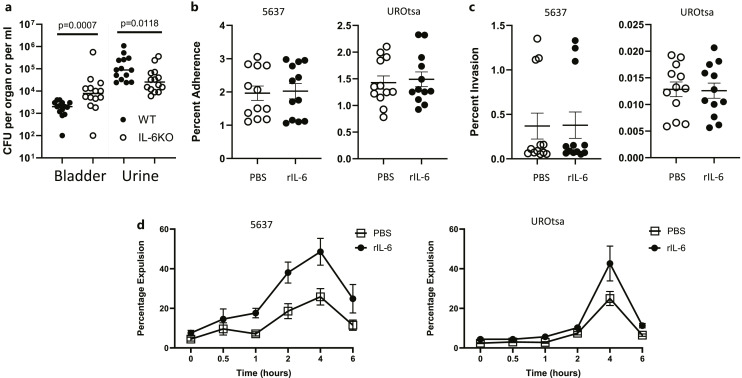
Results: Neutralization of IL-6 or IL-6R increased bladder IBC counts compared to isotype controls. Similarly, while IL-6 KO mice exhibited higher IBC counts than wild-type controls, this phenotype was reversed by rIL-6 administration. Gentamicin protection assays confirmed increased intracellular UPEC burden and reduced bacterial expulsion in IL-6 KO bladders. rIL-6 treatment enhanced UPEC expulsion in human urothelial cells without impacting bacterial attachment or invasion.
Conclusion: IL-6 facilitates UPEC expulsion, limiting intracellular UPEC early in infection and thus the initial formation of IBCs. Since IBC formation is a bottleneck in UPEC survival during UTI, these findings identify a mechanism whereby IL-6 reduces early UPEC urothelial infectivity.
期刊介绍:
The ''Journal of Innate Immunity'' is a bimonthly journal covering all aspects within the area of innate immunity, including evolution of the immune system, molecular biology of cells involved in innate immunity, pattern recognition and signals of ‘danger’, microbial corruption, host response and inflammation, mucosal immunity, complement and coagulation, sepsis and septic shock, molecular genomics, and development of immunotherapies. The journal publishes original research articles, short communications, reviews, commentaries and letters to the editors. In addition to regular papers, some issues feature a special section with a thematic focus.


 求助内容:
求助内容: 应助结果提醒方式:

 京公网安备 11010802042870号


