
Evidence for potential critical windows of immune development in the marine medaka (Oryzias melastigma)
IF 4.3
3区 环境科学与生态学
Q2 BIOCHEMISTRY & MOLECULAR BIOLOGY
Comparative Biochemistry and Physiology C-toxicology & Pharmacology
Pub Date : 2026-06-01
Epub Date: 2026-01-28
DOI:10.1016/j.cbpc.2026.110459
引用次数: 0
Abstract
The developmental origins of health and disease hypothesis suggests that environmental exposures during early immune development may trigger long-term immune pathologies. However, the timing of sensitive developmental windows in the innate immune system of vertebrates remains poorly defined. Here, we propose the marine medaka fish (Oryzias melastigma) as a model organism to define a molecular timeline for innate immune system maturation. To identify critical windows of immune development, we assessed both organismal resistance to bacterial infection and molecular markers of immune gene expression across developmental stages. Immune competence evaluation in embryos and larvae revealed distinct windows of vulnerability to bacterial challenge, suggesting dynamic immune regulation. 17α-Ethinylestradiol (EE2), a potent synthetic estrogen is known to affect both reproductive and immune function. Embryos and larvae were exposed to EE2 during three key periods (7–11 days post fertilization (dpf), 3–5 days post hatching (dph), and 12–19 dph) and subsequently challenged with a bacterial pathogen. EE2 exposure during the embryonic (7–11 dpf) and later larval (12–19 dph) periods significantly reduced pathogen resistance in a non-monotonic dose response manner, altered the expression of immune-related genes involved in protein synthesis and ribosome biogenesis and modified energy and amino acid metabolism. Altogether, this study underscores the importance of identifying sensitive periods in immune development when evaluating environmental risks and support the use of marine medaka as a relevant model for developmental immunotoxicity.
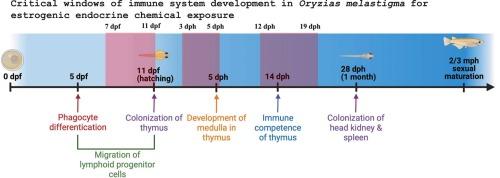
海洋medaka (Oryzias melastigma)免疫发育潜在关键窗口的证据。
健康和疾病的发育起源假说表明,早期免疫发育期间的环境暴露可能引发长期的免疫病理。然而,脊椎动物先天免疫系统中敏感发育窗口的时间仍然不清楚。在这里,我们提出海洋medaka鱼(Oryzias melastigma)作为模式生物来定义先天免疫系统成熟的分子时间线。为了确定免疫发育的关键窗口,我们评估了不同发育阶段对细菌感染的机体抗性和免疫基因表达的分子标记。胚胎和幼虫的免疫能力评估显示出不同的细菌攻击脆弱性窗口,提示动态免疫调节。17α-炔雌醇(EE2)是一种强效的合成雌激素,已知可影响生殖和免疫功能。胚胎和幼虫在3个关键时期(受精后7-11 天(dpf)、孵化后3-5 天(dph)和12-19 dph)暴露于EE2,然后用细菌病原体攻毒。在胚胎期(7-11 dpf)和幼虫后期(12-19 dph)暴露EE2以非单调剂量反应方式显著降低了病原体抗性,改变了参与蛋白质合成和核糖体生物发生的免疫相关基因的表达,并改变了能量和氨基酸代谢。总之,这项研究强调了在评估环境风险时确定免疫发育敏感期的重要性,并支持将海洋medaka作为发育免疫毒性的相关模型。
本文章由计算机程序翻译,如有差异,请以英文原文为准。
求助全文
约1分钟内获得全文
求助全文
来源期刊
CiteScore
7.50
自引率
5.10%
发文量
206
审稿时长
30 days
期刊介绍:
Part C: Toxicology and Pharmacology. This journal is concerned with chemical and drug action at different levels of organization, biotransformation of xenobiotics, mechanisms of toxicity, including reactive oxygen species and carcinogenesis, endocrine disruptors, natural products chemistry, and signal transduction with a molecular approach to these fields.
 求助内容:
求助内容: 应助结果提醒方式:

 京公网安备 11010802042870号


