Mohammed I. Rashied, Rana Th. Abd Alrubaye, Samer G. Abdulridha, Radhaa N. Saeed
{"title":"Effect of Y zeolite mesoporousity on the catalytic cracking of vacuum gas oil (VGO)","authors":"Mohammed I. Rashied, Rana Th. Abd Alrubaye, Samer G. Abdulridha, Radhaa N. Saeed","doi":"10.1007/s10934-025-01858-y","DOIUrl":null,"url":null,"abstract":"<div><p>Mesoporous hierarchical Y zeolites were synthesized through a sequential process involving dealumination with ethylenediaminetetraacetic acid (EDTA) or oxalic acid (OX), followed by desilication using sodium hydroxide (NaOH). Characterization of the materials, employing X-ray diffraction (XRD), nitrogen adsorption–desorption, and scanning electron microscopy (SEM), confirmed significant structural modifications, an increase in mesoporosity, and an enhancement in external surface area. The OX–NaOH route demonstrated superior efficiency, achieving stable mesopores with surface areas exceeding 110 m²/g in shorter treatment times compared to the EDTA pathway. Catalytic testing in vacuum gas oil cracking at 420 °C revealed that the modified zeolite (DSY-OX3) yielded 41.1 vol% gasoline, a substantial improvement over the 18.4 vol% obtained with the parent Y zeolite. These findings suggest that the OX–NaOH method is a time- and energy-efficient approach for producing thermally stable mesoporous zeolites, making it a promising strategy for fluidized catalytic cracking (FCC) applications.</p></div>","PeriodicalId":660,"journal":{"name":"Journal of Porous Materials","volume":"33 1","pages":"199 - 212"},"PeriodicalIF":3.0000,"publicationDate":"2025-10-17","publicationTypes":"Journal Article","fieldsOfStudy":null,"isOpenAccess":false,"openAccessPdf":"","citationCount":"0","resultStr":null,"platform":"Semanticscholar","paperid":null,"PeriodicalName":"Journal of Porous Materials","FirstCategoryId":"88","ListUrlMain":"https://link.springer.com/article/10.1007/s10934-025-01858-y","RegionNum":4,"RegionCategory":"材料科学","ArticlePicture":[],"TitleCN":null,"AbstractTextCN":null,"PMCID":null,"EPubDate":"","PubModel":"","JCR":"Q2","JCRName":"CHEMISTRY, APPLIED","Score":null,"Total":0}
引用次数: 0
Abstract
Mesoporous hierarchical Y zeolites were synthesized through a sequential process involving dealumination with ethylenediaminetetraacetic acid (EDTA) or oxalic acid (OX), followed by desilication using sodium hydroxide (NaOH). Characterization of the materials, employing X-ray diffraction (XRD), nitrogen adsorption–desorption, and scanning electron microscopy (SEM), confirmed significant structural modifications, an increase in mesoporosity, and an enhancement in external surface area. The OX–NaOH route demonstrated superior efficiency, achieving stable mesopores with surface areas exceeding 110 m²/g in shorter treatment times compared to the EDTA pathway. Catalytic testing in vacuum gas oil cracking at 420 °C revealed that the modified zeolite (DSY-OX3) yielded 41.1 vol% gasoline, a substantial improvement over the 18.4 vol% obtained with the parent Y zeolite. These findings suggest that the OX–NaOH method is a time- and energy-efficient approach for producing thermally stable mesoporous zeolites, making it a promising strategy for fluidized catalytic cracking (FCC) applications.
期刊介绍:
The Journal of Porous Materials is an interdisciplinary and international periodical devoted to all types of porous materials. Its aim is the rapid publication
of high quality, peer-reviewed papers focused on the synthesis, processing, characterization and property evaluation of all porous materials. The objective is to
establish a unique journal that will serve as a principal means of communication for the growing interdisciplinary field of porous materials.
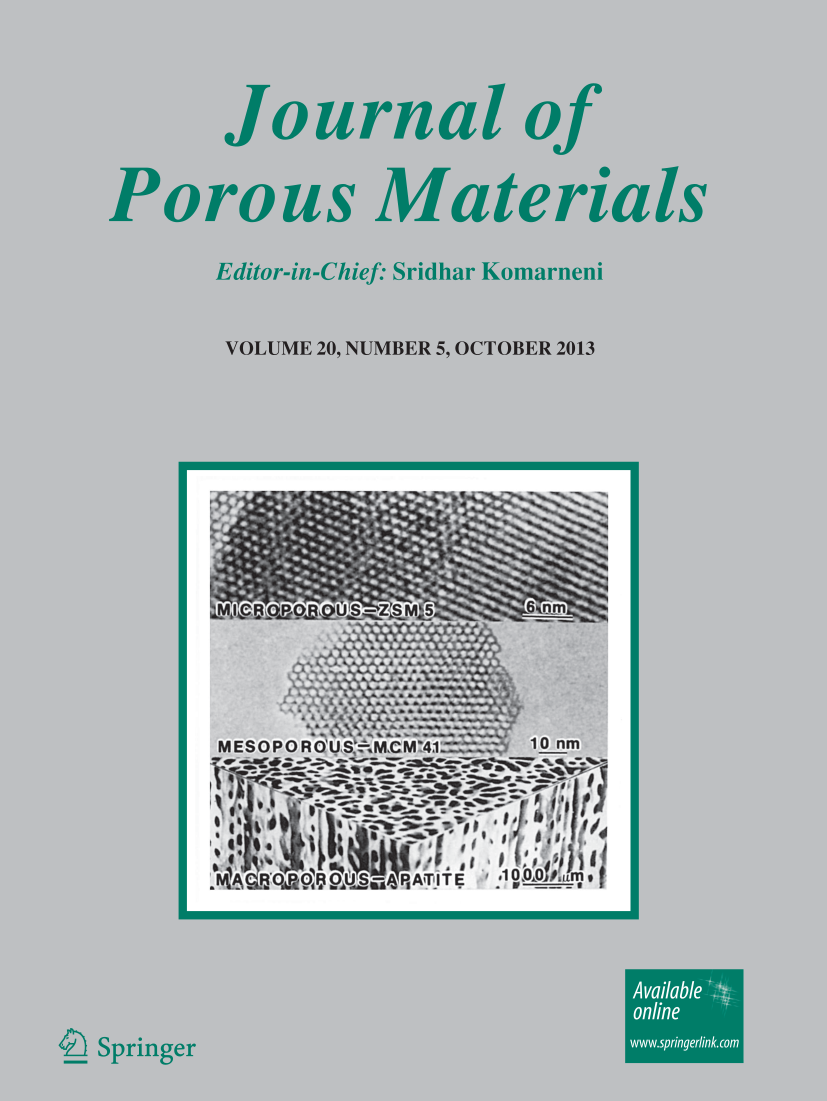
Porous materials include microporous materials with 50 nm pores.
Examples of microporous materials are natural and synthetic molecular sieves, cationic and anionic clays, pillared clays, tobermorites, pillared Zr and Ti
phosphates, spherosilicates, carbons, porous polymers, xerogels, etc. Mesoporous materials include synthetic molecular sieves, xerogels, aerogels, glasses, glass
ceramics, porous polymers, etc.; while macroporous materials include ceramics, glass ceramics, porous polymers, aerogels, cement, etc. The porous materials
can be crystalline, semicrystalline or noncrystalline, or combinations thereof. They can also be either organic, inorganic, or their composites. The overall
objective of the journal is the establishment of one main forum covering the basic and applied aspects of all porous materials.


 求助内容:
 应助结果提醒方式:


 京公网安备 11010802042870号


