{"title":"Ball-milling synthesis of SBA-15-Tuned CuO supported Au NPs for efficient glycerol oxidation to dihydroxyacetone","authors":"Weidong Xie, Xingyu Zhang, Jiali Huang, Yuewen Chen, Hai Liu, Zhile Xiong, Yimin Wang, Xiya Zhang","doi":"10.1007/s10934-025-01881-z","DOIUrl":null,"url":null,"abstract":"<div><p>Catalytic conversion of glycerol to dihydroxyacetone (DHA) has significant advantages, including abundant raw material sources (as glycerol is a by-product of biodiesel) and high added value of the product. Although CuO-based catalysts are currently the most widely used materials in this field, existing catalyst modification strategies are insufficient, and their activity still needs to be improved. In this work, for the first time, a template-induced Au/CuO catalyst with zeolite molecular sieve SBA-15 as the template was prepared via the mechanochemical method, achieving a new breakthrough in the performance of CuO catalysts. The obtained catalyst is characterized by the fact that the introduction of SBA-15 alters the morphology and physical properties of CuO, resulting in smaller gold nanoparticles (Au NPs) and a stronger interaction between the active centers and the support. Under the preparation conditions of a ball-to-powder ratio of 1:15, a milling time of 0.5 h, addition of 0.4 g SBA-15, and an Au loading of 1%, and under the reaction conditions of 100 ℃, a glycerol-to-Au ratio of 100:1, and a reaction time of 2 h, the catalyst achieves a glycerol conversion of 97.65% and a DHA selectivity of 90.47%, outperforming most catalysts reported so far. This work provides new insights for the efficient modification of CuO-based catalysts and the development of high-performance catalytic materials.</p></div>","PeriodicalId":660,"journal":{"name":"Journal of Porous Materials","volume":"33 1","pages":"373 - 385"},"PeriodicalIF":3.0000,"publicationDate":"2025-11-19","publicationTypes":"Journal Article","fieldsOfStudy":null,"isOpenAccess":false,"openAccessPdf":"","citationCount":"0","resultStr":null,"platform":"Semanticscholar","paperid":null,"PeriodicalName":"Journal of Porous Materials","FirstCategoryId":"88","ListUrlMain":"https://link.springer.com/article/10.1007/s10934-025-01881-z","RegionNum":4,"RegionCategory":"材料科学","ArticlePicture":[],"TitleCN":null,"AbstractTextCN":null,"PMCID":null,"EPubDate":"","PubModel":"","JCR":"Q2","JCRName":"CHEMISTRY, APPLIED","Score":null,"Total":0}
引用次数: 0
Abstract
Catalytic conversion of glycerol to dihydroxyacetone (DHA) has significant advantages, including abundant raw material sources (as glycerol is a by-product of biodiesel) and high added value of the product. Although CuO-based catalysts are currently the most widely used materials in this field, existing catalyst modification strategies are insufficient, and their activity still needs to be improved. In this work, for the first time, a template-induced Au/CuO catalyst with zeolite molecular sieve SBA-15 as the template was prepared via the mechanochemical method, achieving a new breakthrough in the performance of CuO catalysts. The obtained catalyst is characterized by the fact that the introduction of SBA-15 alters the morphology and physical properties of CuO, resulting in smaller gold nanoparticles (Au NPs) and a stronger interaction between the active centers and the support. Under the preparation conditions of a ball-to-powder ratio of 1:15, a milling time of 0.5 h, addition of 0.4 g SBA-15, and an Au loading of 1%, and under the reaction conditions of 100 ℃, a glycerol-to-Au ratio of 100:1, and a reaction time of 2 h, the catalyst achieves a glycerol conversion of 97.65% and a DHA selectivity of 90.47%, outperforming most catalysts reported so far. This work provides new insights for the efficient modification of CuO-based catalysts and the development of high-performance catalytic materials.
期刊介绍:
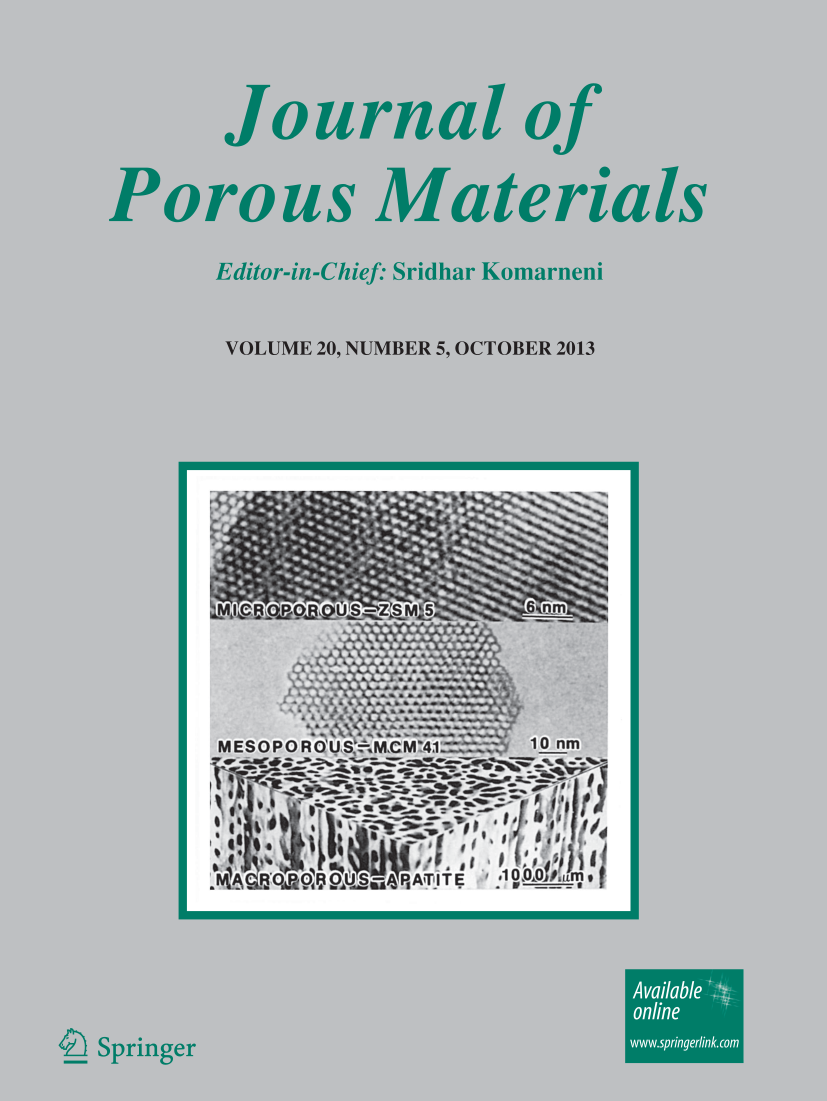
The Journal of Porous Materials is an interdisciplinary and international periodical devoted to all types of porous materials. Its aim is the rapid publication
of high quality, peer-reviewed papers focused on the synthesis, processing, characterization and property evaluation of all porous materials. The objective is to
establish a unique journal that will serve as a principal means of communication for the growing interdisciplinary field of porous materials.
Porous materials include microporous materials with 50 nm pores.
Examples of microporous materials are natural and synthetic molecular sieves, cationic and anionic clays, pillared clays, tobermorites, pillared Zr and Ti
phosphates, spherosilicates, carbons, porous polymers, xerogels, etc. Mesoporous materials include synthetic molecular sieves, xerogels, aerogels, glasses, glass
ceramics, porous polymers, etc.; while macroporous materials include ceramics, glass ceramics, porous polymers, aerogels, cement, etc. The porous materials
can be crystalline, semicrystalline or noncrystalline, or combinations thereof. They can also be either organic, inorganic, or their composites. The overall
objective of the journal is the establishment of one main forum covering the basic and applied aspects of all porous materials.

 求助内容:
 应助结果提醒方式:


 京公网安备 11010802042870号


