
Comparative study on thermal creep resistance of arc ion plated and magnetron sputtered Cr coatings on Zircaloy-4 cladding for accident tolerant fuel
IF 2.9
3区 工程技术
Q1 NUCLEAR SCIENCE & TECHNOLOGY
Nuclear Engineering and Technology
Pub Date : 2026-05-01
Epub Date: 2026-01-22
DOI:10.1016/j.net.2026.104148
引用次数: 0
Abstract
The development of accident tolerant fuel (ATF) claddings, particularly coating techniques, has been encouraged to address the urgent need for improved safety measures. Using the two prominent coating technologies—that is, arc ion plating (AIP) and magnetron sputtering (MS)—pure Cr was coated on Zry-4 claddings, and the effect of the Cr coating on low temperature (≤400 °C) creep behavior was investigated. Moreover, their mechanical performance was compared based on the coating method. Creep tests conducted using internal pressurization methods under constant hoop stresses revealed that the AIP Cr coatings reduced the total creep strain by approximately 43–60 %, whereas the MS Cr coatings exhibited an 18–33 % reduction. These improvements on the creep resistance were attributed to the high elastic modulus and limited plasticity of the Cr layer as well as the compressive residual stresses induced during the deposition process. However, ring compression tests (RCTs) performed after creep deformation showed that the residual ductility, characterized by offset strain, decreased in Cr-coated claddings, most notably in the MS Cr-coated specimens, owing to the intrinsic brittleness of the Cr layer. Experimental findings on thermal creep behaviors suggest that while Cr coatings significantly improved the creep resistance and delay gap closure, their mechanical integrity under irradiation and pellet-to-cladding mechanical interaction conditions must be carefully assessed to ensure long–term fuel performance in ATF systems.
耐事故燃料锆-4包层电弧离子镀和磁控溅射Cr涂层耐热蠕变性能的比较研究
已鼓励发展耐事故燃料包覆层,特别是包覆技术,以解决改进安全措施的迫切需要。采用电弧离子镀(AIP)和磁控溅射(MS)两种主要的涂层技术,在Zry-4包层上镀上纯Cr,并研究了Cr涂层对Zry-4包层低温(≤400℃)蠕变行为的影响。并基于涂层法对其力学性能进行了比较。在恒定环向应力下,采用内加压方法进行的蠕变试验表明,AIP Cr涂层可将总蠕变应变降低约43 - 60%,而MS Cr涂层则可降低18 - 33%。这些抗蠕变性能的提高是由于Cr层的高弹性模量和有限塑性以及沉积过程中产生的残余压应力。然而,在蠕变变形后进行的环压缩试验(rct)表明,由于Cr层的固有脆性,Cr包覆层的残余延展性(以偏应变为特征)下降,尤其是在MS Cr包覆试件中。热蠕变行为的实验结果表明,尽管Cr涂层显著提高了抗蠕变性能和延迟间隙闭合性,但必须仔细评估其在辐照和球团-包层力学相互作用条件下的机械完整性,以确保ATF系统中的长期燃料性能。
本文章由计算机程序翻译,如有差异,请以英文原文为准。
求助全文
约1分钟内获得全文
求助全文
来源期刊
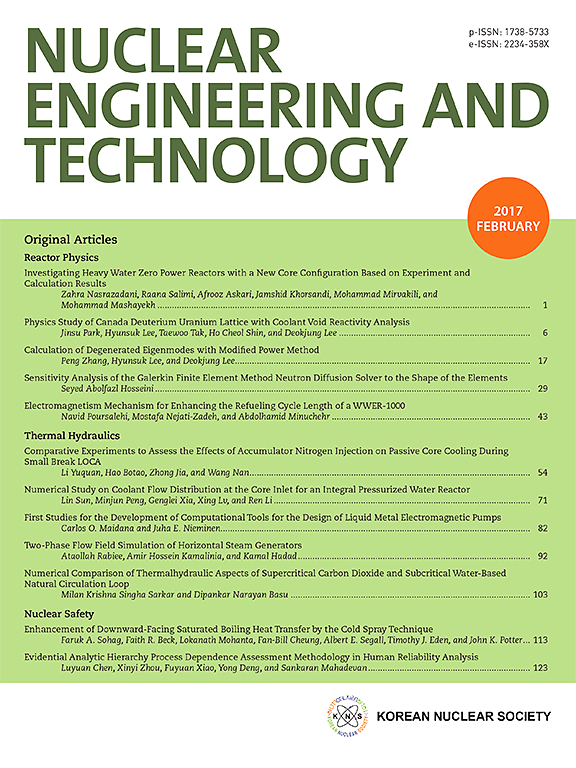
Nuclear Engineering and Technology
工程技术-核科学技术
CiteScore
4.80
自引率
7.40%
发文量
431
审稿时长
3.5 months
期刊介绍:
Nuclear Engineering and Technology (NET), an international journal of the Korean Nuclear Society (KNS), publishes peer-reviewed papers on original research, ideas and developments in all areas of the field of nuclear science and technology. NET bimonthly publishes original articles, reviews, and technical notes. The journal is listed in the Science Citation Index Expanded (SCIE) of Thomson Reuters.
NET covers all fields for peaceful utilization of nuclear energy and radiation as follows:
1) Reactor Physics
2) Thermal Hydraulics
3) Nuclear Safety
4) Nuclear I&C
5) Nuclear Physics, Fusion, and Laser Technology
6) Nuclear Fuel Cycle and Radioactive Waste Management
7) Nuclear Fuel and Reactor Materials
8) Radiation Application
9) Radiation Protection
10) Nuclear Structural Analysis and Plant Management & Maintenance
11) Nuclear Policy, Economics, and Human Resource Development
 求助内容:
 应助结果提醒方式:


 京公网安备 11010802042870号


