
Leveraging Multi-Material Ceramic Additive Manufacturing and Intrinsic Material-Based Catalyst Metallization to Realize Robust and Damage-Free 3D Ceramic Electronics

IF 22 1区 材料科学 Q1 MATERIALS SCIENCE, MULTIDISCIPLINARY
Materials Today Pub Date : 2026-03-01 Epub Date: 2026-01-30 DOI:10.1016/j.mattod.2026.103202
Kewei Song , Ze Zhang , Zifu Fan , Yifan Pan , Weiyang Wan , Yannan Li , Shinjiro Umezu , Hirotaka Sato
{"title":"Leveraging Multi-Material Ceramic Additive Manufacturing and Intrinsic Material-Based Catalyst Metallization to Realize Robust and Damage-Free 3D Ceramic Electronics","authors":"Kewei Song ,&nbsp;Ze Zhang ,&nbsp;Zifu Fan ,&nbsp;Yifan Pan ,&nbsp;Weiyang Wan ,&nbsp;Yannan Li ,&nbsp;Shinjiro Umezu ,&nbsp;Hirotaka Sato","doi":"10.1016/j.mattod.2026.103202","DOIUrl":null,"url":null,"abstract":"<div><div>The fabrication of complex three-dimensional (3D) ceramic electronics is hindered by the lack of metallization methods that can achieve stable coating on curved surfaces and internal cavities without thermal damage. Here, a material-intrinsic catalytic design is implemented on a multi-material vat photopolymerization (MM-VPP) 3D printing platform, in which inert voxels without Pd<sup>2+</sup> and active voxels containing Pd<sup>2+</sup> are directly encoded into the monolithic ceramic structure during the printing stage. After co-sintering, the Pd<sup>2+</sup> is in situ converted into surface Pd(0) nano-anchors, providing autocatalytic sites for subsequent electroless deposition, thereby achieving 3D selective metallization without energy writing. This method is applicable to a variety of systems such as Ni, Cu, and Ag, obtaining dense, continuous metal layers with robust interfaces and showing stable performance in standardized adhesion and electrical characterizations. Long-term thermal aging, damp heat exposure, ozone aging, thermal shock, and thermal cycling tests further confirm that the ceramic–metal interface maintains continuous structure and stable functionality under extended service conditions. Device-level verification shows that the ceramic antenna maintains stable communication at high temperature (short-term conditions), and the ceramic light emitting diode (LED) module exhibits stable conduction at low temperature. The combination of MM-VPP and intrinsic catalytic patterning provides a scalable platform for 3D selective metallization of ceramic architectures and offers compatibility to complement existing processes, particularly for complex ceramic geometries and non-line-of-sight regions.</div></div>","PeriodicalId":387,"journal":{"name":"Materials Today","volume":"93 ","pages":"Article 103202"},"PeriodicalIF":22.0000,"publicationDate":"2026-03-01","publicationTypes":"Journal Article","fieldsOfStudy":null,"isOpenAccess":false,"openAccessPdf":"","citationCount":"0","resultStr":null,"platform":"Semanticscholar","paperid":null,"PeriodicalName":"Materials Today","FirstCategoryId":"88","ListUrlMain":"https://www.sciencedirect.com/science/article/pii/S1369702126000489","RegionNum":1,"RegionCategory":"材料科学","ArticlePicture":[],"TitleCN":null,"AbstractTextCN":null,"PMCID":null,"EPubDate":"2026/1/30 0:00:00","PubModel":"Epub","JCR":"Q1","JCRName":"MATERIALS SCIENCE, MULTIDISCIPLINARY","Score":null,"Total":0}
引用次数: 0

Abstract

The fabrication of complex three-dimensional (3D) ceramic electronics is hindered by the lack of metallization methods that can achieve stable coating on curved surfaces and internal cavities without thermal damage. Here, a material-intrinsic catalytic design is implemented on a multi-material vat photopolymerization (MM-VPP) 3D printing platform, in which inert voxels without Pd2+ and active voxels containing Pd2+ are directly encoded into the monolithic ceramic structure during the printing stage. After co-sintering, the Pd2+ is in situ converted into surface Pd(0) nano-anchors, providing autocatalytic sites for subsequent electroless deposition, thereby achieving 3D selective metallization without energy writing. This method is applicable to a variety of systems such as Ni, Cu, and Ag, obtaining dense, continuous metal layers with robust interfaces and showing stable performance in standardized adhesion and electrical characterizations. Long-term thermal aging, damp heat exposure, ozone aging, thermal shock, and thermal cycling tests further confirm that the ceramic–metal interface maintains continuous structure and stable functionality under extended service conditions. Device-level verification shows that the ceramic antenna maintains stable communication at high temperature (short-term conditions), and the ceramic light emitting diode (LED) module exhibits stable conduction at low temperature. The combination of MM-VPP and intrinsic catalytic patterning provides a scalable platform for 3D selective metallization of ceramic architectures and offers compatibility to complement existing processes, particularly for complex ceramic geometries and non-line-of-sight regions.
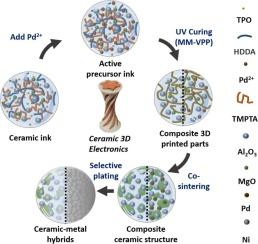
Abstract Image

利用多材料陶瓷增材制造和基于本征材料的催化剂金属化实现坚固和无损伤的三维陶瓷电子
复杂三维(3D)陶瓷电子器件的制造受到缺乏金属化方法的阻碍,这种方法可以在弯曲表面和内部腔上实现稳定的涂层而不会产生热损伤。本研究在多材料还原光聚合(MM-VPP) 3D打印平台上实现了材料本质催化设计,在打印阶段将不含Pd2+的惰性体素和含Pd2+的活性体素直接编码到单片陶瓷结构中。共烧结后,Pd2+在原位转化为表面Pd(0)纳米锚点,为后续化学沉积提供自催化位点,从而实现无需能量写入的3D选择性金属化。该方法适用于多种体系,如Ni、Cu和Ag,获得致密、连续的金属层,具有坚固的界面,并在标准化粘附和电特性方面表现出稳定的性能。长期热老化、湿热暴露、臭氧老化、热冲击和热循环试验进一步证实,陶瓷-金属界面在延长使用条件下保持连续的结构和稳定的功能。器件级验证表明,陶瓷天线在高温(短期条件)下保持稳定的通信,陶瓷发光二极管(LED)模块在低温下保持稳定的导通。MM-VPP和内在催化图图化的结合为陶瓷结构的3D选择性金属化提供了一个可扩展的平台,并提供了兼容性,以补充现有的工艺,特别是复杂的陶瓷几何形状和非视线区域。
本文章由计算机程序翻译,如有差异,请以英文原文为准。
求助全文
约1分钟内获得全文 求助全文
来源期刊
Materials Today
Materials Today 工程技术-材料科学:综合
CiteScore
36.30
自引率
1.20%
发文量
237
审稿时长
23 days
期刊介绍: Materials Today is the leading journal in the Materials Today family, focusing on the latest and most impactful work in the materials science community. With a reputation for excellence in news and reviews, the journal has now expanded its coverage to include original research and aims to be at the forefront of the field. We welcome comprehensive articles, short communications, and review articles from established leaders in the rapidly evolving fields of materials science and related disciplines. We strive to provide authors with rigorous peer review, fast publication, and maximum exposure for their work. While we only accept the most significant manuscripts, our speedy evaluation process ensures that there are no unnecessary publication delays.

×
引用
GB/T 7714-2015
复制
MLA
复制
APA
复制
导出至
BibTeX EndNote RefMan NoteFirst NoteExpress
×
提示
您的信息不完整,为了账户安全,请先补充。
现在去补充
×
提示
您因"违规操作"
具体请查看互助需知
我知道了
×
提示
确定
请完成安全验证×
copy
已复制链接
快去分享给好友吧!
我知道了
右上角分享
点击右上角分享
0
联系我们:info@booksci.cn Book学术提供免费学术资源搜索服务,方便国内外学者检索中英文文献。致力于提供最便捷和优质的服务体验。 Copyright © 2023 布克学术 All rights reserved.
京ICP备2023020795号-1
ghs 京公网安备 11010802042870号
Book学术文献互助
Book学术文献互助群
群 号:604180095
Book学术官方微信
小红书


