
Reactivity influence on carbonaceous particle layer break-up and relocation events in O2-based model filter regeneration
IF 4.3
2区 工程技术
Q2 ENGINEERING, CHEMICAL
Chemical Engineering Science
Pub Date : 2026-05-01
Epub Date: 2026-01-29
DOI:10.1016/j.ces.2026.123467
引用次数: 0
Abstract
Understanding the influence of soot reactivity on layer break-up and particle structure detachment and transport during diesel particulate filter regeneration is essential for optimizing aftertreatment performance. Seven carbon blacks with differing reactivity were investigated as reactive particle model systems. The oxidation behavior was characterized by temperature-programmed oxidation, revealing a wide reactivity range, with the peak oxidation temperature spanning from 817 K for a propane-soot reference to 894-976 K for the carbon blacks. This paper examines the regeneration of a model filter channel in situ with high temporal and spatial resolution. The filter is loaded with 10 mg carbon black particles and then regenerated. The regeneration of the filter is analyzed by varying the particle system under constant regeneration conditions at a gas temperature of 823 K and a channel inlet gas velocity of 60 m/s. In addition, the layer height and temperature are varied for a selected carbon black, and a more reactive hydrocarbon mixture was added to the particle layer of the selected carbon black. In selected experiments high-speed imaging of the model filter channel enabled direct observation of layer break-up and particles detaching from the filters surface. Image-based analysis enables the quantification of the black surface area reduction and isolated particle structures. All carbon blacks showed a reaction of the carbonaceous particles, with little layer break-up and formation of isolated structures, as well as minimal detachment events (0-10 events per experiment). Introducing more reactive hydrocarbons to the particle layer markedly increased fragmentation and particle relocations to more than 500 events.
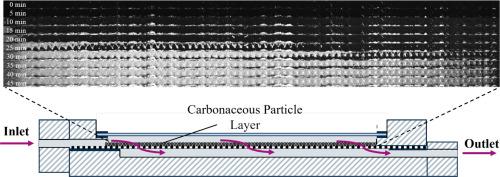
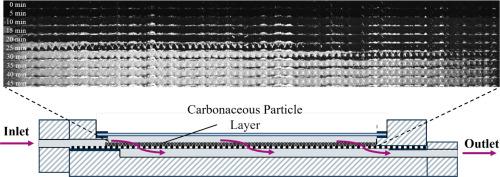
反应性对基于o2的模型过滤器再生中碳质颗粒层破裂和重新定位事件的影响
了解油烟反应性对柴油颗粒过滤器再生过程中颗粒结构剥离和运移的影响,对优化后处理性能具有重要意义。研究了7种反应性不同的炭黑作为反应粒子模型体系。氧化行为采用程序升温氧化法表征,反应性范围广,氧化峰温度从丙烷烟灰的817 K到炭黑的894 ~ 976 K不等。本文研究了具有高时空分辨率的模型滤波通道的原位再生问题。过滤器装载10毫克炭黑颗粒,然后再生。在气体温度为823 K,通道入口气速为60 m/s的恒定再生条件下,通过改变颗粒系统来分析过滤器的再生。此外,对所选炭黑改变层高和温度,并在所选炭黑的颗粒层中加入活性更强的烃混合物。在选定的实验中,模型滤波器通道的高速成像可以直接观察到层破裂和粒子从滤波器表面分离。基于图像的分析可以量化黑色表面积的减少和孤立的颗粒结构。所有炭黑都表现出碳质颗粒的反应,几乎没有层破裂和孤立结构的形成,以及最小的脱离事件(每个实验0-10个事件)。在颗粒层中引入更多的活性烃,会显著增加颗粒破碎和颗粒重定位的次数,超过500次。
本文章由计算机程序翻译,如有差异,请以英文原文为准。
求助全文
约1分钟内获得全文
求助全文
来源期刊
Chemical Engineering Science
工程技术-工程:化工
CiteScore
7.50
自引率
8.50%
发文量
1025
审稿时长
50 days
期刊介绍:
Chemical engineering enables the transformation of natural resources and energy into useful products for society. It draws on and applies natural sciences, mathematics and economics, and has developed fundamental engineering science that underpins the discipline.
Chemical Engineering Science (CES) has been publishing papers on the fundamentals of chemical engineering since 1951. CES is the platform where the most significant advances in the discipline have ever since been published. Chemical Engineering Science has accompanied and sustained chemical engineering through its development into the vibrant and broad scientific discipline it is today.
 求助内容:
求助内容: 应助结果提醒方式:

 京公网安备 11010802042870号


