Cognitive Impairments and Health System Outcomes in Inpatient Rehabilitation: A Comparison of Patients With Stroke and Those With Type II Diabetes Mellitus.
Jessica Edelstein, Bethany Rajaratnam, Audrey Rozell, William McCall, Hallie Zeleznik, Elizabeth Skidmore
{"title":"Cognitive Impairments and Health System Outcomes in Inpatient Rehabilitation: A Comparison of Patients With Stroke and Those With Type II Diabetes Mellitus.","authors":"Jessica Edelstein, Bethany Rajaratnam, Audrey Rozell, William McCall, Hallie Zeleznik, Elizabeth Skidmore","doi":"10.5014/ajot.2026.051328","DOIUrl":null,"url":null,"abstract":"<p><strong>Importance: </strong>Cognitive impairment is associated with poor outcomes in inpatient rehabilitation (IPR) but may be underrecognized among patients without neurologic diagnoses.</p><p><strong>Objective: </strong>To compare cognitive impairment prevalence between IPR patients with ischemic stroke and patients with Type II diabetes mellitus (T2DM) without a cerebrovascular diagnosis and to examine associations with functional outcomes and readmissions.</p><p><strong>Design: </strong>This observational, cross-sectional study used retrospective electronic medical record data collected from 2019 to 2022.</p><p><strong>Setting: </strong>Single inpatient rehabilitation facility in an academic health system.</p><p><strong>Participants: </strong>The sample consisted of 360 patients admitted to IPR, including 147 patients with ischemic stroke without T2DM and 213 patients with T2DM without a neurologic diagnosis.</p><p><strong>Outcomes and measures: </strong>Cognitive status was assessed at admission using the Montreal Cognitive Assessment (MoCA). Outcomes included discharge self-care and mobility (Section GG), within-stay readmission, and 30-day postdischarge readmission.</p><p><strong>Results: </strong>Mild cognitive impairment was more prevalent among patients with T2DM than among patients with stroke at admission. Patients with stroke had lower mean MoCA scores at admission and discharge. Diagnosis was not associated with discharge self-care, discharge mobility, or readmission outcomes. Higher admission functional status and lower disease burden were associated with better functional outcomes, and higher admission mobility was associated with lower odds of within-stay readmission.</p><p><strong>Conclusions and relevance: </strong>Routine, diagnosis-agnostic cognitive screening identified high rates of cognitive impairment across diagnostic groups in IPR. Occupational therapy practitioners should incorporate systematic cognitive screening and follow-up functional cognition assessment to guide intervention planning and discharge preparation. Plain-Language Summary: Many people receiving inpatient rehabilitation experience problems with thinking and memory that can affect daily activities and recovery. These problems are often expected after stroke but may be overlooked in people with other health conditions, such as diabetes. This study compared cognitive impairment and rehabilitation outcomes in people with stroke and people with Type II diabetes who did not have a stroke. The study found that mild cognitive impairment was common in both groups, including many people with diabetes. Whether a person had a stroke or diabetes did not explain differences in functional outcomes or hospital readmissions. Instead, a person's functional ability at admission and overall health burden were more strongly related to outcomes. These findings suggest that occupational therapy practitioners should routinely screen cognition for all patients in inpatient rehabilitation, not only those with neurologic diagnoses. Early identification of cognitive challenges can support therapy planning, daily functioning, and safe discharge.</p>","PeriodicalId":48317,"journal":{"name":"American Journal of Occupational Therapy","volume":"80 2","pages":""},"PeriodicalIF":2.1000,"publicationDate":"2026-03-01","publicationTypes":"Journal Article","fieldsOfStudy":null,"isOpenAccess":false,"openAccessPdf":"https://www.ncbi.nlm.nih.gov/pmc/articles/PMC12955713/pdf/","citationCount":"0","resultStr":null,"platform":"Semanticscholar","paperid":null,"PeriodicalName":"American Journal of Occupational Therapy","FirstCategoryId":"3","ListUrlMain":"https://doi.org/10.5014/ajot.2026.051328","RegionNum":4,"RegionCategory":"医学","ArticlePicture":[],"TitleCN":null,"AbstractTextCN":null,"PMCID":null,"EPubDate":"","PubModel":"","JCR":"Q1","JCRName":"REHABILITATION","Score":null,"Total":0}
引用次数: 0
Abstract
Importance: Cognitive impairment is associated with poor outcomes in inpatient rehabilitation (IPR) but may be underrecognized among patients without neurologic diagnoses.
Objective: To compare cognitive impairment prevalence between IPR patients with ischemic stroke and patients with Type II diabetes mellitus (T2DM) without a cerebrovascular diagnosis and to examine associations with functional outcomes and readmissions.
Design: This observational, cross-sectional study used retrospective electronic medical record data collected from 2019 to 2022.
Setting: Single inpatient rehabilitation facility in an academic health system.
Participants: The sample consisted of 360 patients admitted to IPR, including 147 patients with ischemic stroke without T2DM and 213 patients with T2DM without a neurologic diagnosis.
Outcomes and measures: Cognitive status was assessed at admission using the Montreal Cognitive Assessment (MoCA). Outcomes included discharge self-care and mobility (Section GG), within-stay readmission, and 30-day postdischarge readmission.
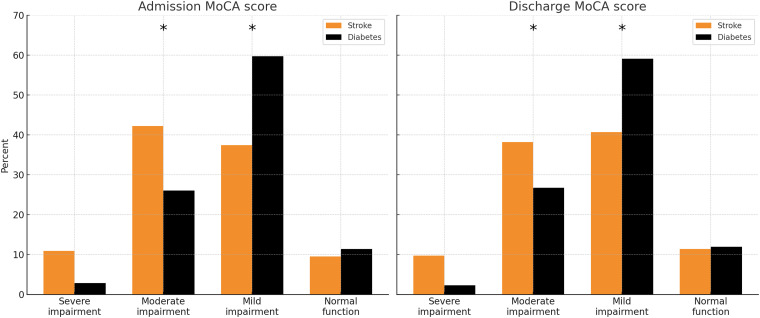
Results: Mild cognitive impairment was more prevalent among patients with T2DM than among patients with stroke at admission. Patients with stroke had lower mean MoCA scores at admission and discharge. Diagnosis was not associated with discharge self-care, discharge mobility, or readmission outcomes. Higher admission functional status and lower disease burden were associated with better functional outcomes, and higher admission mobility was associated with lower odds of within-stay readmission.
Conclusions and relevance: Routine, diagnosis-agnostic cognitive screening identified high rates of cognitive impairment across diagnostic groups in IPR. Occupational therapy practitioners should incorporate systematic cognitive screening and follow-up functional cognition assessment to guide intervention planning and discharge preparation. Plain-Language Summary: Many people receiving inpatient rehabilitation experience problems with thinking and memory that can affect daily activities and recovery. These problems are often expected after stroke but may be overlooked in people with other health conditions, such as diabetes. This study compared cognitive impairment and rehabilitation outcomes in people with stroke and people with Type II diabetes who did not have a stroke. The study found that mild cognitive impairment was common in both groups, including many people with diabetes. Whether a person had a stroke or diabetes did not explain differences in functional outcomes or hospital readmissions. Instead, a person's functional ability at admission and overall health burden were more strongly related to outcomes. These findings suggest that occupational therapy practitioners should routinely screen cognition for all patients in inpatient rehabilitation, not only those with neurologic diagnoses. Early identification of cognitive challenges can support therapy planning, daily functioning, and safe discharge.
期刊介绍:
The American Journal of Occupational Therapy (AJOT) is an official publication of the American Occupational Therapy Association, Inc. and is published 6 times per year. This peer reviewed journal focuses on research, practice, and health care issues in the field of occupational therapy. AOTA members receive 6 issues of AJOT per year and have online access to archived abstracts and full-text articles. Nonmembers may view abstracts online but must purchase full-text articles.


 求助内容:
求助内容: 应助结果提醒方式:

 京公网安备 11010802042870号


