
Study on the performance and mechanism of ammonia nitrogen and phosphorus removal in bioretention facilities enhanced by aluminum-based P-inactivation agent
IF 4.1
3区 地球科学
Q2 GEOSCIENCES, MULTIDISCIPLINARY
Physics and Chemistry of the Earth
Pub Date : 2026-06-01
Epub Date: 2026-01-20
DOI:10.1016/j.pce.2026.104311
引用次数: 0
Abstract
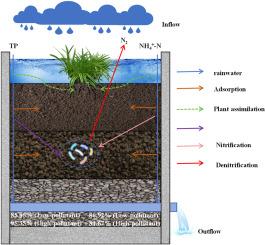
Bioretention facilities are widely utilized in sponge city infrastructure; however, conventional substrate fillers exhibit limited efficiency in removing nitrogen (N) and phosphorus (P). This limitation necessitates the selection of high-performance active fillers to enhance the N and P removal capabilities of bioretention facilities. This study compared the ammonia nitrogen (NH4+-N) and P removal performance of four substrate fillers—bio-ceramsite, volcanic rock, quartz sand, and aluminum-based P-inactivation agent (Al-PIA)—to identify the optimal substrate filler. Under high pollutant loading conditions, the optimal thickness of the selected filler for NH4+-N and P removal was determined. The NH4+-N and P removal performance of bioretention facilities utilizing Al-PIA was then evaluated under low and high pollutant load concentrations, and the effects of the drying period on NH4+-N and P removal were assessed. Additionally, the P removal mechanisms of Al-PIA, as well as the N and P removal pathways in the bioretention facility, were elucidated. Results indicated no significant difference in NH4+-N removal among the four fillers (P > 0.05). However, the Al-PIA exhibited the highest total phosphorus (TP) removal, with a mean removal efficiency of 72.46 %, establishing it as the optimal filler. The most effective Al-PIA layer thickness was 12 cm, achieving mean removal efficiencies of 84.67 % for NH4+-N and 95.35 % for TP. Under various pollution load concentrations, the effluent NH4+-N and TP concentrations from bioretention facilities utilizing Al-PIA complied with China's Class IV surface water standards, and demonstrate excellent NH4+-N and P removal stability and interference resistance under varying drying periods. P removal by Al-PIA was primarily governed by physical adsorption, electrostatic attraction, surface precipitation, and ligand exchange. In the bioretention facility, N removal was facilitated by physical adsorption in the planting soil, plant uptake, adsorption by Al-PIA, and subsequent microbial nitrification. The removal of P was mainly attributed to adsorption by Al-PIA (87.40 %) and plant uptake and assimilation (10.40 %).
铝基p -灭活剂强化生物滞留设施中氨氮磷去除性能及机理研究
生物滞留设施在海绵城市基础设施中得到广泛应用;然而,传统的基质填料在去除氮(N)和磷(P)方面的效率有限。这一限制需要选择高性能活性填料来提高生物滞留设施的氮和磷去除能力。本研究比较了生物陶粒、火山石、石英砂和铝基P-失活剂四种基质填料对氨氮(NH4+-N)和P的去除性能,以确定最佳基质填料。在高污染物负荷条件下,确定了所选填料去除NH4+-N和P的最佳厚度。在低、高污染物负荷浓度条件下,评价了Al-PIA生物滞留设施去除NH4+-N和P的性能,并评估了干燥时间对NH4+-N和P去除的影响。此外,还阐明了Al-PIA的除磷机制以及生物滞留设施中N和P的去除途径。结果表明,4种填料对NH4+-N的去除率无显著差异(P > 0.05)。Al-PIA对总磷(TP)的去除率最高,平均去除率为72.46%,是最佳填料。最有效的Al-PIA层厚度为12 cm,对NH4+-N和TP的平均去除率分别为84.67%和95.35%。在不同污染负荷浓度下,使用Al-PIA的生物滞留设施出水NH4+-N和TP浓度均符合中国地表水IV类标准,并在不同干燥时间下表现出优异的NH4+-N和P去除稳定性和抗干扰性。Al-PIA对磷的去除主要受物理吸附、静电吸引、表面沉淀和配体交换的影响。在生物滞留设施中,氮的去除主要通过种植土壤的物理吸附、植物吸收、Al-PIA吸附以及随后的微生物硝化作用来实现。对磷的去除主要来源于Al-PIA吸附(87.40%)和植物吸收同化(10.40%)。
本文章由计算机程序翻译,如有差异,请以英文原文为准。
求助全文
约1分钟内获得全文
求助全文
来源期刊
Physics and Chemistry of the Earth
地学-地球科学综合
CiteScore
5.40
自引率
2.70%
发文量
176
审稿时长
31.6 weeks
期刊介绍:
Physics and Chemistry of the Earth is an international interdisciplinary journal for the rapid publication of collections of refereed communications in separate thematic issues, either stemming from scientific meetings, or, especially compiled for the occasion. There is no restriction on the length of articles published in the journal. Physics and Chemistry of the Earth incorporates the separate Parts A, B and C which existed until the end of 2001.
Please note: the Editors are unable to consider submissions that are not invited or linked to a thematic issue. Please do not submit unsolicited papers.
The journal covers the following subject areas:
-Solid Earth and Geodesy:
(geology, geochemistry, tectonophysics, seismology, volcanology, palaeomagnetism and rock magnetism, electromagnetism and potential fields, marine and environmental geosciences as well as geodesy).
-Hydrology, Oceans and Atmosphere:
(hydrology and water resources research, engineering and management, oceanography and oceanic chemistry, shelf, sea, lake and river sciences, meteorology and atmospheric sciences incl. chemistry as well as climatology and glaciology).
-Solar-Terrestrial and Planetary Science:
(solar, heliospheric and solar-planetary sciences, geology, geophysics and atmospheric sciences of planets, satellites and small bodies as well as cosmochemistry and exobiology).
 求助内容:
求助内容: 应助结果提醒方式:

 京公网安备 11010802042870号


