
Modeling haloketones in drinking water using conformable neural networks: a case study of Jinhua, China
IF 6.6
2区 工程技术
Q1 ENGINEERING, CHEMICAL
Journal of water process engineering
Pub Date : 2026-03-01
Epub Date: 2026-01-27
DOI:10.1016/j.jwpe.2026.109542
引用次数: 0
Abstract
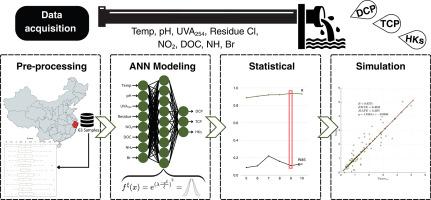
The prediction of halogenated ketones in drinking water is relevant for public health surveillance and treatment control. Sixty-three samples from Jinhua, China, with routinely monitored physicochemical parameters were used, targeting three objectives: 1,1-dichloro-2-propanone (DCP), 1,1,1-trichloro-2-propanone (TCP), and total haloketones (HK). We compared two simple baselines—multiple linear regression and random forests—with an artificial neural network using radial basis function activation. The models were trained with a fixed training/validation/test split, minimum-maximum scaling to [0.1, 0.9], and evaluated with R, RMSE, and MAPE. A global sensitivity analysis identified the most influential inputs. The baselines established realistic performance limits (e.g., for DCP: R ≈ 0.77 and RMSE≈0.23 for linear regression; R ≈ 0.77 and RMSE≈0.28 for random forest). The conformable activation network improved agreement with observations for all targets: averaging R = 0.94, RMSE = 0.398. Sensitivity analysis was consistent with known factors in the process. The proposed activation design achieved strong gains over linear and tree-based baselines on a small dataset while remaining computationally light. We document the assumptions, data ranges, and limitations to support its reuse in routine monitoring.
用适形神经网络模拟饮用水中的卤酮:以金华市为例
饮用水中卤代酮的预测对公共卫生监测和处理控制具有重要意义。使用了来自中国金华的63份样品,常规监测了理化参数,针对三个目标:1,1-二氯-2-丙烷(DCP), 1,1,1-三氯-2-丙烷(TCP)和总卤酮(HK)。我们比较了两个简单的基线-多元线性回归和随机森林-与使用径向基函数激活的人工神经网络。模型以固定的训练/验证/测试分割进行训练,最小-最大缩放至[0.1,0.9],并使用R、RMSE和MAPE进行评估。全球敏感性分析确定了最具影响力的投入。基线建立了现实的性能限制(例如,线性回归的DCP: R≈0.77,RMSE≈0.23;随机森林的R≈0.77,RMSE≈0.28)。整合激活网络提高了对所有目标的观测结果的一致性:平均R = 0.94, RMSE = 0.398。敏感性分析与过程中已知因素一致。所提出的激活设计在小数据集上获得了比线性和基于树的基线更大的收益,同时保持了计算量的减少。我们记录了假设、数据范围和限制,以支持其在日常监控中的重用。
本文章由计算机程序翻译,如有差异,请以英文原文为准。
求助全文
约1分钟内获得全文
求助全文
来源期刊
Journal of water process engineering
Biochemistry, Genetics and Molecular Biology-Biotechnology
CiteScore
10.70
自引率
8.60%
发文量
846
审稿时长
24 days
期刊介绍:
The Journal of Water Process Engineering aims to publish refereed, high-quality research papers with significant novelty and impact in all areas of the engineering of water and wastewater processing . Papers on advanced and novel treatment processes and technologies are particularly welcome. The Journal considers papers in areas such as nanotechnology and biotechnology applications in water, novel oxidation and separation processes, membrane processes (except those for desalination) , catalytic processes for the removal of water contaminants, sustainable processes, water reuse and recycling, water use and wastewater minimization, integrated/hybrid technology, process modeling of water treatment and novel treatment processes. Submissions on the subject of adsorbents, including standard measurements of adsorption kinetics and equilibrium will only be considered if there is a genuine case for novelty and contribution, for example highly novel, sustainable adsorbents and their use: papers on activated carbon-type materials derived from natural matter, or surfactant-modified clays and related minerals, would not fulfil this criterion. The Journal particularly welcomes contributions involving environmentally, economically and socially sustainable technology for water treatment, including those which are energy-efficient, with minimal or no chemical consumption, and capable of water recycling and reuse that minimizes the direct disposal of wastewater to the aquatic environment. Papers that describe novel ideas for solving issues related to water quality and availability are also welcome, as are those that show the transfer of techniques from other disciplines. The Journal will consider papers dealing with processes for various water matrices including drinking water (except desalination), domestic, urban and industrial wastewaters, in addition to their residues. It is expected that the journal will be of particular relevance to chemical and process engineers working in the field. The Journal welcomes Full Text papers, Short Communications, State-of-the-Art Reviews and Letters to Editors and Case Studies
 求助内容:
求助内容: 应助结果提醒方式:

 京公网安备 11010802042870号


