
Optimization of mass transport in PEM electrolysis cell via Triply Periodic Minimal Surfaces (TPMS) based integrated transport layer
IF 17
1区 工程技术
Q1 ENERGY & FUELS
引用次数: 0
Abstract
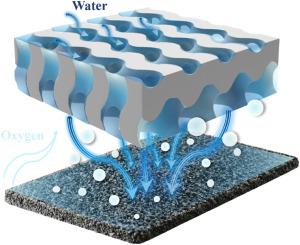
The decarbonization of heavy-duty transport depends critically on affordable green hydrogen, with proton exchange membrane electrolysis cell (PEMEC) serving as a key green-hydrogen production technology due to its high efficiency and dynamic response to renewable power. However, severe mass transfer limitations at the anode—primarily caused by oxygen bubble accumulation—restrict PEMEC performance at high current densities (>2 A cm−2), thereby elevating hydrogen production cost and hindering its competitiveness for mobility applications. In the study, an innovative integrated transport layer (ITL) is proposed by inspiring from the triply periodic minimal surface (TPMS) structure. The TPMS structure is optimized for mass transfer through gas-liquid two-phase flow simulations. Guided by the results, the TPMS-based flow field is fabricated via 3D printing and evaluated in an electrolyzer. The simulations reveal that the TPMS structure significantly enhances gas-liquid distribution uniformity. Specifically, it increases water saturation at the catalytic layer interface by 110 %, and improves the oxygen distribution uniformity index by 78 % over conventional flow fields. The TPMS flow field reduces the cell voltage by 50 mV at 2 A cm−2 and decreases mass transfer loss by 44.6 %, compared to conventional serpentine flow fields. This work provides a critical theoretical foundation for designing high-performance mass transport structures in PEMEC.
基于三周期最小表面(TPMS)的集成传输层优化PEM电解池的质量传输
重型运输的脱碳关键取决于价格合理的绿色氢,而质子交换膜电解电池(PEMEC)因其高效率和对可再生能源的动态响应而成为关键的绿色氢生产技术。然而,阳极处严重的传质限制(主要是由氧泡积累引起的)限制了PEMEC在高电流密度(>2 A cm - 2)下的性能,从而提高了制氢成本,阻碍了其在迁移应用中的竞争力。本文从三周期最小表面(TPMS)结构出发,提出了一种创新的集成传输层(ITL)。通过气液两相流模拟,优化了TPMS结构的传质性能。在实验结果的指导下,利用3D打印技术制作了基于tpms的流场,并在电解槽中进行了评估。仿真结果表明,TPMS结构显著提高了气液分布均匀性。与常规流场相比,催化层界面水饱和度提高了110%,氧分布均匀性指数提高了78%。与传统的蛇形流场相比,TPMS流场在2 A cm−2时可使电池电压降低50 mV,传质损失降低44.6%。这项工作为设计高性能的质量传输结构提供了重要的理论基础。
本文章由计算机程序翻译,如有差异,请以英文原文为准。
求助全文
约1分钟内获得全文
求助全文
来源期刊
Etransportation
Engineering-Automotive Engineering
CiteScore
19.80
自引率
12.60%
发文量
57
审稿时长
39 days
期刊介绍:
eTransportation is a scholarly journal that aims to advance knowledge in the field of electric transportation. It focuses on all modes of transportation that utilize electricity as their primary source of energy, including electric vehicles, trains, ships, and aircraft. The journal covers all stages of research, development, and testing of new technologies, systems, and devices related to electrical transportation.
The journal welcomes the use of simulation and analysis tools at the system, transport, or device level. Its primary emphasis is on the study of the electrical and electronic aspects of transportation systems. However, it also considers research on mechanical parts or subsystems of vehicles if there is a clear interaction with electrical or electronic equipment.
Please note that this journal excludes other aspects such as sociological, political, regulatory, or environmental factors from its scope.
 求助内容:
求助内容: 应助结果提醒方式:

 京公网安备 11010802042870号


