
Multi-stage cubature information filter based nonlinear model predictive scheme for steering control of an autonomous underwater vehicle under sensor/actuator failure
IF 2.6
3区 计算机科学
Q2 AUTOMATION & CONTROL SYSTEMS
European Journal of Control
Pub Date : 2026-03-01
Epub Date: 2026-01-17
DOI:10.1016/j.ejcon.2026.101464
引用次数: 0
Abstract
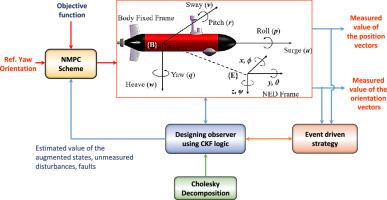
The hydrodynamics of an autonomous underwater vehicle (AUV) is an extremely intricate and multidimensional problem. The dynamic interaction between orientation change and the consequent shift in hydrodynamic forces exerts substantial effects on AUV’s stabilization and steering efficacy. Furthermore, a malfunctioning sensor/actuator leads to unexpected outcomes when executing steering maneuvers. A nonlinear model predictive control (NMPC) scheme incorporated with the observer was proposed in this work for the AUV to perform steering maneuvers. A two-stage high-degree cubature information filter is aimed at accurately tracking sensor/actuator faultiness, undetermined hydrodynamical parameters, and uncertain perturbations. Using the observed AUV state/parameters, a predictive control strategy for the anti-disturbance model has been devised. This research has extensively examined multiple types of real-world situations involving the impact of ocean currents, parametric sensitivity, and repercussions of sensor/actuator faults. A variety of indices, including mean square deviation (improvement of 5.36%) and root mean square error (improvement of 6.29%), are assessed using the proposed control framework and contrasted with the standard form of nonlinear model predictive controller to identify its efficacy and acceptance on the depth tracking scheme.
基于多阶段培养信息滤波的自主水下航行器传感器/执行器失效非线性模型预测方法
自主水下航行器(AUV)的水动力学是一个极其复杂和多维的问题。方向变化和随之产生的水动力变化之间的动态相互作用对水下航行器的稳定性和转向效果有重要影响。此外,在执行转向操作时,传感器/执行器故障会导致意想不到的结果。本文提出了一种结合观测器的非线性模型预测控制(NMPC)方案,用于水下机器人的转向控制。两级高度培养信息滤波器的目的是精确跟踪传感器/执行器的故障、不确定的流体动力参数和不确定的扰动。利用观察到的水下航行器状态/参数,设计了一种预测控制策略。这项研究广泛地研究了多种类型的现实情况,包括洋流的影响、参数灵敏度以及传感器/执行器故障的影响。利用所提出的控制框架对均方差(提高5.36%)和均方根误差(提高6.29%)等指标进行了评估,并与标准形式的非线性模型预测控制器进行了对比,以确定其对深度跟踪方案的有效性和可接受性。
本文章由计算机程序翻译,如有差异,请以英文原文为准。
求助全文
约1分钟内获得全文
求助全文
来源期刊
European Journal of Control
工程技术-自动化与控制系统
CiteScore
5.80
自引率
5.90%
发文量
131
审稿时长
1 months
期刊介绍:
The European Control Association (EUCA) has among its objectives to promote the development of the discipline. Apart from the European Control Conferences, the European Journal of Control is the Association''s main channel for the dissemination of important contributions in the field.
The aim of the Journal is to publish high quality papers on the theory and practice of control and systems engineering.
The scope of the Journal will be wide and cover all aspects of the discipline including methodologies, techniques and applications.
Research in control and systems engineering is necessary to develop new concepts and tools which enhance our understanding and improve our ability to design and implement high performance control systems. Submitted papers should stress the practical motivations and relevance of their results.
The design and implementation of a successful control system requires the use of a range of techniques:
Modelling
Robustness Analysis
Identification
Optimization
Control Law Design
Numerical analysis
Fault Detection, and so on.
 求助内容:
求助内容: 应助结果提醒方式:

 京公网安备 11010802042870号


