
Evaluation of generalised soil water retention models and their role in hydro–mechanical modelling of unsaturated soils
IF 3.7
2区 工程技术
Q3 ENERGY & FUELS
Geomechanics for Energy and the Environment
Pub Date : 2026-03-01
Epub Date: 2026-01-27
DOI:10.1016/j.gete.2026.100794
引用次数: 0
Abstract
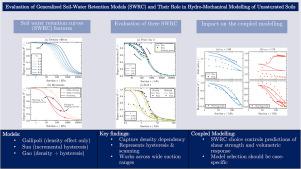
The soil–water retention curve (SWRC) is fundamental in geotechnical engineering, influencing the hydraulic and mechanical response of unsaturated soils. This study evaluates three generalised SWRC models that account for density effects and/or hydraulic hysteresis: the Gallipoli, Sun, and Gao formulations. Their simulation performance is assessed against experimental data from a wide range of soils, including compacted till, Pearl clays, Barcelona silt, and silty sands. The analyses highlight the strengths and limitations of each model in reproducing main wetting and drying branches, scanning curves, and density-dependent shifts of the SWRC. Among the tested formulations, the Gao model demonstrates the most robust capability to represent hysteresis and density effects across broad suction ranges. Finally, selected hydraulic models were coupled with the hypoplastic constitutive model proposed by Tafili and Machaček (2023) to evaluate hydro–mechanical interactions of unsaturated soils under various stress and hydraulic conditions, highlighting that the choice of SWRC formulation strongly influences predictions of volumetric response, stiffness evolution, and suction-dependent strength. This underlines the importance of selecting an appropriate SWRC model for reliable hydro–mechanical modelling of unsaturated soils.
广义土壤保水性模型的评价及其在非饱和土壤水力学模拟中的作用
土水保持曲线(SWRC)是岩土工程的基础,影响着非饱和土的水力和力学响应。本研究评估了考虑密度效应和/或水力滞后的三种广义SWRC模型:Gallipoli、Sun和Gao公式。它们的模拟性能是根据各种土壤的实验数据进行评估的,包括压实耕层、珍珠粘土、巴塞罗那粉砂和粉砂。分析强调了每个模型在再现SWRC主要干湿分支、扫描曲线和密度相关位移方面的优势和局限性。在测试的配方中,Gao模型在大吸力范围内表现出最稳健的滞回和密度效应。最后,将选择的水力模型与Tafili和macha ek(2023)提出的欠塑性本构模型相结合,以评估各种应力和水力条件下非饱和土的水-力相互作用,强调SWRC公式的选择强烈影响体积响应、刚度演化和吸力依赖强度的预测。这强调了选择合适的SWRC模型对非饱和土壤进行可靠的水力学建模的重要性。
本文章由计算机程序翻译,如有差异,请以英文原文为准。
求助全文
约1分钟内获得全文
求助全文
来源期刊
Geomechanics for Energy and the Environment
Earth and Planetary Sciences-Geotechnical Engineering and Engineering Geology
CiteScore
5.90
自引率
11.80%
发文量
87
期刊介绍:
The aim of the Journal is to publish research results of the highest quality and of lasting importance on the subject of geomechanics, with the focus on applications to geological energy production and storage, and the interaction of soils and rocks with the natural and engineered environment. Special attention is given to concepts and developments of new energy geotechnologies that comprise intrinsic mechanisms protecting the environment against a potential engineering induced damage, hence warranting sustainable usage of energy resources.
The scope of the journal is broad, including fundamental concepts in geomechanics and mechanics of porous media, the experiments and analysis of novel phenomena and applications. Of special interest are issues resulting from coupling of particular physics, chemistry and biology of external forcings, as well as of pore fluid/gas and minerals to the solid mechanics of the medium skeleton and pore fluid mechanics. The multi-scale and inter-scale interactions between the phenomena and the behavior representations are also of particular interest. Contributions to general theoretical approach to these issues, but of potential reference to geomechanics in its context of energy and the environment are also most welcome.
 求助内容:
求助内容: 应助结果提醒方式:

 京公网安备 11010802042870号


