
Multi-stimuli-responsive lanthanide-based POM-viologen hybrids: Reversible photochromism, thermochromism, electrochromic hydrogels, and fluorescence for inkless printing and UV detection
IF 4.6
2区 化学
Q1 SPECTROSCOPY
Spectrochimica Acta Part A: Molecular and Biomolecular Spectroscopy
Pub Date : 2026-05-05
Epub Date: 2026-01-25
DOI:10.1016/j.saa.2026.127523
引用次数: 0
Abstract
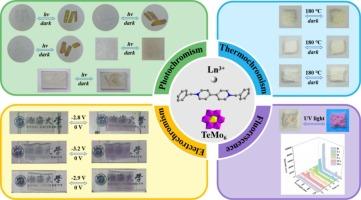
In this work, three multi-stimuli-responsive polyoxometalate-viologen-lanthanide (POM-Viologen-Ln) compounds, (Bz2Bipy)1.5[Ln(H2O)3(TeMo6O24)]·DMA·xH2O (x = 1.5, Ln = Sm (1); x = 2, Ln = Eu (2), Tb (3); Bz2Bipy·Cl2 = 1,1′-dibenzyl-[4,4′-bipyridine]-1,1′-diium dichloride) were synthesized via a solvothermal method and characterized structurally using single-crystal X-ray diffraction. These compounds exhibit rapid and reversible photochromism and thermochromism, which are attributed to photo−/thermo-induced electron transfer. This process generates viologen free radicals, as evidenced by UV–Vis, EPR, and XPS analyses. The hydrogels incorporating these compounds exhibit good electrochromic performance, characterized by high optical contrast, fast switching, and high coloration efficiency. Compounds 1–3 exhibit strong lanthanide emissions that are dynamically tunable via light irradiation. Furthermore, the mixed matrix films containing compounds 1–3 demonstrate potential for inkless printing and UV detection. The systematic strategy paves the way for developing multi-stimuli-responsive materials with superior performance and a broader application scope.
多刺激响应镧系pom -紫外光杂化物:可逆光致变色,热致变色,电致变色水凝胶,以及用于无墨水印刷和紫外检测的荧光
在这项工作中,三个多刺激响应的多金属氧酸-紫罗兰-镧系化合物(pom -紫罗兰-Ln), (Bz2Bipy)1.5[Ln(H2O)3(TeMo6O24)]·DMA·xH2O (x = 1.5, Ln = Sm (1);x = 2, Ln = Eu (2) Tb (3);采用溶剂热法合成了Bz2Bipy·Cl2 = 1,1′-二苄基-[4,4′-联吡啶]-1,1′-二氯化二钠),并用单晶x射线衍射对其结构进行了表征。这些化合物表现出快速和可逆的光致变色和热致变色,这是由于光/热诱导的电子转移。UV-Vis, EPR和XPS分析证实了这一过程会产生紫色自由基。结合这些化合物的水凝胶表现出良好的电致变色性能,具有高光学对比度、快速开关和高显色效率的特点。化合物1-3表现出强烈的镧系辐射,可通过光照射动态调节。此外,含有化合物1-3的混合基质薄膜显示出无墨印刷和紫外线检测的潜力。系统的策略为开发性能优越、应用范围更广的多刺激响应材料铺平了道路。
本文章由计算机程序翻译,如有差异,请以英文原文为准。
求助全文
约1分钟内获得全文
求助全文
来源期刊
CiteScore
8.40
自引率
11.40%
发文量
1364
审稿时长
40 days
期刊介绍:
Spectrochimica Acta, Part A: Molecular and Biomolecular Spectroscopy (SAA) is an interdisciplinary journal which spans from basic to applied aspects of optical spectroscopy in chemistry, medicine, biology, and materials science.
The journal publishes original scientific papers that feature high-quality spectroscopic data and analysis. From the broad range of optical spectroscopies, the emphasis is on electronic, vibrational or rotational spectra of molecules, rather than on spectroscopy based on magnetic moments.
Criteria for publication in SAA are novelty, uniqueness, and outstanding quality. Routine applications of spectroscopic techniques and computational methods are not appropriate.
Topics of particular interest of Spectrochimica Acta Part A include, but are not limited to:
Spectroscopy and dynamics of bioanalytical, biomedical, environmental, and atmospheric sciences,
Novel experimental techniques or instrumentation for molecular spectroscopy,
Novel theoretical and computational methods,
Novel applications in photochemistry and photobiology,
Novel interpretational approaches as well as advances in data analysis based on electronic or vibrational spectroscopy.
 求助内容:
求助内容: 应助结果提醒方式:

 京公网安备 11010802042870号


