
Transfer of silver nanoparticles (AgNPs) to dichloromethane for single-step and in-situ synthesis of PDMS-AgNPs nanocomposites for SERS analysis
IF 4.6
2区 化学
Q1 SPECTROSCOPY
Spectrochimica Acta Part A: Molecular and Biomolecular Spectroscopy
Pub Date : 2026-05-05
Epub Date: 2026-01-25
DOI:10.1016/j.saa.2026.127524
引用次数: 0
Abstract
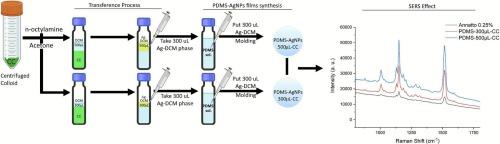
Silver nanoparticles (AgNPs) deposited in polydimethylsiloxane (PDMS) films has recently received significant attention for the fabrication of SERS substrates, but, conventional deposition of AgNPs on PDMS requires complex, additional post-synthesis steps. This work presents a novel, single-step, and in-situ synthesis of flexible PDMS films with incorporated AgNPs for Raman-SERS applications. The method involves an AgNPs phase transfer from aqueous colloid to a dichloromethane (DCM) organic phase, which is then used as the solvent during PDMS synthesis. UV–Vis spectroscopy results show a maximum transference using a minimum volume of DCM and centrifugation of the colloid. Given its historical and cultural relevance as a colorant in diverse artefacts and ancient codices made of cellulose paper, the common dye, annatto, impregnated in paper, was used as an analyte model to evaluate the SERS performance of PDMS-AgNPs films in Raman spectroscopy, using 785 and 532 nm lasers, along with different concentrations of aqueous annatto extracts (0.01, 0.1, 0.125, 0.25, 0.5, and 1% w/V). The results demonstrated a significant enhancement in the intensity of the characteristic peaks of bixin (the main component of annatto), especially in extracts of low concentration (0.125 and 0.25% w/V) when the PDMS-AgNPs nanocomposite films synthesized with the AgNPs transferred using a minimum volume of DCM and centrifugation were used.
银纳米粒子(AgNPs)单步转移至二氯甲烷及原位合成用于SERS分析的PDMS-AgNPs纳米复合材料
沉积在聚二甲基硅氧烷(PDMS)薄膜上的银纳米粒子(AgNPs)最近在SERS衬底的制造方面受到了极大的关注,但是,传统的在PDMS上沉积AgNPs需要复杂的、额外的合成后步骤。这项工作提出了一种新颖的、单步的、原位合成柔性PDMS薄膜的方法,该薄膜含有用于拉曼- sers应用的AgNPs。该方法涉及AgNPs相从水性胶体转移到二氯甲烷(DCM)有机相,然后在PDMS合成过程中用作溶剂。紫外可见光谱结果表明,使用最小体积的DCM和胶体的离心转移最大。考虑到其作为纤维素纸制成的各种人工制品和古代手书的着色剂的历史和文化相关性,我们使用浸渍在纸中的常见染料红木作为分析物模型,使用785和532 nm激光,以及不同浓度的水红木提取物(0.01,0.1,0.125,0.25,0.5和1% w/V),在拉曼光谱中评估PDMS-AgNPs薄膜的SERS性能。结果表明,以最小体积DCM转移的AgNPs为原料制备的PDMS-AgNPs纳米复合膜,在低浓度(0.125 w/V和0.25% w/V)条件下,其特征峰强度显著增强。
本文章由计算机程序翻译,如有差异,请以英文原文为准。
求助全文
约1分钟内获得全文
求助全文
来源期刊
CiteScore
8.40
自引率
11.40%
发文量
1364
审稿时长
40 days
期刊介绍:
Spectrochimica Acta, Part A: Molecular and Biomolecular Spectroscopy (SAA) is an interdisciplinary journal which spans from basic to applied aspects of optical spectroscopy in chemistry, medicine, biology, and materials science.
The journal publishes original scientific papers that feature high-quality spectroscopic data and analysis. From the broad range of optical spectroscopies, the emphasis is on electronic, vibrational or rotational spectra of molecules, rather than on spectroscopy based on magnetic moments.
Criteria for publication in SAA are novelty, uniqueness, and outstanding quality. Routine applications of spectroscopic techniques and computational methods are not appropriate.
Topics of particular interest of Spectrochimica Acta Part A include, but are not limited to:
Spectroscopy and dynamics of bioanalytical, biomedical, environmental, and atmospheric sciences,
Novel experimental techniques or instrumentation for molecular spectroscopy,
Novel theoretical and computational methods,
Novel applications in photochemistry and photobiology,
Novel interpretational approaches as well as advances in data analysis based on electronic or vibrational spectroscopy.
 求助内容:
求助内容: 应助结果提醒方式:

 京公网安备 11010802042870号


