
CFD-DEM simulation of bubble dynamics and hydrodynamics in fluidized beds with louver baffles
IF 5.5
2区 工程技术
Q2 ENGINEERING, CHEMICAL
引用次数: 0
Abstract
Fluidized beds are commonly used equipment in the chemical industry, but large bubbles might be generated, which lower the conversion efficiency and operational stability. To address this issue, internal components (e.g., louver baffles) can be employed to improve fluidization performance. Considering that the interaction between louver baffles and fluidized particle flows is quite complex, and the deploy settings would greatly influence the fluidization, further understanding is needed. The objective of this study is to investigate the effects of baffle inclination angle and superficial velocity on bubble dynamics and hydrodynamics in fluidized beds equipped with multi-layer louver baffles using computational fluid dynamics coupled with the discrete element method (CFD-DEM). Simulation results reveal that increasing superficial velocity in the baffle-free bed aggravates slug formation and deteriorates particle mixing. In contrast, the introduction of louver baffles effectively promotes bubble breakup and suppresses these phenomena, reducing the maximum average equivalent bubble diameter from approximately 140 mm to 31 mm. Baffles with 45° inclination generate the most uniformly distributed small spherical bubbles. As the inclination angle increases, particle downward motion becomes more pronounced, which induces local dilute regions and leads to an increase in bubble size. Notably, at low superficial velocities, steeper baffles with inclination angles of 55° and 60° may instead induce increased instability in the fluidized bed. These findings provide guidance for the design and optimization of baffled fluidized beds.
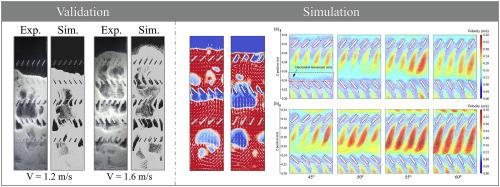
带有百叶挡板的流化床气泡动力学和流体动力学的CFD-DEM模拟
流化床是化工行业常用的设备,但其产生的气泡较大,降低了转化效率和运行稳定性。为了解决这个问题,可以使用内部组件(例如百叶挡板)来改善流化性能。考虑到百叶挡板与流态化颗粒流之间的相互作用非常复杂,布置设置对流态化影响很大,需要进一步了解。本文采用计算流体力学与离散元法(CFD-DEM)相结合的方法,研究了挡板倾角和表面速度对多层挡板流化床气泡动力学和流体动力学的影响。模拟结果表明,增加无挡板床内的表面速度会加剧段塞的形成,并使颗粒混合恶化。相比之下,百叶挡板的引入有效地促进了气泡破裂并抑制了这些现象,将最大平均等效气泡直径从大约140毫米减少到31毫米。倾角为45°的挡板产生的小球形气泡分布最均匀。随着倾角的增大,颗粒向下运动更加明显,产生局部稀释区,导致气泡尺寸增大。值得注意的是,在低表面速度下,倾角为55°和60°的更陡的挡板反而会增加流化床的不稳定性。研究结果对折流板流化床的设计和优化具有指导意义。
本文章由计算机程序翻译,如有差异,请以英文原文为准。
求助全文
约1分钟内获得全文
求助全文
来源期刊
Powder Technology
工程技术-工程:化工
CiteScore
9.90
自引率
15.40%
发文量
1047
审稿时长
46 days
期刊介绍:
Powder Technology is an International Journal on the Science and Technology of Wet and Dry Particulate Systems. Powder Technology publishes papers on all aspects of the formation of particles and their characterisation and on the study of systems containing particulate solids. No limitation is imposed on the size of the particles, which may range from nanometre scale, as in pigments or aerosols, to that of mined or quarried materials. The following list of topics is not intended to be comprehensive, but rather to indicate typical subjects which fall within the scope of the journal's interests:
Formation and synthesis of particles by precipitation and other methods.
Modification of particles by agglomeration, coating, comminution and attrition.
Characterisation of the size, shape, surface area, pore structure and strength of particles and agglomerates (including the origins and effects of inter particle forces).
Packing, failure, flow and permeability of assemblies of particles.
Particle-particle interactions and suspension rheology.
Handling and processing operations such as slurry flow, fluidization, pneumatic conveying.
Interactions between particles and their environment, including delivery of particulate products to the body.
Applications of particle technology in production of pharmaceuticals, chemicals, foods, pigments, structural, and functional materials and in environmental and energy related matters.
For materials-oriented contributions we are looking for articles revealing the effect of particle/powder characteristics (size, morphology and composition, in that order) on material performance or functionality and, ideally, comparison to any industrial standard.
 求助内容:
求助内容: 应助结果提醒方式:

 京公网安备 11010802042870号


