
Seasonal flooding amplifies the positive asymmetric response of ecosystem carbon exchange along the precipitation gradient in saline wetlands
IF 5.7
1区 农林科学
Q1 GEOSCIENCES, MULTIDISCIPLINARY
引用次数: 0
Abstract
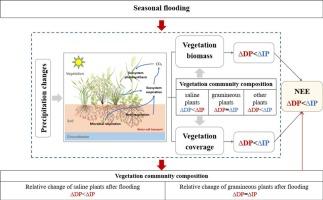
Intensified precipitation variability profoundly affects saline wetland hydrological dynamics, potentially interfering with key carbon processes within ecosystems. However, the mechanisms underlying how precipitation changes affect ecosystems carbon processes in saline wetland remain unclear. Moreover, whether seasonal flooding influences wetland ecosystems' carbon processes response to precipitation changes is still poorly understood. Based on a six-year field precipitation experiment including five precipitation levels (−60%, −40%, +0%, +40%, and + 60% of ambient precipitation) in the Yellow River Delta wetlands, we examined how seasonal flooding regulated ecosystem CO2 exchange (NEE), gross ecosystem production (GEP) and ecosystem respiration (ER) response to precipitation changes. Over three years, ecosystem carbon fluxes exhibited a positive asymmetric response along the precipitation gradient, with the increment under wet treatments exceeding the reduction under dry treatments. Compared with the control, the −60% treatment significantly reduced GEP and ER by 9.7% and 9.3% respectively; whereas the +40% and + 60% treatments significantly increased GEP, ER, and NEE by 18.0%, 23.5%, 15.4%, 19.4%, 22.1%, and 29.0% respectively. Moreover, the observed positive asymmetry in ecosystem carbon flux arose because, under reduced precipitation, vegetation coverage and total biomass were less affected by high soil salinity. Additionally, plants coverage responded differently to flooding under precipitation treatments: saline plants were most affected under reduced precipitation, while gramineous plants showed no significant difference. Our results demonstrated that acclimation of vegetation to salinization leads to the asymmetric response of ecosystem carbon exchange along the precipitation gradient, while seasonal flooding may amplify the positive asymmetric response by affecting vegetation community composition in saline wetlands. The findings underscore the importance of seasonal flooding in modulating wetland ecosystem responses within global change manipulation experiments.
季节性洪水放大了咸化湿地生态系统碳交换沿降水梯度的正不对称响应
降水变异性的增强深刻地影响了咸水湿地的水文动态,潜在地干扰了生态系统内的关键碳过程。然而,降水变化如何影响盐碱地生态系统碳过程的机制尚不清楚。此外,季节性洪水是否影响湿地生态系统碳过程对降水变化的响应尚不清楚。基于黄河三角洲湿地6年的野外降水试验,研究了季节性洪水对生态系统CO2交换(NEE)、生态系统总生产量(GEP)和生态系统呼吸(ER)对降水变化的响应,包括5个降水水平(- 60%、- 40%、+0%、+40%和+ 60%)。3年内,生态系统碳通量沿降水梯度呈非对称正响应,湿处理的增量大于干处理的减少。与对照组相比,−60%处理的GEP和ER分别显著降低9.7%和9.3%;而+40%和+ 60%处理的GEP、ER和NEE分别显著提高了18.0%、23.5%、15.4%、19.4%、22.1%和29.0%。此外,观测到的生态系统碳通量正不对称的原因是,在降水减少的情况下,植被覆盖度和总生物量受高土壤盐度的影响较小。此外,不同降水处理下植物盖度对洪水的响应也不同:盐碱植物在降水减少下受影响最大,而禾本科植物无显著差异。研究结果表明,植被对盐碱化的适应导致生态系统碳交换沿降水梯度的不对称响应,而季节性洪水可能通过影响盐碱化湿地植被群落组成,放大了生态系统碳交换的正不对称响应。这些发现强调了季节性洪水在全球变化操纵实验中调节湿地生态系统响应的重要性。
本文章由计算机程序翻译,如有差异,请以英文原文为准。
求助全文
约1分钟内获得全文
求助全文
来源期刊
Catena
环境科学-地球科学综合
CiteScore
10.50
自引率
9.70%
发文量
816
审稿时长
54 days
期刊介绍:
Catena publishes papers describing original field and laboratory investigations and reviews on geoecology and landscape evolution with emphasis on interdisciplinary aspects of soil science, hydrology and geomorphology. It aims to disseminate new knowledge and foster better understanding of the physical environment, of evolutionary sequences that have resulted in past and current landscapes, and of the natural processes that are likely to determine the fate of our terrestrial environment.
Papers within any one of the above topics are welcome provided they are of sufficiently wide interest and relevance.
 求助内容:
求助内容: 应助结果提醒方式:

 京公网安备 11010802042870号


