
Spatiotemporal analysis of rainfall erosivity in Oklahoma
IF 5.7
1区 农林科学
Q1 GEOSCIENCES, MULTIDISCIPLINARY
引用次数: 0
Abstract
The Universal Soil Loss Equation (USLE) and its family of models have been used for soil loss prediction and erosion mitigation. These empirical models relied on precipitation data predating 1957 to calculate the Rainfall Erosivity (R-factor) value; however, the isoerodent map published in AH703 is still widely used in soil loss estimations today. Climatic and precipitation changes have presented questions about the validity and reliability of using these estimation methods. Additionally, instrumentation, precipitation gauging networks, and data availability have improved since the original publication of the AH703 isoerodent map. This study conducted a spatiotemporal analysis in the GIS environment to estimate modern rainfall erosivity across Oklahoma using high-resolution rainfall data. Average annual and monthly rainfall erosivity factors, R-factor and -factor, respectively, were estimated using 5-min interval rainfall data collected from 111 Oklahoma Mesonet sites. The sites had an average historical precipitation record of 28 years. Using new rainfall erosivity values, spatial variation was assessed within two geographical segments: a) NOAA-defined state climate divisions and b) EPA-defined Level III ecoregions. Temporal analysis revealed that rainfall erosivity occurring between April and October contributed 86% of the annual R-factor. This study also developed an updated isoerodent map for the state of Oklahoma. The updated R-factor significantly differed from the original AH703 isoerodent map. Specifically, comparing the isoerodent maps revealed that the R-factor changed between −20% and 112%. The reasons contribute to the discrepancies between the two maps are also discussed.
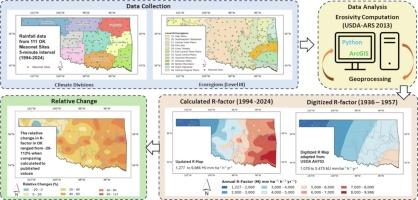
俄克拉荷马州降雨侵蚀力的时空分析
通用土壤流失方程(USLE)及其模型族已被用于土壤流失预测和侵蚀减缓。这些经验模型基于1957年以前的降水资料来计算降雨侵蚀力(r因子)值;然而,AH703发表的等侵蚀图至今仍被广泛应用于土壤流失估算。气候和降水变化对这些估算方法的有效性和可靠性提出了质疑。此外,自AH703等蚀图最初出版以来,仪器仪表、降水测量网络和数据可用性都得到了改进。本研究在GIS环境下进行了时空分析,利用高分辨率降雨数据估计俄克拉荷马州的现代降雨侵蚀力。利用从俄克拉荷马州111个Mesonet站点收集的5分钟间隔降雨数据,分别估算了年平均和月平均降雨侵蚀力因子、r因子和rm因子。这些地点的平均历史降水记录为28年。利用新的降雨侵蚀力值,在两个地理区域内评估了空间变化:a) noaa定义的州气候区和b) epa定义的III级生态区。时间分析表明,4 - 10月的降雨侵蚀力贡献了年r因子的86%。这项研究还为俄克拉何马州开发了一份更新的等蚀地图。更新后的r因子与原来的AH703等侵蚀图有显著差异。具体来说,比较等侵蚀图显示r因子在- 20%到112%之间变化。本文还讨论了导致两幅地图差异的原因。
本文章由计算机程序翻译,如有差异,请以英文原文为准。
求助全文
约1分钟内获得全文
求助全文
来源期刊
Catena
环境科学-地球科学综合
CiteScore
10.50
自引率
9.70%
发文量
816
审稿时长
54 days
期刊介绍:
Catena publishes papers describing original field and laboratory investigations and reviews on geoecology and landscape evolution with emphasis on interdisciplinary aspects of soil science, hydrology and geomorphology. It aims to disseminate new knowledge and foster better understanding of the physical environment, of evolutionary sequences that have resulted in past and current landscapes, and of the natural processes that are likely to determine the fate of our terrestrial environment.
Papers within any one of the above topics are welcome provided they are of sufficiently wide interest and relevance.
 求助内容:
求助内容: 应助结果提醒方式:

 京公网安备 11010802042870号


