
One-dimensional unsteady modeling of drying and devolatilization of coal particles under pressurized oxy-fuel conditions in fluidized beds
IF 4.3
2区 材料科学
Q2 ENGINEERING, CHEMICAL
引用次数: 0
Abstract
This study develops a one-dimensional unsteady model to simulate the drying and devolatilization of large coal particles (4–12 mm) under pressurized oxy-fuel conditions in fluidized beds. The model reveals that devolatilization time scales quadratically with particle diameter (t ∝ dp2), confirming heat conduction as the rate-limiting step. Increased system pressure significantly shortens drying and devolatilization times by up to 18 % and 31 %, respectively, but also amplifies intra-particle temperature gradients. Under identical operating conditions, differences between O2/CO2 and O2/N2 atmospheres were marginal (<5 %). Model predictions agree with experimental measurements within 20 % deviation. The results provide operational guidance for pressurized fluidized bed combustors, emphasizing the strong influence of particle size and pressure on process efficiency and heat transfer limitations, while also highlighting their implications for energy efficiency improvement, emission reduction, and the advancement of environmentally sustainable combustion technologies.

流化床加压氧燃料条件下煤颗粒干燥与脱挥发的一维非定常模型
本文建立了一维非稳态模型,模拟了流化床加压氧燃料条件下大颗粒煤(4-12 mm)的干燥和脱挥发过程。模型表明,脱挥发时间随颗粒直径(t∝dp2)呈二次标度,证实了热传导是脱挥发的限速步骤。增加系统压力可显著缩短干燥和脱挥发时间,分别可达18%和31%,但也会放大颗粒内的温度梯度。在相同的操作条件下,O2/CO2和O2/N2气氛之间的差异很小(< 5%)。模型预测与实验测量值的偏差在20%以内。研究结果为加压流化床燃烧器提供了操作指导,强调了颗粒尺寸和压力对过程效率和传热限制的强烈影响,同时也强调了它们对能效提高、减排和环境可持续燃烧技术进步的影响。
本文章由计算机程序翻译,如有差异,请以英文原文为准。
求助全文
约1分钟内获得全文
求助全文
来源期刊
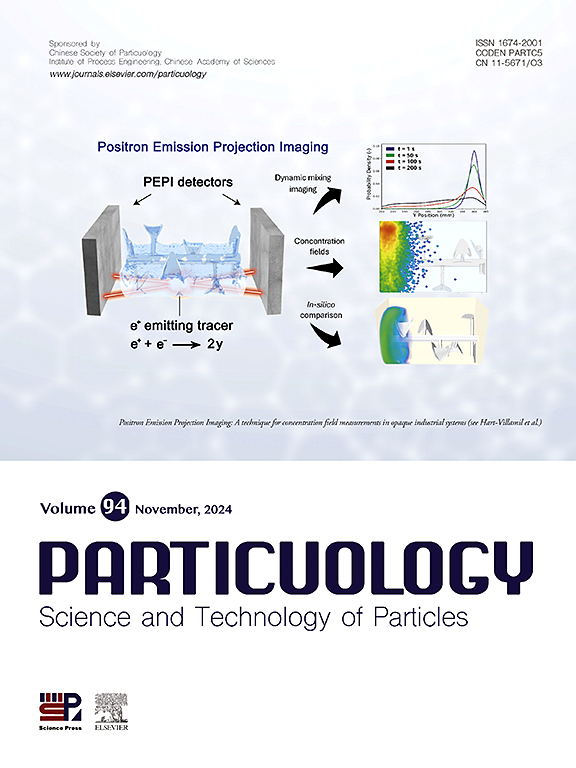
Particuology
工程技术-材料科学:综合
CiteScore
6.70
自引率
2.90%
发文量
1730
审稿时长
32 days
期刊介绍:
The word ‘particuology’ was coined to parallel the discipline for the science and technology of particles.
Particuology is an interdisciplinary journal that publishes frontier research articles and critical reviews on the discovery, formulation and engineering of particulate materials, processes and systems. It especially welcomes contributions utilising advanced theoretical, modelling and measurement methods to enable the discovery and creation of new particulate materials, and the manufacturing of functional particulate-based products, such as sensors.
Papers are handled by Thematic Editors who oversee contributions from specific subject fields. These fields are classified into: Particle Synthesis and Modification; Particle Characterization and Measurement; Granular Systems and Bulk Solids Technology; Fluidization and Particle-Fluid Systems; Aerosols; and Applications of Particle Technology.
Key topics concerning the creation and processing of particulates include:
-Modelling and simulation of particle formation, collective behaviour of particles and systems for particle production over a broad spectrum of length scales
-Mining of experimental data for particle synthesis and surface properties to facilitate the creation of new materials and processes
-Particle design and preparation including controlled response and sensing functionalities in formation, delivery systems and biological systems, etc.
-Experimental and computational methods for visualization and analysis of particulate system.
These topics are broadly relevant to the production of materials, pharmaceuticals and food, and to the conversion of energy resources to fuels and protection of the environment.
 求助内容:
求助内容: 应助结果提醒方式:

 京公网安备 11010802042870号


