
Penicillium oxalicum mediated phosphate solubilization as a Bio-stimulant approach enhancing barley growth
Q1 Environmental Science
Bioresource Technology Reports
Pub Date : 2026-02-01
Epub Date: 2026-01-22
DOI:10.1016/j.biteb.2026.102590
引用次数: 0
Abstract
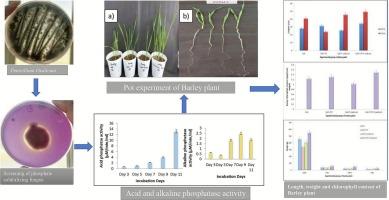
Phosphate-solubilizing microorganisms (PSMs) enhance plant phosphorus uptake by converting insoluble phosphorus into a soluble form. This study isolated and evaluated PSMs from barley rhizosphere soils in Tonk, Rajasthan, using Pikovskaya's agar medium. Six bacterial and six fungal strains demonstrated phosphate solubilization, with Penicillium oxalicum (isolate BLF-7) showing the highest efficiency. Penicillium oxalicum exhibited the highest phosphate solubilization index (1.9 ± 0.02) and efficiency (49.42% ± 0.99). Subsequent investigation indicated that P. oxalicum exhibited elevated concentrations of soluble phosphorus (1147.93 ± 2.43 mg/L) on the 10th day of incubation and exhibited acid phosphatase activity (13.18 ± 0.51 μM/min/mL) on the 11th day. Furthermore, it produced indole-3-acetic acid (3.36 μg/mL) within three days, facilitating plant development. Pot studies with barley demonstrated a 20% enhancement in plant height, notable improvements in root and shoot biomass, and a 20% rise in chlorophyll content in plants treated with P. oxalicum and tricalcium phosphate. These findings underscore P. oxalicum's dual role as a phosphate solubilizer and plant growth enhancer, affirming its promise as a sustainable biofertilizer.
草青霉介导的磷酸盐增溶作为一种促进大麦生长的生物刺激剂
增磷微生物(psm)通过将不溶性磷转化为可溶性磷来增强植物对磷的吸收。本研究利用Pikovskaya琼脂培养基从拉贾斯坦邦Tonk大麦根际土壤中分离和评价了psm。6株细菌和6株真菌表现出磷酸盐增溶作用,其中草酸青霉(BLF-7)表现出最高的增溶效果。草酸青霉的磷酸盐增溶指数最高(1.9±0.02),效率最高(49.42%±0.99)。随后的研究表明,草藻在培养第10天可溶性磷浓度升高(1147.93±2.43 mg/L),第11天酸性磷酸酶活性升高(13.18±0.51 μM/min/mL)。3 d内产生吲哚-3-乙酸(3.36 μg/mL),有利于植物发育。对大麦进行盆栽试验表明,草酸磷和磷酸三钙处理后,大麦株高增加20%,根和茎生物量显著增加,叶绿素含量增加20%。这些发现强调了草酸磷作为磷酸盐增溶剂和植物生长促进剂的双重作用,肯定了其作为可持续生物肥料的前景。
本文章由计算机程序翻译,如有差异,请以英文原文为准。
求助全文
约1分钟内获得全文
求助全文
来源期刊

Bioresource Technology Reports
Environmental Science-Environmental Engineering
CiteScore
7.20
自引率
0.00%
发文量
390
审稿时长
28 days
 求助内容:
求助内容: 应助结果提醒方式:

 京公网安备 11010802042870号


