
Genomic and functional characterization of pyomelanin production by Shewanella indica biofilms on 3D-printed scaffolds for dye removal
Q1 Environmental Science
Bioresource Technology Reports
Pub Date : 2026-02-01
Epub Date: 2026-01-26
DOI:10.1016/j.biteb.2026.102595
引用次数: 0
Abstract
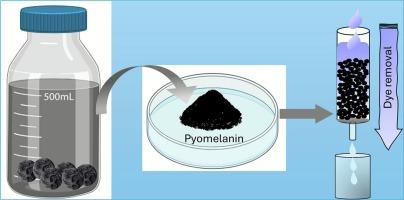
Inspired by the interactions between sponges and bacteria within marine ecosystems, this study presents a scalable platform for the production of pyomelanin utilizing Shewanella indica immobilized on three-dimensional (3D) printed gyroid spheres with a surface area of 1835 mm2. The application of five gyroid spheres immobilized with S. indica in 100 ml of growth medium resulted in a yield of 0.937 mg ml−1 of pyomelanin, which could be enhanced to 3.76 mg ml−1 when utilizing 20 spheres. The extraction of pyomelanin was accomplished through an alkali-acid treatment, and the gyroid spheres demonstrated reusability over five cycles. Furthermore, the pyomelanin exhibited an adsorption capacity of up to 70% for various textile dyes, including crystal violet and trypan blue, within a three-hour period. Genomic analysis identified genes associated with biofilm formation (lap A, B; lol A, B, D, E; DGC and bdl A) and pyomelanin biosynthesis (hppD, aspC, tyrA, and phhA). These results underscore a sustainable approach for pyomelanin production and its potential applications in bioremediation.
在3d打印的染料去除支架上,印度希瓦氏菌生物膜产生脓黑素的基因组和功能表征
受海洋生态系统中海绵和细菌之间相互作用的启发,本研究提出了一个可扩展的平台,用于生产pyomelanin,利用固定化在三维(3D)打印的旋转球体上的印度希瓦氏菌(Shewanella indica),其表面积为1835 mm2。在100 ml培养基中使用5个固定化球,产黑素为0.937 mg ml−1,使用20个球时产黑素为3.76 mg ml−1。通过碱酸处理完成了黑素的提取,旋转球在5个循环中证明了可重复使用。此外,在3小时内,黑素对各种纺织染料(包括结晶紫和台锥蓝)的吸附量高达70%。基因组分析鉴定出与生物膜形成(lap A、B、lol A、B、D、E、DGC和bdl A)和黑素生物合成(hppD、aspC、tyrA和phhA)相关的基因。这些结果强调了一种可持续的产黑素方法及其在生物修复中的潜在应用。
本文章由计算机程序翻译,如有差异,请以英文原文为准。
求助全文
约1分钟内获得全文
求助全文
来源期刊

Bioresource Technology Reports
Environmental Science-Environmental Engineering
CiteScore
7.20
自引率
0.00%
发文量
390
审稿时长
28 days
 求助内容:
求助内容: 应助结果提醒方式:

 京公网安备 11010802042870号


