
Toxicity of Ocimum basilicum L. (Lamiaceae) essential oil to Spodoptera frugiperda (J.E. Smith, 1797) (Lepidoptera: Noctuidae) and its selectivity for Telenomus remus Nixon, 1937 (Hymenoptera: Scelionidae)
IF 2.5
2区 农林科学
Q1 AGRONOMY
引用次数: 0
Abstract
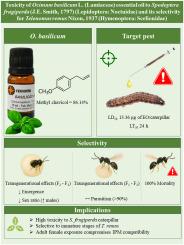
Spodoptera frugiperda is an agricultural pest that has spread to several regions, with frequent reports of populations resistant to synthetic insecticides. Consequently, there is an increasing number of studies seeking novel control strategies compatible with beneficial organisms. This study aimed to: (i) evaluate the toxicity of Ocimum basilicum essential oil (EO) to S. frugiperda; (ii) chemically characterize O. basilicum EO; (iii) determine the toxicity of the EO's major compound to S. frugiperda; and (iv) assess selectivity of EO toward Telenomus remus. The EO was toxic to second-instar caterpillars (LD50 = 13.36 μg of EO/caterpillar). Methyl chavicol was identified as the major compound (86.14 %) in EO and exhibited toxicity to S. frugiperda. The EO reduced the emergence of T. remus in the F2 and F3 generations when exposed during the egg and pupal stages within the natural host and was classified as harmless to slightly harmful according to the IOBC scale, without affecting parasitism rates. The sex ratio was reduced. The O. basilicum EO caused 100 % mortality in adult female T. remus. In conclusion, O. basilicum EO is toxic to S. frugiperda and induces transgenerational effects on T. remus emergence during the egg and pupal stages, while exhibiting high toxicity to adult females. These findings indicate that O. basilicum EO is compatible with T. remus during its immature stages and underscore the need for application strategies that prevent exposure of adult parasitoids in IPM programs.
罗勒香精油对夜蛾(J.E. Smith, 1797)(鳞翅目:夜蛾科)的毒性及对夜蛾的选择性
狐尾夜蛾是一种农业害虫,已蔓延到一些地区,经常有报道称其种群对合成杀虫剂产生抗药性。因此,越来越多的研究寻求与有益生物兼容的新控制策略。本研究的目的是:(1)评价罗勒精油(EO)对果螨的毒性;(ii) basilicum EO的化学特征;(iii)测定精油的主要化合物对果蚜的毒性;以及(iv)评估EO对鼠尾绦虫的选择性。EO对二龄幼虫有毒性(LD50 = 13.36 μg /只)。甲基chavicol是其主要成分(86.14%),对frugiperda具有一定的毒性。在自然寄主的卵期和蛹期暴露于EO时,可减少F2代和F3代的黄颡鱼幼虫的羽化,并根据IOBC分级将其归类为无害至轻度有害,不影响寄生率。性别比降低了。basilicum EO对成年雌鼠的死亡率为100%。综上所述,basilicum EO对frugiperda具有毒性,并在卵期和蛹期诱导T. remus羽化的跨代效应,但对成年雌性具有高毒性。这些结果表明,basilicum EO在其未成熟阶段与T. remus兼容,并强调了在IPM计划中防止成虫暴露的应用策略的必要性。
本文章由计算机程序翻译,如有差异,请以英文原文为准。
求助全文
约1分钟内获得全文
求助全文
来源期刊
Crop Protection
农林科学-农艺学
CiteScore
6.10
自引率
3.60%
发文量
200
审稿时长
29 days
期刊介绍:
The Editors of Crop Protection especially welcome papers describing an interdisciplinary approach showing how different control strategies can be integrated into practical pest management programs, covering high and low input agricultural systems worldwide. Crop Protection particularly emphasizes the practical aspects of control in the field and for protected crops, and includes work which may lead in the near future to more effective control. The journal does not duplicate the many existing excellent biological science journals, which deal mainly with the more fundamental aspects of plant pathology, applied zoology and weed science. Crop Protection covers all practical aspects of pest, disease and weed control, including the following topics:
-Abiotic damage-
Agronomic control methods-
Assessment of pest and disease damage-
Molecular methods for the detection and assessment of pests and diseases-
Biological control-
Biorational pesticides-
Control of animal pests of world crops-
Control of diseases of crop plants caused by microorganisms-
Control of weeds and integrated management-
Economic considerations-
Effects of plant growth regulators-
Environmental benefits of reduced pesticide use-
Environmental effects of pesticides-
Epidemiology of pests and diseases in relation to control-
GM Crops, and genetic engineering applications-
Importance and control of postharvest crop losses-
Integrated control-
Interrelationships and compatibility among different control strategies-
Invasive species as they relate to implications for crop protection-
Pesticide application methods-
Pest management-
Phytobiomes for pest and disease control-
Resistance management-
Sampling and monitoring schemes for diseases, nematodes, pests and weeds.
 求助内容:
求助内容: 应助结果提醒方式:

 京公网安备 11010802042870号


