
First report of Alternaria alternata causing soft rot in pitaya (Hylocereus polyrhizus) fruits in Rio Grande do Sul, Brazil
IF 2.5
2区 农林科学
Q1 AGRONOMY
引用次数: 0
Abstract
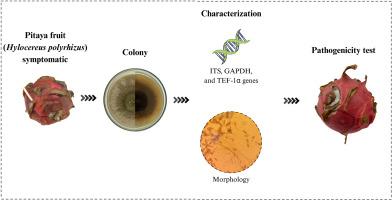
This study reports the first case of Alternaria alternata causing soft rot in pitaya (Hylocereus polyrhizus) fruits in Rio Grande do Sul, Brazil. Symptomatic fruits were collected from a commercial orchard, and the pathogen was isolated, characterized both morphologically and molecularly (using ITS, GAPDH, and TEF-1α loci), and tested for pathogenicity. The colonies exhibited mycelial growth of 5.24 ± 0.35 cm after 7 days and 8.08 ± 0.37 cm after 14 days, with olive gray centers and light brown edges. The obclavate or obpyriform conidia had transverse (1–6) and longitudinal (0–3) septa, with a short apical tip (5–22.5 μm). Molecular analysis revealed 100 % similarity with A. alternata sequences in GenBank, confirming the pathogen via phylogenetic analysis. Pathogenicity tests produced dark brown, depressed lesions with a clear halo, characteristic of the disease, confirming Koch's postulates. The 100 % incidence in commercial fruit crops resulted in significant economic losses, exacerbated by favorable weather conditions. Thus, this study presents the first evidence of A. alternata associated with post-harvest soft rot in pitaya fruits in Brazil, underscoring the need for management strategies to reduce waste and economic losses along the production chain.
在巴西南巴西大德州发现引起火龙果(Hylocereus polyrhizus)果实软腐病的交替孢霉首次报道
本研究报道了巴西南大德州(里约热内卢Grande do Sul)火龙果(Hylocereus polyrhizus)果实中第一例引起软腐病的交替孢霉。从某商业果园采集有症状的果实,对病原菌进行分离、形态和分子鉴定(利用ITS、GAPDH和TEF-1α位点),并进行致病性检测。菌落生长7 d后为5.24±0.35 cm, 14 d后为8.08±0.37 cm,菌丝中心呈橄榄灰色,边缘呈浅棕色。倒卵形或倒梨形分生孢子有横向(1-6)和纵向(0-3)隔,尖尖短(5-22.5 μm)。分子分析结果显示,与GenBank中的A. alternata序列具有100%的相似性,通过系统发育分析证实了该病原体。致病性测试产生了带有清晰光晕的深棕色凹陷病灶,这是该疾病的特征,证实了科赫的假设。商品水果作物100%的发病率造成了重大的经济损失,有利的天气条件加剧了经济损失。因此,本研究首次提出了与巴西火龙果采后软腐病相关的交替孢霉的证据,强调了采取管理策略以减少生产链上的浪费和经济损失的必要性。
本文章由计算机程序翻译,如有差异,请以英文原文为准。
求助全文
约1分钟内获得全文
求助全文
来源期刊
Crop Protection
农林科学-农艺学
CiteScore
6.10
自引率
3.60%
发文量
200
审稿时长
29 days
期刊介绍:
The Editors of Crop Protection especially welcome papers describing an interdisciplinary approach showing how different control strategies can be integrated into practical pest management programs, covering high and low input agricultural systems worldwide. Crop Protection particularly emphasizes the practical aspects of control in the field and for protected crops, and includes work which may lead in the near future to more effective control. The journal does not duplicate the many existing excellent biological science journals, which deal mainly with the more fundamental aspects of plant pathology, applied zoology and weed science. Crop Protection covers all practical aspects of pest, disease and weed control, including the following topics:
-Abiotic damage-
Agronomic control methods-
Assessment of pest and disease damage-
Molecular methods for the detection and assessment of pests and diseases-
Biological control-
Biorational pesticides-
Control of animal pests of world crops-
Control of diseases of crop plants caused by microorganisms-
Control of weeds and integrated management-
Economic considerations-
Effects of plant growth regulators-
Environmental benefits of reduced pesticide use-
Environmental effects of pesticides-
Epidemiology of pests and diseases in relation to control-
GM Crops, and genetic engineering applications-
Importance and control of postharvest crop losses-
Integrated control-
Interrelationships and compatibility among different control strategies-
Invasive species as they relate to implications for crop protection-
Pesticide application methods-
Pest management-
Phytobiomes for pest and disease control-
Resistance management-
Sampling and monitoring schemes for diseases, nematodes, pests and weeds.
 求助内容:
求助内容: 应助结果提醒方式:

 京公网安备 11010802042870号


