{"title":"Bio-inspired designer cellulosomes show strongest synergy on industrial substrates under natural-like conditions.","authors":"Babette Lamote, Julie Vanderstraeten, Nette De Ridder, Kenan Meert, Wout Boerjan, Yves Briers","doi":"10.1093/jimb/kuag004","DOIUrl":null,"url":null,"abstract":"<p><p>Designer cellulosomes (DCs) are engineered multienzyme complexes inspired by natural cellulosomes, designed to improve lignocellulose breakdown. Their modular architecture enables the spatial colocalization of diverse catalytic activities, potentially enhancing depolymerization efficiency compared to free enzymes. Although conceptually promising, little is known about how they perform on complex lignocellulosic substrates. In this study, we developed a tetravalent DC using a modular VersaTile assembly approach, incorporating endoglucanase, cellobiohydrolase, β-glucosidase, and endoxylanase activities. The process involved (i) delineating catalytic modules from Cellvibrio japonicus enzymes, (ii) generating docking enzyme variants via combinatorial cloning, and (iii) selecting optimal candidates based on expression, activity, and cohesin-dockerin binding before assembling them onto a scaffoldin with four cohesins and a cellulose-binding module. The resulting DC was tested on two industrially relevant substrates: agro-industrial wheat fibers and genome-edited low-lignin poplar biomass under controlled laboratory conditions. It achieved cellulose-to-glucose conversion yields of 24.98% (150 pmol DC/ml) and 0.82% (200 pmol DC/ml), respectively, under the test conditions. By comparing the saccharification efficiencies of the enzymes in their free and complexed forms, we found that colocalization on a common scaffoldin significantly enhanced synergistic activity. This effect was most pronounced under low enzyme concentrations and when acting on complex lignocellulosic substrates, increasing glucose release compared to free enzymes. These observations highlight that the benefits of colocalization are substrate-dependent and occur under conditions that mimic the natural environment of biomass degradation, conditions that differ from typical industrial settings. This work advances our understanding of DC behavior on real-world substrates, providing essential insights for evaluating their economic viability in industrial applications. One-sentence summary Natural-like conditions helped customized DC release more sugars from biomass than standard industrial setups.</p>","PeriodicalId":16092,"journal":{"name":"Journal of Industrial Microbiology & Biotechnology","volume":" ","pages":""},"PeriodicalIF":3.2000,"publicationDate":"2026-01-08","publicationTypes":"Journal Article","fieldsOfStudy":null,"isOpenAccess":false,"openAccessPdf":"https://www.ncbi.nlm.nih.gov/pmc/articles/PMC12963819/pdf/","citationCount":"0","resultStr":null,"platform":"Semanticscholar","paperid":null,"PeriodicalName":"Journal of Industrial Microbiology & Biotechnology","FirstCategoryId":"5","ListUrlMain":"https://doi.org/10.1093/jimb/kuag004","RegionNum":4,"RegionCategory":"生物学","ArticlePicture":[],"TitleCN":null,"AbstractTextCN":null,"PMCID":null,"EPubDate":"","PubModel":"","JCR":"Q2","JCRName":"BIOTECHNOLOGY & APPLIED MICROBIOLOGY","Score":null,"Total":0}
引用次数: 0
Abstract
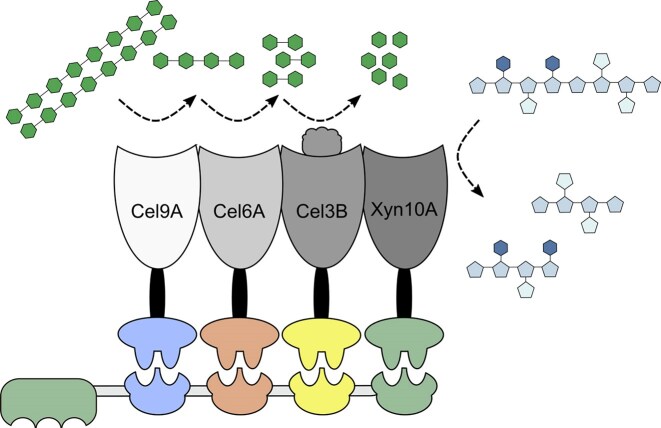
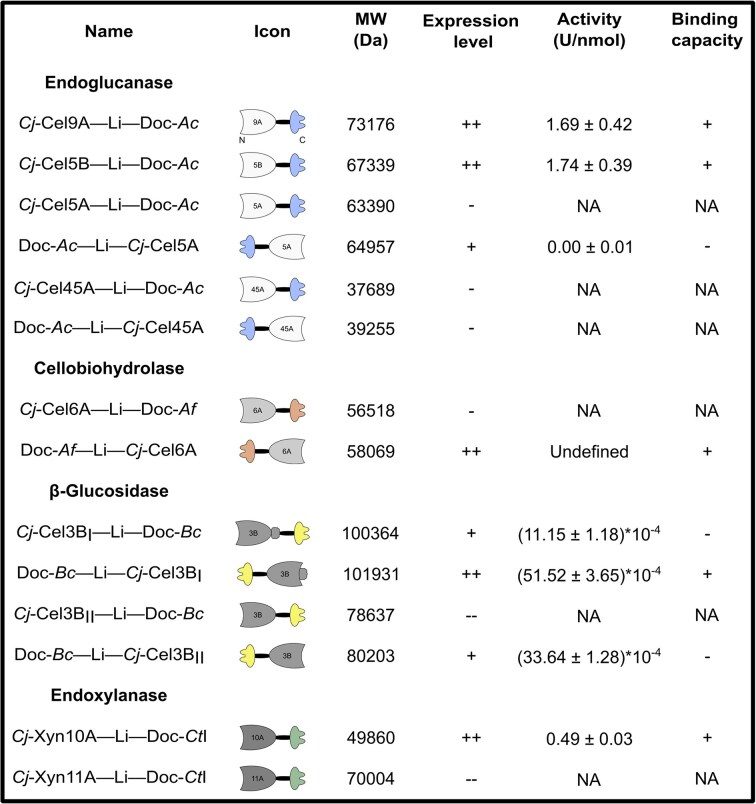
Designer cellulosomes (DCs) are engineered multienzyme complexes inspired by natural cellulosomes, designed to improve lignocellulose breakdown. Their modular architecture enables the spatial colocalization of diverse catalytic activities, potentially enhancing depolymerization efficiency compared to free enzymes. Although conceptually promising, little is known about how they perform on complex lignocellulosic substrates. In this study, we developed a tetravalent DC using a modular VersaTile assembly approach, incorporating endoglucanase, cellobiohydrolase, β-glucosidase, and endoxylanase activities. The process involved (i) delineating catalytic modules from Cellvibrio japonicus enzymes, (ii) generating docking enzyme variants via combinatorial cloning, and (iii) selecting optimal candidates based on expression, activity, and cohesin-dockerin binding before assembling them onto a scaffoldin with four cohesins and a cellulose-binding module. The resulting DC was tested on two industrially relevant substrates: agro-industrial wheat fibers and genome-edited low-lignin poplar biomass under controlled laboratory conditions. It achieved cellulose-to-glucose conversion yields of 24.98% (150 pmol DC/ml) and 0.82% (200 pmol DC/ml), respectively, under the test conditions. By comparing the saccharification efficiencies of the enzymes in their free and complexed forms, we found that colocalization on a common scaffoldin significantly enhanced synergistic activity. This effect was most pronounced under low enzyme concentrations and when acting on complex lignocellulosic substrates, increasing glucose release compared to free enzymes. These observations highlight that the benefits of colocalization are substrate-dependent and occur under conditions that mimic the natural environment of biomass degradation, conditions that differ from typical industrial settings. This work advances our understanding of DC behavior on real-world substrates, providing essential insights for evaluating their economic viability in industrial applications. One-sentence summary Natural-like conditions helped customized DC release more sugars from biomass than standard industrial setups.
期刊介绍:
The Journal of Industrial Microbiology and Biotechnology is an international journal which publishes papers describing original research, short communications, and critical reviews in the fields of biotechnology, fermentation and cell culture, biocatalysis, environmental microbiology, natural products discovery and biosynthesis, marine natural products, metabolic engineering, genomics, bioinformatics, food microbiology, and other areas of applied microbiology


 求助内容:
求助内容: 应助结果提醒方式:

 京公网安备 11010802042870号


