
Recent engineering strategies for enhancing C2+ product formation in copper-catalyzed CO2 electroreduction

IF 17.9 2区 材料科学 Q1 Engineering
Nano Materials Science Pub Date : 2026-02-01 Epub Date: 2024-10-22 DOI:10.1016/j.nanoms.2024.09.001
Muhammad Shakir Hussain , Sheraz Ahmed , Muhammad Irshad , Syeda Sidra Bibi , Muhammad Asif , Farooq Sher , Muhammad Kashif Khan
{"title":"Recent engineering strategies for enhancing C2+ product formation in copper-catalyzed CO2 electroreduction","authors":"Muhammad Shakir Hussain ,&nbsp;Sheraz Ahmed ,&nbsp;Muhammad Irshad ,&nbsp;Syeda Sidra Bibi ,&nbsp;Muhammad Asif ,&nbsp;Farooq Sher ,&nbsp;Muhammad Kashif Khan","doi":"10.1016/j.nanoms.2024.09.001","DOIUrl":null,"url":null,"abstract":"<div><div>The conversion of carbon dioxide (CO<sub>2</sub>) into hydrocarbons through electrochemical CO<sub>2</sub> reduction reaction (eCO<sub>2</sub>RR) shows a promising method to reduce CO<sub>2</sub> levels and decrease reliance on fossil fuels in the years to come. Copper-based electrocatalysts exhibit a pronounced inclination for C–C coupling, drawing considerable interest as a favored metal catalyst for generating C<sub>2+</sub> products through CO<sub>2</sub>RR. However, CO<sub>2</sub>RR still has some obstacles including product selectivity, higher overpotential, low Faradic efficiency (FE), stability, and current density (CD). Therefore, advancement in this field enables us to comprehend the complex multi-proton electron transfer during C–C coupling and engineering strategies to improve FE and CD. Herein, this review presents some key features of Cu-based catalysts as an electrocatalyst for C<sub>2</sub> product formation while addressing the industrial challenges that hinder commercialization of CO<sub>2</sub>RR. In addition, recent strategies on Cu-based catalysts, synthesis strategies, advanced characterizations, and mechanistic investigations via theoretical simulations have been presented. Furthermore, recent approaches towards the composition, oxidation states, and active facets have been presented. Thus, the most favorable mechanism and possible pathways to synthesize C<sub>2+</sub> products have been explained using theoretical calculations.</div></div>","PeriodicalId":33573,"journal":{"name":"Nano Materials Science","volume":"8 1","pages":"Pages 207-233"},"PeriodicalIF":17.9000,"publicationDate":"2026-02-01","publicationTypes":"Journal Article","fieldsOfStudy":null,"isOpenAccess":false,"openAccessPdf":"","citationCount":"0","resultStr":null,"platform":"Semanticscholar","paperid":null,"PeriodicalName":"Nano Materials Science","FirstCategoryId":"1089","ListUrlMain":"https://www.sciencedirect.com/science/article/pii/S2589965124001284","RegionNum":2,"RegionCategory":"材料科学","ArticlePicture":[],"TitleCN":null,"AbstractTextCN":null,"PMCID":null,"EPubDate":"2024/10/22 0:00:00","PubModel":"Epub","JCR":"Q1","JCRName":"Engineering","Score":null,"Total":0}
引用次数: 0

Abstract

The conversion of carbon dioxide (CO2) into hydrocarbons through electrochemical CO2 reduction reaction (eCO2RR) shows a promising method to reduce CO2 levels and decrease reliance on fossil fuels in the years to come. Copper-based electrocatalysts exhibit a pronounced inclination for C–C coupling, drawing considerable interest as a favored metal catalyst for generating C2+ products through CO2RR. However, CO2RR still has some obstacles including product selectivity, higher overpotential, low Faradic efficiency (FE), stability, and current density (CD). Therefore, advancement in this field enables us to comprehend the complex multi-proton electron transfer during C–C coupling and engineering strategies to improve FE and CD. Herein, this review presents some key features of Cu-based catalysts as an electrocatalyst for C2 product formation while addressing the industrial challenges that hinder commercialization of CO2RR. In addition, recent strategies on Cu-based catalysts, synthesis strategies, advanced characterizations, and mechanistic investigations via theoretical simulations have been presented. Furthermore, recent approaches towards the composition, oxidation states, and active facets have been presented. Thus, the most favorable mechanism and possible pathways to synthesize C2+ products have been explained using theoretical calculations.
铜催化CO2电还原中提高C2+产物形成的最新工程策略
通过电化学二氧化碳还原反应(eCO2RR)将二氧化碳(CO2)转化为碳氢化合物,显示出在未来几年减少二氧化碳水平和减少对化石燃料依赖的一种很有前途的方法。铜基电催化剂表现出明显的C-C偶联倾向,作为通过CO2RR生成C2+产物的首选金属催化剂,引起了人们的极大兴趣。然而,CO2RR仍然存在一些障碍,包括产物选择性,高过电位,低法拉迪效率(FE),稳定性和电流密度(CD)。因此,这一领域的进展使我们能够理解C-C耦合过程中复杂的多质子电子转移以及提高FE和CD的工程策略。本文介绍了cu基催化剂作为C2产物形成电催化剂的一些关键特征,同时解决了阻碍CO2RR商业化的工业挑战。此外,本文还介绍了铜基催化剂的最新发展策略、合成策略、先进的表征以及通过理论模拟进行的机理研究。此外,最近对其组成、氧化态和活性方面的研究也有所进展。因此,用理论计算解释了合成C2+产物的最有利的机理和可能的途径。
本文章由计算机程序翻译,如有差异,请以英文原文为准。
求助全文
约1分钟内获得全文 求助全文
来源期刊
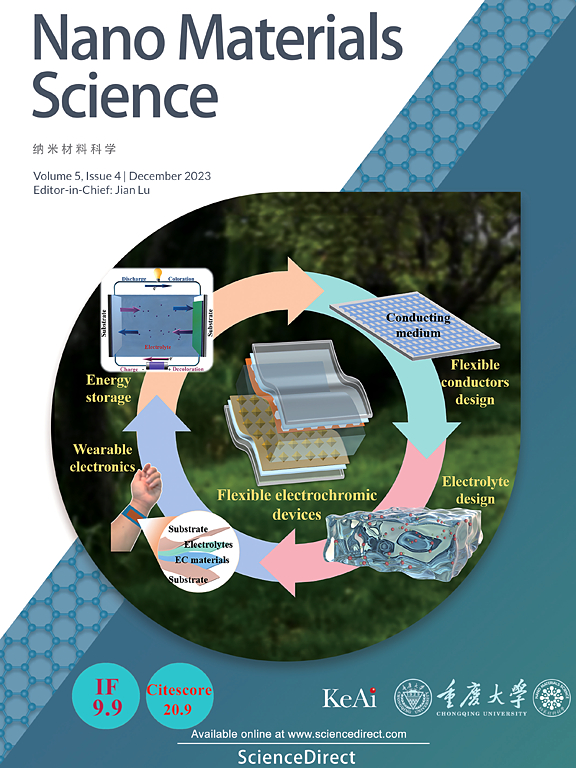
Nano Materials Science
Nano Materials Science Engineering-Mechanics of Materials
CiteScore
20.90
自引率
3.00%
发文量
294
审稿时长
9 weeks
期刊介绍: Nano Materials Science (NMS) is an international and interdisciplinary, open access, scholarly journal. NMS publishes peer-reviewed original articles and reviews on nanoscale material science and nanometer devices, with topics encompassing preparation and processing; high-throughput characterization; material performance evaluation and application of material characteristics such as the microstructure and properties of one-dimensional, two-dimensional, and three-dimensional nanostructured and nanofunctional materials; design, preparation, and processing techniques; and performance evaluation technology and nanometer device applications.

×
引用
GB/T 7714-2015
复制
MLA
复制
APA
复制
导出至
BibTeX EndNote RefMan NoteFirst NoteExpress
×
提示
您的信息不完整,为了账户安全,请先补充。
现在去补充
×
提示
您因"违规操作"
具体请查看互助需知
我知道了
×
提示
确定
请完成安全验证×
copy
已复制链接
快去分享给好友吧!
我知道了
右上角分享
点击右上角分享
0
联系我们:info@booksci.cn Book学术提供免费学术资源搜索服务,方便国内外学者检索中英文文献。致力于提供最便捷和优质的服务体验。 Copyright © 2023 布克学术 All rights reserved.
京ICP备2023020795号-1
ghs 京公网安备 11010802042870号
Book学术文献互助
Book学术文献互助群
群 号:604180095
Book学术官方微信
小红书


