{"title":"Network analysis of changes in post-migration stressors during treatment for refugees with PTSD.","authors":"Maja Bruhn, Henriette Laugesen Attardo, Tobias Spiller, Carsten Hjorthøj, Lene Falgaard Eplov, Jessica Carlsson","doi":"10.1080/20008066.2026.2613554","DOIUrl":null,"url":null,"abstract":"<p><p><b>Background:</b> Refugees resettled in high-income countries are at high risk of post-traumatic stress disorder (PTSD) and often face multiple post-migration stressors that can influence symptom severity. While individual and cumulative effects of these stressors have been examined, little is known about how they interact and change during treatment.<b>Objective:</b> To investigate changes in the structure and interconnections of post-migration stressors among refugees with PTSD before and after mental health treatment.<b>Method:</b> Participants were refugees with PTSD receiving multidisciplinary treatment at a specialised mental health clinic in Denmark, as part of a randomised controlled trial. The Post-Migration Living Difficulties Checklist (17-item Danish version) (PMLD) was completed pre- and post-treatment. Partial correlation networks were estimated for each time point, with network comparison test assessing changes in global network connectivity. Predictability of individual stressors and paired-sample t-tests for item-level change were also conducted.<b>Results:</b> Global network connectivity increased significantly from pre- to post-treatment (<i>p</i> = .004), suggesting stronger interrelations among stressors over time. Overall PMLD score did not change from pre- to post-treatment, but on item-level, financial and housing-related stress decreased (<i>p</i> = .006; <i>p</i> = .028), while concerns about returning to the country of origin in an emergency increased (<i>p</i> = .028).<b>Discussion:</b> Post-migration stressors became more interconnected during treatment, underscoring the need to address them not as isolated issues but as interdependent, mutually reinforcing challenges shaped by cultural and structural contexts. Clinically, effective support for trauma-affected refugees requires multi-level interventions that integrate legal, social, and economic determinants alongside mental health care.</p>","PeriodicalId":12055,"journal":{"name":"European Journal of Psychotraumatology","volume":"17 1","pages":"2613554"},"PeriodicalIF":4.1000,"publicationDate":"2026-12-01","publicationTypes":"Journal Article","fieldsOfStudy":null,"isOpenAccess":false,"openAccessPdf":"https://www.ncbi.nlm.nih.gov/pmc/articles/PMC12836408/pdf/","citationCount":"0","resultStr":null,"platform":"Semanticscholar","paperid":null,"PeriodicalName":"European Journal of Psychotraumatology","FirstCategoryId":"3","ListUrlMain":"https://doi.org/10.1080/20008066.2026.2613554","RegionNum":2,"RegionCategory":"医学","ArticlePicture":[],"TitleCN":null,"AbstractTextCN":null,"PMCID":null,"EPubDate":"2026/1/26 0:00:00","PubModel":"Epub","JCR":"Q1","JCRName":"PSYCHIATRY","Score":null,"Total":0}
引用次数: 0
Abstract
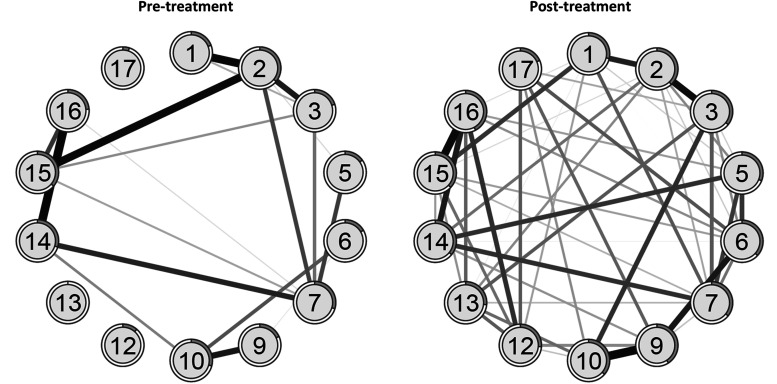
Background: Refugees resettled in high-income countries are at high risk of post-traumatic stress disorder (PTSD) and often face multiple post-migration stressors that can influence symptom severity. While individual and cumulative effects of these stressors have been examined, little is known about how they interact and change during treatment.Objective: To investigate changes in the structure and interconnections of post-migration stressors among refugees with PTSD before and after mental health treatment.Method: Participants were refugees with PTSD receiving multidisciplinary treatment at a specialised mental health clinic in Denmark, as part of a randomised controlled trial. The Post-Migration Living Difficulties Checklist (17-item Danish version) (PMLD) was completed pre- and post-treatment. Partial correlation networks were estimated for each time point, with network comparison test assessing changes in global network connectivity. Predictability of individual stressors and paired-sample t-tests for item-level change were also conducted.Results: Global network connectivity increased significantly from pre- to post-treatment (p = .004), suggesting stronger interrelations among stressors over time. Overall PMLD score did not change from pre- to post-treatment, but on item-level, financial and housing-related stress decreased (p = .006; p = .028), while concerns about returning to the country of origin in an emergency increased (p = .028).Discussion: Post-migration stressors became more interconnected during treatment, underscoring the need to address them not as isolated issues but as interdependent, mutually reinforcing challenges shaped by cultural and structural contexts. Clinically, effective support for trauma-affected refugees requires multi-level interventions that integrate legal, social, and economic determinants alongside mental health care.
期刊介绍:
The European Journal of Psychotraumatology (EJPT) is a peer-reviewed open access interdisciplinary journal owned by the European Society of Traumatic Stress Studies (ESTSS). The European Journal of Psychotraumatology (EJPT) aims to engage scholars, clinicians and researchers in the vital issues of how to understand, prevent and treat the consequences of stress and trauma, including but not limited to, posttraumatic stress disorder (PTSD), depressive disorders, substance abuse, burnout, and neurobiological or physical consequences, using the latest research or clinical experience in these areas. The journal shares ESTSS’ mission to advance and disseminate scientific knowledge about traumatic stress. Papers may address individual events, repeated or chronic (complex) trauma, large scale disasters, or violence. Being open access, the European Journal of Psychotraumatology is also evidence of ESTSS’ stand on free accessibility of research publications to a wider community via the web. The European Journal of Psychotraumatology seeks to attract contributions from academics and practitioners from diverse professional backgrounds, including, but not restricted to, those in mental health, social sciences, and health and welfare services. Contributions from outside Europe are welcome. The journal welcomes original basic and clinical research articles that consolidate and expand the theoretical and professional basis of the field of traumatic stress; Review articles including meta-analyses; short communications presenting new ideas or early-stage promising research; study protocols that describe proposed or ongoing research; case reports examining a single individual or event in a real‑life context; clinical practice papers sharing experience from the clinic; letters to the Editor debating articles already published in the Journal; inaugural Lectures; conference abstracts and book reviews. Both quantitative and qualitative research is welcome.


 求助内容:
求助内容: 应助结果提醒方式:

 京公网安备 11010802042870号


