Xing Wu , Huiling Peng , Lei Zhang , Yaheng Geng , Zehao Yu , Mengjiao Li , Yuhong Nie , Zichao Yan , Mingshan Han , Yuxiang Hu , Zhiqiang Zhu
{"title":"Scalable and universal synthesis of hierarchical organic/carbon composites towards practical organic batteries","authors":"Xing Wu , Huiling Peng , Lei Zhang , Yaheng Geng , Zehao Yu , Mengjiao Li , Yuhong Nie , Zichao Yan , Mingshan Han , Yuxiang Hu , Zhiqiang Zhu","doi":"10.1016/j.esci.2025.100474","DOIUrl":null,"url":null,"abstract":"<div><div>Organic electrode materials with renewability, environmental benignity, and structural tunability have attracted increasing attention for lithium-ion batteries, but their practical application is hindered by low mass loadings (< 2 mg cm<sup>−2</sup>) and inadequate areal capacities (< 0.5 mAh cm<sup>−2</sup>), primarily due to low electronic conductivity and sluggish ion diffusion. Here, we address these limitations by introducing a scalable spray-drying method to synthesize hierarchical organic/carbon composites. By using lithium terephthalate (Li<sub>2</sub>TP), carbon nanotubes (CNTs), and polyvinylpyrrolidone as precursors, we fabricate Li<sub>2</sub>TP-H, a composite featuring Li<sub>2</sub>TP nanoparticles (∼20 nm) assembled into microspheres with 3D CNTs networks. This hierarchical design ensures efficient ion and electron transport, yielding a high capacity retention of 91.6% (from 298 to 273 mAh g<sup>−1</sup>) when increasing mass loading from 2 to 43 mg cm<sup>−2</sup>. The resulting areal capacity of 11.7 mAh cm<sup>−2</sup> ranks among the highest reported for organic electrodes. Moreover, the methodology is extendable to other carboxylate-based compounds, with all derivatives exhibiting enhanced performance under a high-mass-loading of 10 mg cm<sup>−2</sup>. This work provides a new paradigm for developing high-areal-capacity organic electrodes, representing a pivotal step toward commercializing organic battery technologies.</div></div>","PeriodicalId":100489,"journal":{"name":"eScience","volume":"6 2","pages":"Article 100474"},"PeriodicalIF":36.6000,"publicationDate":"2026-03-01","publicationTypes":"Journal Article","fieldsOfStudy":null,"isOpenAccess":false,"openAccessPdf":"","citationCount":"0","resultStr":null,"platform":"Semanticscholar","paperid":null,"PeriodicalName":"eScience","FirstCategoryId":"1085","ListUrlMain":"https://www.sciencedirect.com/science/article/pii/S2667141725001041","RegionNum":0,"RegionCategory":null,"ArticlePicture":[],"TitleCN":null,"AbstractTextCN":null,"PMCID":null,"EPubDate":"2025/9/17 0:00:00","PubModel":"Epub","JCR":"Q1","JCRName":"ELECTROCHEMISTRY","Score":null,"Total":0}
引用次数: 0
Abstract
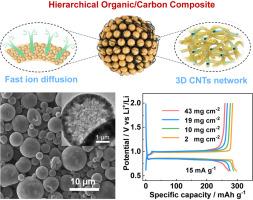
Organic electrode materials with renewability, environmental benignity, and structural tunability have attracted increasing attention for lithium-ion batteries, but their practical application is hindered by low mass loadings (< 2 mg cm−2) and inadequate areal capacities (< 0.5 mAh cm−2), primarily due to low electronic conductivity and sluggish ion diffusion. Here, we address these limitations by introducing a scalable spray-drying method to synthesize hierarchical organic/carbon composites. By using lithium terephthalate (Li2TP), carbon nanotubes (CNTs), and polyvinylpyrrolidone as precursors, we fabricate Li2TP-H, a composite featuring Li2TP nanoparticles (∼20 nm) assembled into microspheres with 3D CNTs networks. This hierarchical design ensures efficient ion and electron transport, yielding a high capacity retention of 91.6% (from 298 to 273 mAh g−1) when increasing mass loading from 2 to 43 mg cm−2. The resulting areal capacity of 11.7 mAh cm−2 ranks among the highest reported for organic electrodes. Moreover, the methodology is extendable to other carboxylate-based compounds, with all derivatives exhibiting enhanced performance under a high-mass-loading of 10 mg cm−2. This work provides a new paradigm for developing high-areal-capacity organic electrodes, representing a pivotal step toward commercializing organic battery technologies.
具有可再生性、环境友好性和结构可调性的有机电极材料越来越受到锂离子电池的关注,但其实际应用受到低质量负载(< 2mg cm - 2)和面积容量(< 0.5 mAh cm - 2)的阻碍,主要是由于电子电导率低和离子扩散缓慢。在这里,我们通过引入一种可扩展的喷雾干燥方法来合成分层有机/碳复合材料来解决这些限制。通过使用对苯二甲酸锂(Li2TP)、碳纳米管(CNTs)和聚乙烯吡咯烷酮作为前体,我们制备了Li2TP- h,这是一种将Li2TP纳米颗粒(~ 20 nm)组装成具有3D碳纳米管网络的微球的复合材料。这种分层设计确保了高效的离子和电子传输,当质量负载从2增加到43 mg cm - 2时,产生91.6%的高容量保留(从298到273 mAh g - 1)。所得的面积容量为11.7 mAh cm−2,是有机电极中最高的。此外,该方法可扩展到其他羧酸基化合物,所有衍生物在10 mg cm−2的高质量负载下表现出增强的性能。这项工作为开发高面积容量有机电极提供了一个新的范例,代表了有机电池技术商业化的关键一步。


 求助内容:
求助内容: 应助结果提醒方式:

 京公网安备 11010802042870号


