
Integration of causal deep learning for tide level forecasting in data-scarce coasts
IF 2.8
3区 地球科学
Q1 MARINE & FRESHWATER BIOLOGY
Estuarine Coastal and Shelf Science
Pub Date : 2026-03-01
Epub Date: 2026-01-17
DOI:10.1016/j.ecss.2026.109715
引用次数: 0
Abstract
Accurate prediction of tide gauge heights is crucial for effective coastal risk management, especially in data-scarce regions like Oman, where monitoring networks are limited. High Tide Flooding (HTF) behavior on Masirah Island is investigated in this study by combining meteorological records and a cutting-edge causal deep learning model. We compare four models—Gated Recurrent Unit (GRU), Long Short-Term Memory (LSTM), its variant Bidirectional LSTM (Bi-LSTM), Temporal Convolutional Network (TCN), and a newly developed Causal-Bi-LSTM—for their suitability in modeling tide gauge levels using precipitation, temperature, wind speed, and sea level pressure derived from ERA5-Land climate variables. Our study reveals that HTF events are highly seasonal, with 70 % occurring in June, primarily due to the combined effects of tidal (median contribution: 53.24 %) and non-tidal residual (110.57 %) effects. The Causal-Bi-LSTM model performed best (Nash–Sutcliffe Efficiency = 0.961, Correlation Coefficient = 0.99) when incorporating physical constraints, while sensitivity analysis revealed that sea level pressure was the key driver. Future projections under SSP scenarios unveil alarming trends: while SSP126 maintains conditions relatively stable, SSP245 and SSP585 exhibit intensification and seasonality in HTF events, with the high emission scenario (SSP585) projecting 36 events by mid-century and extending vulnerability to months not affected before. These results highlight the need for region-specific adaptation strategies and reveal how causal deep learning can enhance flood forecasting in terms of both accuracy and physical interpretability. The study provides a methodology for coastal vulnerability assessment that can be applied to other data-scarce regions with rising flood hazards under climate change.

基于因果深度学习的海岸潮位预测
潮汐计高度的准确预测对于有效的沿海风险管理至关重要,特别是在监测网络有限的阿曼等数据匮乏的地区。本研究通过结合气象记录和前沿的因果深度学习模型,研究了Masirah岛的涨潮洪水(HTF)行为。我们比较了门控循环单元(GRU)、长短期记忆(LSTM)、双向LSTM (Bi-LSTM)、时间卷积网络(TCN)和新开发的因果-Bi-LSTM四种模型在利用era5陆地气候变量衍生的降水、温度、风速和海平面压力模拟潮汐计水位方面的适用性。研究表明,6月份HTF事件具有很强的季节性,其中70%发生在6月份,主要是潮汐(贡献中值为53.24%)和非潮汐残留(贡献中值为110.57%)的共同作用。考虑物理因素时,因果关系- bi - lstm模型表现最佳(Nash-Sutcliffe效率= 0.961,相关系数= 0.99),而敏感性分析显示海平面压力是主要驱动因素。SSP情景下的未来预测揭示了令人担忧的趋势:虽然SSP126保持条件相对稳定,但SSP245和SSP585在HTF事件中表现出加剧和季节性,高排放情景(SSP585)预测到本世纪中叶将发生36次事件,并将脆弱性扩大到以前未受影响的月份。这些结果强调了对特定区域适应策略的需求,并揭示了因果深度学习如何在准确性和物理可解释性方面提高洪水预测。该研究为沿海脆弱性评估提供了一种方法,可应用于气候变化下洪水灾害增加的其他数据稀缺地区。
本文章由计算机程序翻译,如有差异,请以英文原文为准。
求助全文
约1分钟内获得全文
求助全文
来源期刊
CiteScore
5.60
自引率
7.10%
发文量
374
审稿时长
9 months
期刊介绍:
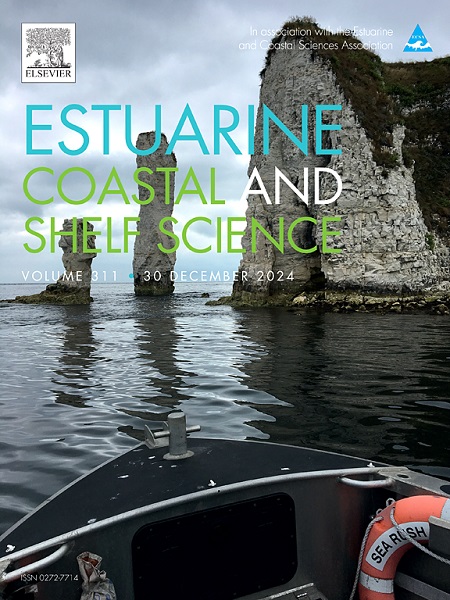
Estuarine, Coastal and Shelf Science is an international multidisciplinary journal devoted to the analysis of saline water phenomena ranging from the outer edge of the continental shelf to the upper limits of the tidal zone. The journal provides a unique forum, unifying the multidisciplinary approaches to the study of the oceanography of estuaries, coastal zones, and continental shelf seas. It features original research papers, review papers and short communications treating such disciplines as zoology, botany, geology, sedimentology, physical oceanography.
 求助内容:
 应助结果提醒方式:


 京公网安备 11010802042870号


