
Quantitative assessment of active tectonics of Chittagong-Tripura Fold Belt, Bengal Basin, Bangladesh

Geosystems and Geoenvironment Pub Date : 2026-05-01 Epub Date: 2026-01-13 DOI:10.1016/j.geogeo.2026.100493
Md. Sakawat Hossain , Mery Biswas , Md. Sharif Hossain Khan , Dilruba Yesmin Shetu , Probir Biswas , Zakia Sultana
{"title":"Quantitative assessment of active tectonics of Chittagong-Tripura Fold Belt, Bengal Basin, Bangladesh","authors":"Md. Sakawat Hossain ,&nbsp;Mery Biswas ,&nbsp;Md. Sharif Hossain Khan ,&nbsp;Dilruba Yesmin Shetu ,&nbsp;Probir Biswas ,&nbsp;Zakia Sultana","doi":"10.1016/j.geogeo.2026.100493","DOIUrl":null,"url":null,"abstract":"<div><div>The Chittagong-Tripura Fold Belt (CTFB) is part of the active accretionary wedge of the Indo-Burman Ranges (IBR), spanning more than 100 km in width. Although the tectonic evolution and signature of active tectonics are evident from tectonogeomorphic and structural features, the assessment of active tectonics in the CTFB area—especially along the Chittagong Coastal Fault (CCF) and Kaladan Fault—remains limited. The present study attempts to comprehensively analyze fracture orientations and geomorphic features of the area to assess the level of active tectonics. The WSW-ENE generalized compressional direction, deciphered from the fracture set analysis, represents the normal component of present-day Indian Plate motion. Different morphometric parameter values of the seven watresheds in the CTFB area assign the range of the index of active tectonics (IAT): Class 1 is highly active (1.375–1.500), Class 2 is moderately active (1.501–1.875), and Class 3 is low/less active (1.876–2.250). The best-fit curves with the power-law (<em>R</em><sup>2</sup> values) for linear, exponential, logarithmic, and power functions for seven master streams from seven watersheds and sixteen other streams from four different regions reflect the relative levels of active tectonics. Overall, the western margin of the CTFB along the Frontal Thrust/CCF appears to be relatively more active than the eastern margin along the Kaladan Fault and is therefore more prone to seismic hazards.</div></div>","PeriodicalId":100582,"journal":{"name":"Geosystems and Geoenvironment","volume":"5 2","pages":"Article 100493"},"PeriodicalIF":0.0000,"publicationDate":"2026-05-01","publicationTypes":"Journal Article","fieldsOfStudy":null,"isOpenAccess":false,"openAccessPdf":"","citationCount":"0","resultStr":null,"platform":"Semanticscholar","paperid":null,"PeriodicalName":"Geosystems and Geoenvironment","FirstCategoryId":"1085","ListUrlMain":"https://www.sciencedirect.com/science/article/pii/S277288382600004X","RegionNum":0,"RegionCategory":null,"ArticlePicture":[],"TitleCN":null,"AbstractTextCN":null,"PMCID":null,"EPubDate":"2026/1/13 0:00:00","PubModel":"Epub","JCR":"","JCRName":"","Score":null,"Total":0}
引用次数: 0

Abstract

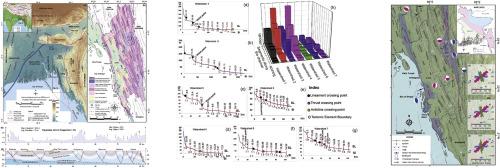
The Chittagong-Tripura Fold Belt (CTFB) is part of the active accretionary wedge of the Indo-Burman Ranges (IBR), spanning more than 100 km in width. Although the tectonic evolution and signature of active tectonics are evident from tectonogeomorphic and structural features, the assessment of active tectonics in the CTFB area—especially along the Chittagong Coastal Fault (CCF) and Kaladan Fault—remains limited. The present study attempts to comprehensively analyze fracture orientations and geomorphic features of the area to assess the level of active tectonics. The WSW-ENE generalized compressional direction, deciphered from the fracture set analysis, represents the normal component of present-day Indian Plate motion. Different morphometric parameter values of the seven watresheds in the CTFB area assign the range of the index of active tectonics (IAT): Class 1 is highly active (1.375–1.500), Class 2 is moderately active (1.501–1.875), and Class 3 is low/less active (1.876–2.250). The best-fit curves with the power-law (R2 values) for linear, exponential, logarithmic, and power functions for seven master streams from seven watersheds and sixteen other streams from four different regions reflect the relative levels of active tectonics. Overall, the western margin of the CTFB along the Frontal Thrust/CCF appears to be relatively more active than the eastern margin along the Kaladan Fault and is therefore more prone to seismic hazards.
Abstract Image

孟加拉盆地吉大港-特里普拉褶皱带活动构造定量评价
吉大港-特里普拉褶皱带(CTFB)是印度-缅甸山脉(IBR)活动增生楔的一部分,宽度超过100公里。尽管构造地貌和构造特征显示出明显的构造演化和活动构造特征,但对CTFB地区特别是吉大港海岸断裂和卡拉丹断裂的活动构造评价仍然有限。本研究试图综合分析该区的裂缝走向和地貌特征,以评价该区的活动构造水平。从断裂集分析中破译出的WSW-ENE广义挤压方向代表了现今印度板块运动的正向分量。CTFB地区7个流域的不同形态参数值分配了活动构造指数(IAT)的范围:1级为高度活动(1.375 ~ 1.500),2级为中度活动(1.501 ~ 1.875),3级为低/弱活动(1.876 ~ 2.250)。7个流域的7条主要河流和4个不同地区的16条其他河流的线性、指数、对数和幂函数的最佳拟合曲线(R2值)反映了活动构造的相对水平。总体而言,沿锋面逆冲/CCF的CTFB西缘似乎比沿卡拉丹断层的东缘相对更活跃,因此更容易发生地震灾害。
本文章由计算机程序翻译,如有差异,请以英文原文为准。
求助全文
约1分钟内获得全文 求助全文
来源期刊
CiteScore
4.70
自引率
0.00%
发文量
0
×
引用
GB/T 7714-2015
复制
MLA
复制
APA
复制
导出至
BibTeX EndNote RefMan NoteFirst NoteExpress
×
提示
您的信息不完整,为了账户安全,请先补充。
现在去补充
×
提示
您因"违规操作"
具体请查看互助需知
我知道了
×
提示
确定
请完成安全验证×
copy
已复制链接
快去分享给好友吧!
我知道了
右上角分享
点击右上角分享
0
联系我们:info@booksci.cn Book学术提供免费学术资源搜索服务,方便国内外学者检索中英文文献。致力于提供最便捷和优质的服务体验。 Copyright © 2023 布克学术 All rights reserved.
京ICP备2023020795号-1
ghs 京公网安备 11010802042870号
Book学术文献互助
Book学术文献互助群
群 号:604180095
Book学术官方微信
小红书



