
Astronomical and greenhouse gas configuration from past to future simulation: An analysis of sea surface temperature's impact on sea levels in Indonesia
Geosystems and Geoenvironment
Pub Date : 2026-05-01
Epub Date: 2025-11-20
DOI:10.1016/j.geogeo.2025.100480
引用次数: 0
Abstract
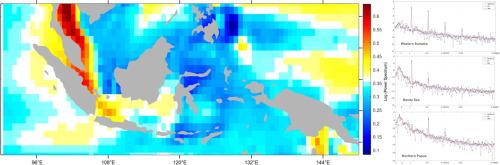
Climate change and steric variables influence sea level rise in the modern era. This study used the Community Climate System Model version 4 (CCSM4) to compare sea surface temperature (SST) and sea level height (SSH) in Indonesia during the mid-Holocene (MH), pre-industrial (PI), and future periods in 2300 with Representative Concentration Pathways 8.5 (RCP8.5). The results show that the average SST value is lower in the MH, with a change in values of around −1°C in the MAM season and increases in the future by around 2°C, whereas the average SSH value is lower in the MH with a change in values of around −0.1 m during the SON season in Western Sumatra and increases in the future over the SON season by around 0.1 m in Northern Papua, compared to PI. The average correlation between the two metrics is positive, with values of 0.55 (MH-PI) and 0.8 (RCP8.5-PI). SST and SSH climatological patterns in Western Sumatra, the Banda Sea, and Northern Papua reveal that SST and SSH fall during the JJA season and increase during the SON season, respectively. This fluctuation is produced by either a lag in insolation or the winter remnant effect. Signal analysis with Fourier transform reveals that the major signal spectrum for changes in SST and SSH is contributed by annual and semi-annual periodicity in the three regions. A notable interannual periodicity exists; however, it is not predominant, leading to variable interannual influences on SST and SSH in Indonesia.
从过去到未来模拟的天文和温室气体配置:印尼海面温度对海平面影响的分析
气候变化和空间变量影响现代海平面上升。本研究利用社区气候系统模式第4版(CCSM4)比较了印度尼西亚在全新世中期(MH)、工业化前(PI)和2300年未来时期的海表温度(SST)和海平面高度(SSH)与代表性浓度路径8.5 (RCP8.5)。结果表明,与PI相比,MH的平均海表温度较低,在MAM季节变化约为−1°C,未来增加约2°C;而MH的平均海表温度较低,在苏门答腊西部的SON季节变化约为−0.1 m,在巴布亚北部的SON季节增加约0.1 m。两个指标的平均相关性为正,分别为0.55 (MH-PI)和0.8 (RCP8.5-PI)。苏门答腊西部、班达海和巴布亚北部的海温和海面高度气候特征表明,JJA季海温和海面高度分别下降,SON季海温和海面高度分别上升。这种波动是由日照滞后或冬季残余效应造成的。傅里叶变换信号分析表明,海表温度和海面高度变化的主要信号谱由三个区域的年周期性和半年周期性贡献。存在显著的年际周期性;然而,它并不占主导地位,导致印尼海温和海平面的年际影响变化。
本文章由计算机程序翻译,如有差异,请以英文原文为准。
求助全文
约1分钟内获得全文
求助全文

 求助内容:
求助内容: 应助结果提醒方式:

 京公网安备 11010802042870号


