
Hierarchically organized carbon-modified sea-urchin NiCo2O4 electrodes for high-performance symmetric supercapacitors
IF 5.1
3区 材料科学
Q2 MATERIALS SCIENCE, COATINGS & FILMS
Diamond and Related Materials
Pub Date : 2026-03-01
Epub Date: 2026-01-19
DOI:10.1016/j.diamond.2026.113335
引用次数: 0
Abstract
Systematic experimental studies were conducted to engineer optimized composite electrode structures for high-performance supercapacitors. Sea urchin-shaped NiCo2O4 (NICO) nanostructures were combined with two carbonaceous materials, activated carbon (AC) and multi-walled carbon nanotubes (MWCNTs), to maximize electrochemical properties. NICO/AC and NICO/MWCNT composites were fabricated using a physical blending technique. The two symmetric supercapacitor cell configurations NICO/AC||NICO/AC and NICO/MWCNT||NICO/MWCNT were fabricated. Among the above devices, the NICO/MWCNT-based device exhibited superior electrochemical performance with a high specific capacitance of 514 F g−1 at discharge current density of 2 A g−1, and exceptional energy density of 29.4 Wh kg−1 and power density of 4000 W kg−1. Notably, the device maintained 92.1% of its original capacitance after 4000 cycles with tremendous stability. Additionally, a 2032-coin cell device made of the optimized composite powered a blue LED uninterrupted for 35 min, which proves its feasibility for practical energy storage applications. These findings validate carbon-decorated sea urchin-shaped NiCo2O4 as an effective electrode material for prospective high-energy technologies.
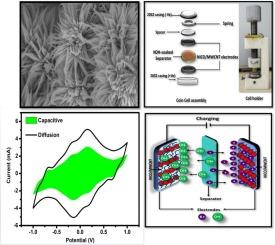
用于高性能对称超级电容器的分层组织碳修饰海胆NiCo2O4电极
为了优化高性能超级电容器的复合电极结构,进行了系统的实验研究。将海胆形状的NiCo2O4 (NICO)纳米结构与活性炭(AC)和多壁碳纳米管(MWCNTs)两种碳质材料结合,以最大限度地提高电化学性能。采用物理共混技术制备NICO/AC和NICO/MWCNT复合材料。制备了NICO/AC||NICO/AC和NICO/MWCNT||NICO/MWCNT两种对称的超级电容器电池结构。在上述器件中,NICO/ mwcnts基器件表现出优异的电化学性能,在放电电流密度为2 a g−1时具有514 F g−1的高比电容,能量密度为29.4 Wh kg−1,功率密度为4000 W kg−1。值得注意的是,该器件在4000次循环后保持了92.1%的原始电容,并具有极大的稳定性。此外,由优化的复合材料制成的2032硬币电池装置为蓝色LED不间断供电35分钟,这证明了其在实际储能应用中的可行性。这些发现证实了碳装饰海胆形状的NiCo2O4是未来高能技术的有效电极材料。
本文章由计算机程序翻译,如有差异,请以英文原文为准。
求助全文
约1分钟内获得全文
求助全文
来源期刊
Diamond and Related Materials
工程技术-材料科学:综合
CiteScore
6.00
自引率
14.60%
发文量
702
审稿时长
2.1 months
期刊介绍:
DRM is a leading international journal that publishes new fundamental and applied research on all forms of diamond, the integration of diamond with other advanced materials and development of technologies exploiting diamond. The synthesis, characterization and processing of single crystal diamond, polycrystalline films, nanodiamond powders and heterostructures with other advanced materials are encouraged topics for technical and review articles. In addition to diamond, the journal publishes manuscripts on the synthesis, characterization and application of other related materials including diamond-like carbons, carbon nanotubes, graphene, and boron and carbon nitrides. Articles are sought on the chemical functionalization of diamond and related materials as well as their use in electrochemistry, energy storage and conversion, chemical and biological sensing, imaging, thermal management, photonic and quantum applications, electron emission and electronic devices.
The International Conference on Diamond and Carbon Materials has evolved into the largest and most well attended forum in the field of diamond, providing a forum to showcase the latest results in the science and technology of diamond and other carbon materials such as carbon nanotubes, graphene, and diamond-like carbon. Run annually in association with Diamond and Related Materials the conference provides junior and established researchers the opportunity to exchange the latest results ranging from fundamental physical and chemical concepts to applied research focusing on the next generation carbon-based devices.
 求助内容:
求助内容: 应助结果提醒方式:

 京公网安备 11010802042870号


