
Emerging multi-omics biomarkers in glioblastoma: Integrative insights from genomics to metabolomics
IF 9.7
1区 医学
Q1 BIOCHEMISTRY & MOLECULAR BIOLOGY
Biochimica et biophysica acta. Reviews on cancer
Pub Date : 2026-04-01
Epub Date: 2026-01-21
DOI:10.1016/j.bbcan.2026.189540
引用次数: 0
Abstract
Glioblastoma (GBM) is the most malignant form of primary brain tumor in adults, described by profound molecular heterogeneity, rapid progression, and limited therapeutic response. Despite advances in chemotherapy (TMZ), radiotherapy, and surgery, patient outcomes remain poor, with a median survival of 12–15 months. Traditional single-omics studies have identified critical biomarkers such as IDH mutations, MGMT promoter methylation, and EGFR alterations; however, these provide only partial insight into the disease's complexity. Recent integrative multi-omics approaches encompassing genomics, transcriptomics, epigenomics, proteomics, metabolomics, and non-coding RNAs have transformed the landscape of biomarker discovery in GBM. Genomic profiling has revealed recurrent mutations and subtype-specific aberrations, while transcriptomic analyses refine molecular classification and uncover alternative splicing and fusion events. Epigenomic markers, particularly MGMT methylation and G-CIMP status, are now central to prognosis and therapy stratification. Proteomic and metabolomic studies highlight dysregulated pathways, metabolic vulnerabilities, and non-invasive biomarkers in cerebrospinal fluid and plasma. Integrating multi-omics data not only improves diagnostic and prognostic accuracy but also unveils therapeutic targets, offering opportunities for precision oncology. Furthermore, liquid biopsy and single-cell/spatial omics enhance real-time monitoring of disease progression and treatment response, addressing challenges posed by intratumoral heterogeneity. This review synthesizes recent advances in GBM biomarker research across multiple omics layers, emphasizing their complementary roles in unravelling tumor biology, guiding personalized treatment, and shaping future therapeutic strategies.
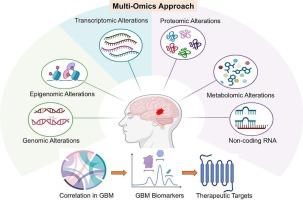
胶质母细胞瘤中新兴的多组学生物标志物:从基因组学到代谢组学的综合见解
胶质母细胞瘤(GBM)是成人原发性脑肿瘤中最恶性的形式,具有深刻的分子异质性,快速进展和有限的治疗反应。尽管在化疗(TMZ)、放疗和手术方面取得了进展,但患者的预后仍然很差,中位生存期为12-15个月。传统的单组学研究已经确定了关键的生物标志物,如IDH突变、MGMT启动子甲基化和EGFR改变;然而,这些只提供了对这种疾病复杂性的部分了解。最近,包括基因组学、转录组学、表观基因组学、蛋白质组学、代谢组学和非编码rna在内的综合多组学方法已经改变了GBM生物标志物发现的格局。基因组分析揭示了复发性突变和亚型特异性畸变,而转录组学分析改进了分子分类并揭示了可选择的剪接和融合事件。表观基因组标记,特别是MGMT甲基化和G-CIMP状态,现在是预后和治疗分层的核心。蛋白质组学和代谢组学研究强调了脑脊液和血浆中的失调途径、代谢脆弱性和非侵入性生物标志物。整合多组学数据不仅提高了诊断和预后的准确性,而且揭示了治疗靶点,为精确肿瘤学提供了机会。此外,液体活检和单细胞/空间组学增强了疾病进展和治疗反应的实时监测,解决了肿瘤内异质性带来的挑战。本文综述了GBM生物标志物在多个组学层面的最新研究进展,强调了它们在揭示肿瘤生物学、指导个性化治疗和塑造未来治疗策略方面的互补作用。
本文章由计算机程序翻译,如有差异,请以英文原文为准。
求助全文
约1分钟内获得全文
求助全文
来源期刊
Biochimica et biophysica acta. Reviews on cancer
医学-生化与分子生物学
CiteScore
17.20
自引率
0.00%
发文量
138
审稿时长
33 days
期刊介绍:
Biochimica et Biophysica Acta (BBA) - Reviews on Cancer encompasses the entirety of cancer biology and biochemistry, emphasizing oncogenes and tumor suppressor genes, growth-related cell cycle control signaling, carcinogenesis mechanisms, cell transformation, immunologic control mechanisms, genetics of human (mammalian) cancer, control of cell proliferation, genetic and molecular control of organismic development, rational anti-tumor drug design. It publishes mini-reviews and full reviews.
 求助内容:
求助内容: 应助结果提醒方式:

 京公网安备 11010802042870号


