
Disclosing the dyeing formulations of weld yellows from 18th-century recipe books with molecular fluorescence
IF 4.2
3区 工程技术
Q2 CHEMISTRY, APPLIED
引用次数: 0
Abstract
For millennia, organic dyes have been used in artworks such as textiles and have great artistic and historic value. They may provide clues to the understanding of the technology behind an artwork's production. The characterization of natural organic colourants in artworks is still a challenge to this day, and of the natural dyes used in cultural heritage, yellows are some of the most difficult to identify.
This paper explores the potential of combining molecular fluorescence in the visible range with high-performance liquid chromatography coupled with diode-array detection, to disclose historical dye formulations.
By analysing historically accurate reconstructions following recipes from two 18th c. French master dyers, Antoine Janot and Paul Gout, it was possible to demonstrate that molecular fluorescence is highly sensitive to the presence of specific dye ingredients and different use of recipes. Luteolin (Lut) and Luteolin 7-O-glucoside (Lut-7-O-glc) were identified as the main compounds, with the first being extracted in higher amounts, especially in Janot's variations. The analytical data demonstrated that molecular fluorescence is very sensitive to recipe differences: the presence of tartar correlated with a higher Lut presence, and the use of lime induced a slight shift in the emission maxima, even without affecting the spectral shape due to the exhaustion of molecules in the dye bath. Moreover, our findings revealed technological insights, showing that Paul Gout's optimized recipes achieved comparable yellow tonality to Janot's using a lower percentage of weld. This will provide key knowledge on the technological processes for dyeing with weld from these 18th c. French masters, while creating a molecular fluorescence database for the analysis of artworks.
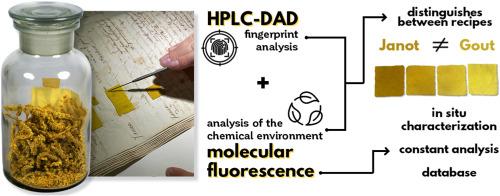
利用分子荧光技术,公开了18世纪配方书中焊缝黄的染色配方
几千年来,有机染料一直用于纺织品等艺术品,具有很高的艺术和历史价值。它们可能为理解艺术品生产背后的技术提供线索。时至今日,艺术作品中天然有机色素的特征仍然是一个挑战,在文化遗产中使用的天然染料中,黄色是最难识别的。本文探讨了将可见范围内的分子荧光与高效液相色谱和二极管阵列检测相结合,揭示历史染料配方的潜力。通过分析两位18世纪法国染色大师Antoine Janot和Paul Gout的配方,历史上准确的重建有可能证明分子荧光对特定染料成分的存在和不同配方的使用高度敏感。木犀草素(Lut)和木犀草素7- o -葡糖苷(Lut-7- o -glc)是主要的化合物,其中木犀草素的含量较高,尤其是在雅诺氏变种中。分析数据表明,分子荧光对配方差异非常敏感:酒石的存在与较高的Lut存在相关,石灰的使用诱导了发射最大值的轻微变化,即使没有由于染料浴中分子耗尽而影响光谱形状。此外,我们的研究结果揭示了技术见解,表明Paul Gout的优化配方使用较低的焊缝百分比实现了与Janot相当的黄色色调。这将提供这些18世纪法国大师的焊接染色技术过程的关键知识,同时创建一个用于艺术品分析的分子荧光数据库。
本文章由计算机程序翻译,如有差异,请以英文原文为准。
求助全文
约1分钟内获得全文
求助全文
来源期刊
Dyes and Pigments
工程技术-材料科学:纺织
CiteScore
8.20
自引率
13.30%
发文量
933
审稿时长
33 days
期刊介绍:
Dyes and Pigments covers the scientific and technical aspects of the chemistry and physics of dyes, pigments and their intermediates. Emphasis is placed on the properties of the colouring matters themselves rather than on their applications or the system in which they may be applied.
Thus the journal accepts research and review papers on the synthesis of dyes, pigments and intermediates, their physical or chemical properties, e.g. spectroscopic, surface, solution or solid state characteristics, the physical aspects of their preparation, e.g. precipitation, nucleation and growth, crystal formation, liquid crystalline characteristics, their photochemical, ecological or biological properties and the relationship between colour and chemical constitution. However, papers are considered which deal with the more fundamental aspects of colourant application and of the interactions of colourants with substrates or media.
The journal will interest a wide variety of workers in a range of disciplines whose work involves dyes, pigments and their intermediates, and provides a platform for investigators with common interests but diverse fields of activity such as cosmetics, reprographics, dye and pigment synthesis, medical research, polymers, etc.
 求助内容:
求助内容: 应助结果提醒方式:

 京公网安备 11010802042870号


