
Insights into citrus peel cellulose nanofiber enhanced pea protein isolate emulsion gels: Mechanical properties, microstructure, and gelation mechanism
IF 11
1区 农林科学
Q1 CHEMISTRY, APPLIED
引用次数: 0
Abstract
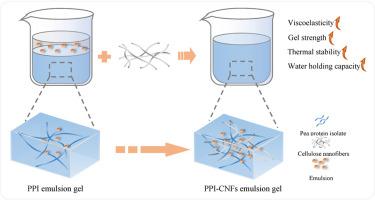
Pea protein isolate (PPI), known for its high nutritional quality and low allergenicity, exhibits limited applicability in emulsion gel systems due to its weak gel-forming ability. In this work, the influence of citrus peel-derived cellulose nanofibers (CNFs) on the gelling behavior and structural characteristics of PPI emulsion gels was investigated. Rheological and textural analyses indicated that the incorporation of CNFs significantly enhanced the viscoelastic properties and gel strength of PPI-CNFs emulsion gels. Lissajous curve analysis further showed that under low strain (1.0 %), all samples exhibited predominantly elastic behavior, while gels containing CNFs displayed excellent deformation resistance and shear recovery. Thermogravimetric analysis confirmed that CNFs addition enhanced the thermal stability of PPI emulsion gels. Fourier transform infrared spectroscopy revealed the formation of stronger hydrogen bonds between CNFs and PPI molecules. This interaction favored the development of a dense gel network, facilitating the conversion of free water to bound water within the system. Overall, this work offers a sustainable and green strategy to improve the functional and structural properties of legume protein emulsion gels, while promoting the high-value utilization of citrus peel.
柑橘皮纤维素纳米纤维增强豌豆分离蛋白乳液凝胶的研究:机械性能、微观结构和凝胶机制
豌豆分离蛋白(Pea protein isolate, PPI)以其高营养品质和低致敏性而闻名,但由于其弱凝胶形成能力,在乳液凝胶体系中的适用性有限。本文研究了柑橘皮衍生纤维素纳米纤维(CNFs)对PPI乳液凝胶的凝胶行为和结构特性的影响。流变学和结构分析表明,CNFs的加入显著提高了PPI-CNFs乳液凝胶的粘弹性和凝胶强度。Lissajous曲线分析进一步表明,在低应变(1.0%)下,所有样品都表现出主要的弹性行为,而含有CNFs的凝胶具有优异的抗变形和剪切恢复能力。热重分析证实,CNFs的加入增强了PPI乳液凝胶的热稳定性。傅里叶变换红外光谱显示CNFs和PPI分子之间形成了更强的氢键。这种相互作用有利于致密凝胶网络的发展,促进了系统内自由水向结合水的转化。综上所述,本研究为改善豆科蛋白乳液凝胶的功能和结构特性,促进柑橘皮的高价值利用提供了可持续和绿色的策略。
本文章由计算机程序翻译,如有差异,请以英文原文为准。
求助全文
约1分钟内获得全文
求助全文
来源期刊
Food Hydrocolloids
工程技术-食品科技
CiteScore
19.90
自引率
14.00%
发文量
871
审稿时长
37 days
期刊介绍:
Food Hydrocolloids publishes original and innovative research focused on the characterization, functional properties, and applications of hydrocolloid materials used in food products. These hydrocolloids, defined as polysaccharides and proteins of commercial importance, are added to control aspects such as texture, stability, rheology, and sensory properties. The research's primary emphasis should be on the hydrocolloids themselves, with thorough descriptions of their source, nature, and physicochemical characteristics. Manuscripts are expected to clearly outline specific aims and objectives, include a fundamental discussion of research findings at the molecular level, and address the significance of the results. Studies on hydrocolloids in complex formulations should concentrate on their overall properties and mechanisms of action, while simple formulation development studies may not be considered for publication.
The main areas of interest are:
-Chemical and physicochemical characterisation
Thermal properties including glass transitions and conformational changes-
Rheological properties including viscosity, viscoelastic properties and gelation behaviour-
The influence on organoleptic properties-
Interfacial properties including stabilisation of dispersions, emulsions and foams-
Film forming properties with application to edible films and active packaging-
Encapsulation and controlled release of active compounds-
The influence on health including their role as dietary fibre-
Manipulation of hydrocolloid structure and functionality through chemical, biochemical and physical processes-
New hydrocolloids and hydrocolloid sources of commercial potential.
The Journal also publishes Review articles that provide an overview of the latest developments in topics of specific interest to researchers in this field of activity.
 求助内容:
求助内容: 应助结果提醒方式:

 京公网安备 11010802042870号


