
Numerical simulation study on particle migration and clogging behavior in typical pore-throat structures based on the resolved CFD-DEM method
IF 5.5
2区 工程技术
Q2 ENGINEERING, CHEMICAL
引用次数: 0
Abstract
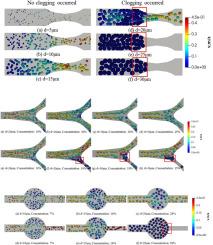
Particle migration and clogging in porous media significantly impact reservoir development and groundwater remediation. However, systematic comparisons of typical pore-throat structures and their influence on particle dynamics remain insufficient. This study employs a fully resolved CFD-DEM-IBM framework integrated with dynamic mesh refinement to simulate particle transport and clogging in three representative pore-throat geometries: constricted, bifurcated, and large-pore throats. Results show that, in constricted pore throat, the propensity for clogging is primarily governed by the particle-to-throat size ratio and the hydrodynamic conditions, with a clear transition observed from free migration to intermittent and finally stable clogging as particle size increases. For bifurcated pore throat, clogging in the narrower branch induces significant flow redistribution and markedly alters the local pressure field. Within large pore throat, particle accumulation leads to complex internal flow patterning and can ultimately result in throat clogging. The proposed model accurately captures clogging dynamics and provides a reference for predicting particle migration and clogging behavior in complex porous media.
基于解析CFD-DEM方法的典型孔喉结构中颗粒迁移与堵塞行为数值模拟研究
多孔介质中的颗粒迁移和堵塞对储层发育和地下水修复具有重要影响。然而,系统比较典型的孔喉结构及其对颗粒动力学的影响仍然不足。本研究采用完全解析的CFD-DEM-IBM框架,结合动态网格细化,模拟三种代表性孔喉几何形状(收缩孔喉、分叉孔喉和大孔喉)中的颗粒传输和堵塞。结果表明,在收缩孔喉中,堵塞倾向主要受颗粒与喉道尺寸比和水动力条件的影响,随着颗粒尺寸的增加,从自由迁移到间歇性堵塞,最后是稳定堵塞的明显转变。对于分叉孔喉,较窄分支的堵塞会引起明显的流动再分布,并显著改变局部压力场。在大孔喉内,颗粒积聚导致复杂的内部流动模式,最终导致孔喉堵塞。该模型准确地捕捉了堵塞动态,为预测复杂多孔介质中的颗粒迁移和堵塞行为提供了参考。
本文章由计算机程序翻译,如有差异,请以英文原文为准。
求助全文
约1分钟内获得全文
求助全文
来源期刊
Powder Technology
工程技术-工程:化工
CiteScore
9.90
自引率
15.40%
发文量
1047
审稿时长
46 days
期刊介绍:
Powder Technology is an International Journal on the Science and Technology of Wet and Dry Particulate Systems. Powder Technology publishes papers on all aspects of the formation of particles and their characterisation and on the study of systems containing particulate solids. No limitation is imposed on the size of the particles, which may range from nanometre scale, as in pigments or aerosols, to that of mined or quarried materials. The following list of topics is not intended to be comprehensive, but rather to indicate typical subjects which fall within the scope of the journal's interests:
Formation and synthesis of particles by precipitation and other methods.
Modification of particles by agglomeration, coating, comminution and attrition.
Characterisation of the size, shape, surface area, pore structure and strength of particles and agglomerates (including the origins and effects of inter particle forces).
Packing, failure, flow and permeability of assemblies of particles.
Particle-particle interactions and suspension rheology.
Handling and processing operations such as slurry flow, fluidization, pneumatic conveying.
Interactions between particles and their environment, including delivery of particulate products to the body.
Applications of particle technology in production of pharmaceuticals, chemicals, foods, pigments, structural, and functional materials and in environmental and energy related matters.
For materials-oriented contributions we are looking for articles revealing the effect of particle/powder characteristics (size, morphology and composition, in that order) on material performance or functionality and, ideally, comparison to any industrial standard.
 求助内容:
求助内容: 应助结果提醒方式:

 京公网安备 11010802042870号


