
Sustainable nanosystems for targeted drug delivery and their impacts on combination therapies and personalized medicine: Advancements and perspectives
IF 5.2
3区 医学
Q1 PHARMACOLOGY & PHARMACY
Journal of Drug Delivery Science and Technology
Pub Date : 2026-03-01
Epub Date: 2026-01-12
DOI:10.1016/j.jddst.2026.108006
引用次数: 0
Abstract
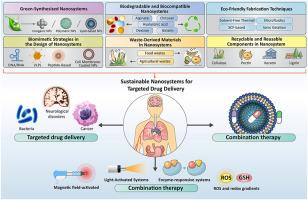
Recent advances in sustainable nanosystems for targeted drug delivery have emphasized biodegradable and biocompatible nanocarriers synthesized through eco-friendly methods to enable precise, controlled, and stimuli-responsive drug release with minimal environmental impact. This review focuses on green-synthesized and sustainable nanocarriers, highlighting emerging strategies that prioritize environmentally responsible design. Eco-friendly fabrication techniques, including microfluidics, solvent-free processes, supercritical fluid methods, and ionic gelation, are discussed for their potential to reduce resource use and environmental burden. Moreover, biomimetic approaches such as cell membrane-coated nanoparticles, virus-like particles, peptide-based nanostructures, and DNA/RNA carriers are examined for their enhanced targeting efficiency and biological compatibility. Besides, the use of waste-derived materials as renewable resources is also explored, reflecting the growing influence of circular economy principles in pharmaceutical nanotechnology. Furthermore, key applications in cancer, infectious diseases, and neurological disorders are summarized, with emphasis on stimuli-responsive platforms that support precision therapy. The novelty of this review lies in its integrated perspective that unifies green synthesis, circular-economy materials, and biomimetic engineering to present a comprehensive roadmap for next-generation sustainable drug delivery. We have also discussed challenges such as material variability, reproducibility, safety concerns, and scale-up issues, while also providing insights into future directions focused on renewable materials, sustainable manufacturing strategies, and smart multifunctional nanosystems.
靶向药物递送的可持续纳米系统及其对联合治疗和个性化医疗的影响:进展和前景
靶向药物递送的可持续纳米系统的最新进展强调了通过生态友好的方法合成的可生物降解和生物相容性纳米载体,以实现精确、可控和刺激反应性的药物释放,同时对环境的影响最小。本文综述了绿色合成和可持续的纳米载体,重点介绍了优先考虑环境负责任设计的新兴策略。生态友好型制造技术,包括微流体、无溶剂工艺、超临界流体方法和离子凝胶,讨论了它们减少资源使用和环境负担的潜力。此外,仿生方法,如细胞膜包被的纳米颗粒、病毒样颗粒、基于肽的纳米结构和DNA/RNA载体,因其增强的靶向效率和生物相容性而得到检验。此外,废物衍生材料作为可再生资源的利用也进行了探索,反映了循环经济原则在制药纳米技术中的日益增长的影响。此外,总结了在癌症、传染病和神经系统疾病中的关键应用,重点是支持精确治疗的刺激反应平台。本综述的新颖之处在于其综合的视角,将绿色合成、循环经济材料和仿生工程相结合,为下一代可持续给药提供了全面的路线图。我们还讨论了诸如材料可变性、可重复性、安全问题和规模问题等挑战,同时也提供了对可再生材料、可持续制造战略和智能多功能纳米系统的未来方向的见解。
本文章由计算机程序翻译,如有差异,请以英文原文为准。
求助全文
约1分钟内获得全文
求助全文
来源期刊
CiteScore
8.00
自引率
8.00%
发文量
879
审稿时长
94 days
期刊介绍:
The Journal of Drug Delivery Science and Technology is an international journal devoted to drug delivery and pharmaceutical technology. The journal covers all innovative aspects of all pharmaceutical dosage forms and the most advanced research on controlled release, bioavailability and drug absorption, nanomedicines, gene delivery, tissue engineering, etc. Hot topics, related to manufacturing processes and quality control, are also welcomed.
 求助内容:
求助内容: 应助结果提醒方式:

 京公网安备 11010802042870号


