
Fine modulation of carbon flow in central carbon metabolism via ribosome-binding site modification in Escherichia coli
IF 4.1
Q2 BIOTECHNOLOGY & APPLIED MICROBIOLOGY
Metabolic Engineering Communications
Pub Date : 2026-06-01
Epub Date: 2026-01-13
DOI:10.1016/j.mec.2026.e00270
引用次数: 0
Abstract
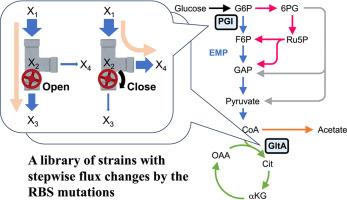
Optimization of flux distribution in central carbon metabolism is important to improve the microbial productivity. As the number of precursors required for synthesis differs for each target compound, optimal flux distribution also varies. A library of mutant strains with diverse flux distributions can aid in optimal strain screening. Therefore, in this study, we aimed to construct a library of Escherichia coli strains with stepwise changes in flux distribution by introducing mutations into the ribosome-binding sites of key enzyme genes on its chromosome. We focused on the flux ratios at the glucose-6-phosphate and acetyl-CoA branch points to enhance mevalonate production. Mutations were introduced into the ribosome-binding sites of pgi and gltA to vary the flux ratios of the two pathway branches. Furthermore, a combinatorial repression library comprising 16 strains was constructed by varying pgi and gltA expression at four levels, and a plasmid containing mevalonate synthesis genes was introduced into each strain. Batch cultures were performed to obtain strains with mevalonate titers and yields 2.4- and 3.4-fold higher than those of the parent strain. Overall, our combinatorial suppression library of pgi and gltA facilitated the effective identification of mutants with optimal metabolism for mevalonate production.
大肠杆菌核糖体结合位点修饰对中心碳代谢中碳流的精细调节
优化中心碳代谢通量分布对提高微生物生产力具有重要意义。由于每种目标化合物合成所需的前驱体数量不同,因此最佳通量分布也不同。具有不同通量分布的突变菌株库可以帮助进行最佳菌株筛选。因此,本研究旨在通过在大肠杆菌染色体上关键酶基因的核糖体结合位点引入突变,构建通量分布逐步变化的大肠杆菌菌株文库。我们关注葡萄糖-6-磷酸和乙酰辅酶a分支点的通量比,以提高甲羟戊酸的产生。将突变引入pgi和gltA的核糖体结合位点,以改变两种途径分支的通量比率。此外,通过改变pgi和gltA在4个水平上的表达,构建了包含16株菌株的组合抑制文库,并在每个菌株中引入含有甲羟戊酸合成基因的质粒。分批培养获得的菌株甲羟戊酸滴度和产量分别比亲本菌株高2.4倍和3.4倍。总的来说,我们的pgi和gltA组合抑制文库有助于有效识别具有最佳代谢的甲羟戊酸生产突变体。
本文章由计算机程序翻译,如有差异,请以英文原文为准。
求助全文
约1分钟内获得全文
求助全文
来源期刊
Metabolic Engineering Communications
Medicine-Endocrinology, Diabetes and Metabolism
CiteScore
13.30
自引率
1.90%
发文量
22
审稿时长
18 weeks
期刊介绍:
Metabolic Engineering Communications, a companion title to Metabolic Engineering (MBE), is devoted to publishing original research in the areas of metabolic engineering, synthetic biology, computational biology and systems biology for problems related to metabolism and the engineering of metabolism for the production of fuels, chemicals, and pharmaceuticals. The journal will carry articles on the design, construction, and analysis of biological systems ranging from pathway components to biological complexes and genomes (including genomic, analytical and bioinformatics methods) in suitable host cells to allow them to produce novel compounds of industrial and medical interest. Demonstrations of regulatory designs and synthetic circuits that alter the performance of biochemical pathways and cellular processes will also be presented. Metabolic Engineering Communications complements MBE by publishing articles that are either shorter than those published in the full journal, or which describe key elements of larger metabolic engineering efforts.
 求助内容:
求助内容: 应助结果提醒方式:

 京公网安备 11010802042870号


