
Seasonal variation and distribution of microplastics in surface water and sediments of Coimbatore Lakes, India
IF 8.9
1区 地球科学
Q1 GEOSCIENCES, MULTIDISCIPLINARY
引用次数: 0
Abstract
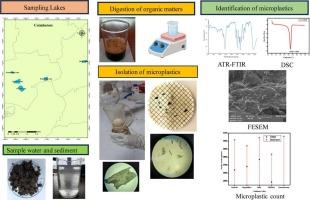
This study quantified the abundance, distribution, and characteristics of microplastics in surface water and sediments from five lakes in the Coimbatore District: Kumaraswamy Lake, Ukkadam Lake, Kuruchi Lake, Singanallur Lake, and Sulur Lake. The highest microplastic abundance was found in the surface water of Kuruchi Lake (14.08 ± 0.63 particles/L) at site S5 during the monsoon, and in the surface sediments of Kumaraswamy Lake (13.33 ± 0.33 particles/g) at site S6 during summer. Spatial distribution patterns indicated that lakes receiving urban runoff, domestic wastewater inflow, and inputs from fishing and recreational activities exhibited higher microplastic concentrations. Seasonal variations showed elevated microplastic abundance in summer sediments and monsoon surface water samples. Microplastics were identified using Attenuated total reflectance- Fourier Transform Infrared Spectroscopy (ATR-FTIR) and Differential Scanning Calorimetry (DSC)), revealing Linear low-density polyethylene (LLDPE), High-density polyethylene (HDPE), Polyethylene terephthalate (PET), and Polypropylene (PP). These microplastic occurred in white, transparent, black, blue, yellow, and pink colors and appeared as films, fragments, thin pieces, and fibres. Characteristic DSC melting peaks were observed 200 °C for PET, 167.98 °C for PP, 126.70 °C for LLDPE, and 130.02 °C for HDPE. The lake’s pollution load index is categorized as risk level 1, indicating a low level of microplastic pollution. The presence and distribution of these microplastics suggest potential ecological risks to freshwater organisms and possible implications for human health.
印度哥印拜陀湖表层水和沉积物中微塑料的季节变化和分布
本研究量化了哥印拜陀地区Kumaraswamy湖、Ukkadam湖、Kuruchi湖、Singanallur湖和Sulur湖五个湖泊地表水和沉积物中微塑料的丰度、分布和特征。季风期库鲁奇湖表层水(14.08±0.63颗粒/L)和夏季库马拉斯瓦米湖表层沉积物(13.33±0.33颗粒/g)的微塑料丰度最高。空间分布格局表明,城市径流、生活污水流入以及渔业和娱乐活动输入的湖泊呈现出较高的微塑料浓度。夏季沉积物和季风地表水样品的微塑料丰度随季节变化而升高。利用衰减全反射-傅里叶变换红外光谱(ATR-FTIR)和差示扫描量热法(DSC)对微塑料进行了鉴定,发现了线性低密度聚乙烯(LLDPE)、高密度聚乙烯(HDPE)、聚对苯二甲酸乙二醇酯(PET)和聚丙烯(PP)。这些微塑料有白色、透明、黑色、蓝色、黄色和粉红色,以薄膜、碎片、薄片和纤维的形式出现。PET的DSC熔化峰为200°C, PP为167.98°C, LLDPE为126.70°C, HDPE为130.02°C。该湖的污染负荷指数为风险1级,表明微塑料污染水平较低。这些微塑料的存在和分布表明对淡水生物存在潜在的生态风险,并可能对人类健康产生影响。
本文章由计算机程序翻译,如有差异,请以英文原文为准。
求助全文
约1分钟内获得全文
求助全文
来源期刊
Gondwana Research
地学-地球科学综合
CiteScore
12.90
自引率
6.60%
发文量
298
审稿时长
65 days
期刊介绍:
Gondwana Research (GR) is an International Journal aimed to promote high quality research publications on all topics related to solid Earth, particularly with reference to the origin and evolution of continents, continental assemblies and their resources. GR is an "all earth science" journal with no restrictions on geological time, terrane or theme and covers a wide spectrum of topics in geosciences such as geology, geomorphology, palaeontology, structure, petrology, geochemistry, stable isotopes, geochronology, economic geology, exploration geology, engineering geology, geophysics, and environmental geology among other themes, and provides an appropriate forum to integrate studies from different disciplines and different terrains. In addition to regular articles and thematic issues, the journal invites high profile state-of-the-art reviews on thrust area topics for its column, ''GR FOCUS''. Focus articles include short biographies and photographs of the authors. Short articles (within ten printed pages) for rapid publication reporting important discoveries or innovative models of global interest will be considered under the category ''GR LETTERS''.
 求助内容:
求助内容: 应助结果提醒方式:

 京公网安备 11010802042870号


