
Process-scale evaluation of biochar for calcium removal and mineral recovery in industrial wastewater treatment
IF 8.1
2区 环境科学与生态学
Q1 ENVIRONMENTAL SCIENCES
引用次数: 0
Abstract
Increasing calcium (Ca2+) concentrations in water systems, largely attributed to industrial effluents and agricultural runoff, present serious environmental and health concerns, including scaling, infrastructure degradation, and elevated risk of kidney stone formation. Conventional calcium removal techniques such as chemical precipitation and reverse osmosis are often energy-intensive and economically unsustainable. This study explores engineered biochars derived from algae and wood as alternative, sustainable materials for Ca2+ remediation from aqueous environments. The performance of each biochar was evaluated through a combination of atomistic simulations, batch and continuous-flow adsorption experiments, and gas–liquid–solid phase carbonation tests. Algae-based biochar reduced Ca2+ concentrations by up to 47 percent, from 802.4 to 425 mg per liter, outperforming wood-based biochar, which reduced concentrations from 839.5 to 574.3 mg per liter. Both biochars demonstrated significantly higher Ca2+ uptake than inert glass bead controls. Carbonation experiments further confirmed the ability of biochar to facilitate calcium carbonate (CaCO3) precipitation, with algae biochar yielding 762 mg of CaCO3 and exhibiting substantial surface-scale deposition, suggesting enhanced nucleation and crystal growth. Density Functional Theory (DFT) calculations indicated that nitrogen- and oxygen-containing surface functional groups, particularly amine, pyridine, and carboxyl moieties, are key contributors to Ca2+ binding. The adsorption energy analysis supported the superior performance of algae biochar, driven by stronger Ca2+ affinity. These results demonstrate the potential of designed biochars as efficient, low-cost materials for water treatment, while supporting sustainable resource management and circular bioeconomy initiatives.
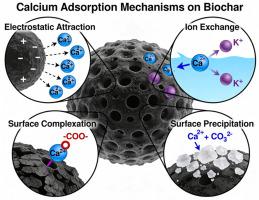
生物炭在工业废水处理中除钙和矿物回收的工艺规模评价。
水系统中钙(Ca2+)浓度的增加,主要归因于工业废水和农业径流,带来了严重的环境和健康问题,包括结垢、基础设施退化和肾结石形成风险的增加。传统的除钙技术,如化学沉淀和反渗透,往往是能源密集型和经济上不可持续的。本研究探索从藻类和木材中提取的工程生物炭作为水环境中钙离子修复的替代、可持续材料。通过原子模拟、间歇和连续流吸附实验以及气液固相碳酸化测试来评估每种生物炭的性能。藻类生物炭将Ca2+浓度降低了47%,从每升802.4毫克降至425毫克,优于木质生物炭,将浓度从每升839.5毫克降至574.3毫克。两种生物炭均表现出明显高于惰性玻璃珠对照的Ca2+摄取。碳化实验进一步证实了生物炭促进碳酸钙(CaCO3)沉淀的能力,藻类生物炭产生762 mg CaCO3,并表现出大量的表面沉积,表明生物炭促进了成核和晶体生长。密度泛函理论(DFT)计算表明,含氮和含氧的表面官能团,特别是胺,吡啶和羧基部分,是Ca2+结合的关键贡献者。吸附能分析表明,藻类生物炭具有较强的Ca2+亲和力,具有较好的吸附性能。这些结果证明了设计的生物炭作为高效、低成本的水处理材料的潜力,同时支持可持续资源管理和循环生物经济倡议。
本文章由计算机程序翻译,如有差异,请以英文原文为准。
求助全文
约1分钟内获得全文
求助全文
来源期刊
Chemosphere
环境科学-环境科学
CiteScore
15.80
自引率
8.00%
发文量
4975
审稿时长
3.4 months
期刊介绍:
Chemosphere, being an international multidisciplinary journal, is dedicated to publishing original communications and review articles on chemicals in the environment. The scope covers a wide range of topics, including the identification, quantification, behavior, fate, toxicology, treatment, and remediation of chemicals in the bio-, hydro-, litho-, and atmosphere, ensuring the broad dissemination of research in this field.
 求助内容:
求助内容: 应助结果提醒方式:

 京公网安备 11010802042870号


