
Boosting methanol steam reforming performance via crystal-phase-driven strong metal-support interactions: From encapsulated Pt nanoparticles to deeply embedded PtOx-induced Pt single atoms
IF 15.6
1区 化学
Q1 Energy
Journal of Energy Chemistry
Pub Date : 2026-05-01
Epub Date: 2026-01-07
DOI:10.1016/j.jechem.2025.12.054
引用次数: 0
Abstract
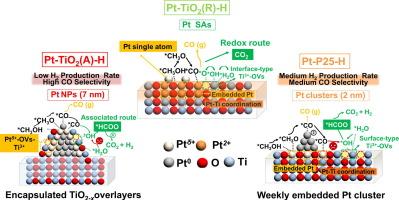
Traditional strong metal-support interactions (SMSIs) induced by encapsulated reducible oxide overlayers on metal nanoparticles can suppress sintering but has a strong negative impact on the catalytic activity because of decreased availability of active sites. Herein, we design three SMSIs configurations on Pt-TiO2 via crystal-phase engineering. These configurations comprised encapsulated Pt nanoparticle (NPs) with TiO2−x overlayer on anatase, weakly embedded Pt clusters on P25, and deeply embedded PtOx-induced Pt single-atom (SA) structure on rutile. These configurations exhibited Pt species at multiple scales, ranging from NPs to SAs. Among them, Pt supported rutile TiO2 sample (Pt-TiO2(R)-H) achieved extremely low CO selectivity (2.05%, 200 °C) and optimal H2 production performance due to the enhanced SMSIs from Pt–Ti coordination in the deeply embedded PtOx region. This Pt–Ti coordination facilitated the electron transfer from Pt to Ti and induced dual-function centers of electron-deficient Ptδ+–Pt2+ pairs (0 < δ < 2, where Ptδ+ represent Pt SAs) for methanol decomposition and electron-rich Ti3+–oxygen vacancies for water dissociation. Such unique configuration altered the MSR reaction pathway and the kinetic rates of each elementary step in these reaction pathways were systematically analyzed. This work proposes an SMSIs configuration induced by a deeply embedded structure, which mitigates the negative impact on catalytic activity from encapsulated overlayers, meanwhile providing a strategy for developing high-loading Pt SAs catalysts.
通过晶体相驱动的强金属支持相互作用提高甲醇蒸汽重整性能:从封装的Pt纳米颗粒到深嵌入的pxo诱导的Pt单原子
传统的强金属-支撑相互作用(SMSIs)是由金属纳米颗粒上的可还原性氧化物包覆层诱导的,可以抑制烧结,但由于活性位点的可用性降低,对催化活性有很强的负面影响。本文采用晶相工程的方法在Pt-TiO2上设计了三种smsi结构。这些结构包括锐钛矿上包覆TiO2−x的纳米Pt粒子(NPs)、P25上弱嵌入的Pt簇和金红石上深嵌入的pxo诱导的Pt单原子(SA)结构。这些构型显示了从NPs到SAs的多个尺度上的铂种。其中,Pt负载的金红石型TiO2样品(Pt-TiO2(R)-H)由于Pt- ti在深度嵌入PtOx区域的配位增强了smsi,实现了极低的CO选择性(2.05%,200℃)和最佳的制氢性能。这种Pt - Ti配位促进了电子从Pt到Ti的转移,并诱导了甲醇分解的缺电子Ptδ+ -Pt2 +对(0 < δ < 2,其中Ptδ+代表Pt SAs)和水解离的富电子Ti3+ -氧空位的双功能中心。这种独特的构型改变了MSR反应途径,并系统地分析了这些反应途径中每个基本步骤的动力学速率。本研究提出了一种由深嵌入结构诱导的smsi结构,该结构减轻了封装层对催化活性的负面影响,同时为开发高负载Pt SAs催化剂提供了一种策略。
本文章由计算机程序翻译,如有差异,请以英文原文为准。
求助全文
约1分钟内获得全文
求助全文
来源期刊
Journal of Energy Chemistry
CHEMISTRY, APPLIED-CHEMISTRY, PHYSICAL
CiteScore
19.10
自引率
8.40%
发文量
3631
审稿时长
15 days
期刊介绍:
The Journal of Energy Chemistry, the official publication of Science Press and the Dalian Institute of Chemical Physics, Chinese Academy of Sciences, serves as a platform for reporting creative research and innovative applications in energy chemistry. It mainly reports on creative researches and innovative applications of chemical conversions of fossil energy, carbon dioxide, electrochemical energy and hydrogen energy, as well as the conversions of biomass and solar energy related with chemical issues to promote academic exchanges in the field of energy chemistry and to accelerate the exploration, research and development of energy science and technologies.
This journal focuses on original research papers covering various topics within energy chemistry worldwide, including:
Optimized utilization of fossil energy
Hydrogen energy
Conversion and storage of electrochemical energy
Capture, storage, and chemical conversion of carbon dioxide
Materials and nanotechnologies for energy conversion and storage
Chemistry in biomass conversion
Chemistry in the utilization of solar energy
 求助内容:
求助内容: 应助结果提醒方式:

 京公网安备 11010802042870号


