
Bifunctional crosslinking-induced structural engineering towards improved sodium storage in pitch-derived hard carbon
IF 15.6
1区 化学
Q1 Energy
Journal of Energy Chemistry
Pub Date : 2026-05-01
Epub Date: 2026-01-04
DOI:10.1016/j.jechem.2025.12.048
引用次数: 0
Abstract
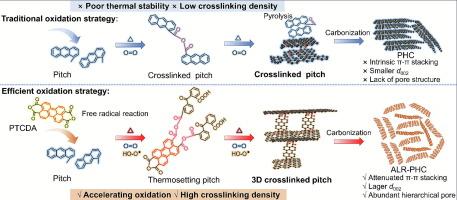
The construction of crosslinking structures in pitch-derived carbons is essential for disrupting intrinsic π-π stacking and achieving high performance sodium-ion batteries. However, the structural collapse caused by the pyrolysis-oxidation kinetic mismatch and the challenge of rational crosslinker selection remain significant obstacles. Herein, we introduce a bifunctional crosslinking agent that simultaneously accelerates oxidative ring-opening and reinforces covalent network formation, thereby overcoming the kinetic imbalance between oxidation and pyrolysis. Specifically, 3, 4, 9, 10-perylenetetracarboxylic dianhydride (PTCDA) not only promotes generating oxygen-free radicals due to the low bond energy of its C–O bonds but also reacts with oxygen-containing functional groups in oxidized pitch to form covalent linkages, thereby further increasing crosslinking density. Consequently, the resulting hard carbons exhibit expanded interlayer spacing (d002) and a defect-rich hierarchical porous structure. This gives rise to high reversible capacity (328.32 mAh g−1), excellent rate capability (171.54 mAh g−1 at 400 mA g−1), and outstanding cycling stability (93.4% capacity retention after 200 cycles at 40 mA g−1). Moreover, its practical feasibility is demonstrated in full cells. This work establishes a robust paradigm for developing next-generation hard carbon anodes by synergistically optimizing the bonding configuration of precursors, pore architecture, and carbon framework, while offering deep mechanistic insight into the pitch crosslinking process.
改善沥青衍生硬碳中钠储存的双功能交联诱导结构工程
在沥青衍生碳中构建交联结构对于破坏本征π-π堆积和实现高性能钠离子电池至关重要。然而,由热解氧化动力学失配引起的结构崩溃和合理选择交联剂的挑战仍然是重要的障碍。本文介绍了一种双功能交联剂,该交联剂可以同时加速氧化开环和加强共价网络的形成,从而克服氧化和热解之间的动力学不平衡。具体来说,3,4,9,10 -苝四羧酸二酐(PTCDA)由于其C-O键的键能较低,不仅能促进氧自由基的生成,还能与氧化沥青中的含氧官能团反应形成共价键,从而进一步提高交联密度。因此,所得到的硬碳表现出扩大的层间距(d002)和富含缺陷的分层多孔结构。这产生了高可逆容量(328.32 mAh g - 1),出色的倍率容量(171.54 mAh g - 1, 400 mA g - 1),以及出色的循环稳定性(在40 mA g - 1下200次循环后,容量保持率为93.4%)。并在全电池中验证了其实际可行性。这项工作通过协同优化前驱体、孔隙结构和碳框架的键合配置,为开发下一代硬碳阳极建立了一个强大的范例,同时为节距交联过程提供了深入的机制见解。
本文章由计算机程序翻译,如有差异,请以英文原文为准。
求助全文
约1分钟内获得全文
求助全文
来源期刊
Journal of Energy Chemistry
CHEMISTRY, APPLIED-CHEMISTRY, PHYSICAL
CiteScore
19.10
自引率
8.40%
发文量
3631
审稿时长
15 days
期刊介绍:
The Journal of Energy Chemistry, the official publication of Science Press and the Dalian Institute of Chemical Physics, Chinese Academy of Sciences, serves as a platform for reporting creative research and innovative applications in energy chemistry. It mainly reports on creative researches and innovative applications of chemical conversions of fossil energy, carbon dioxide, electrochemical energy and hydrogen energy, as well as the conversions of biomass and solar energy related with chemical issues to promote academic exchanges in the field of energy chemistry and to accelerate the exploration, research and development of energy science and technologies.
This journal focuses on original research papers covering various topics within energy chemistry worldwide, including:
Optimized utilization of fossil energy
Hydrogen energy
Conversion and storage of electrochemical energy
Capture, storage, and chemical conversion of carbon dioxide
Materials and nanotechnologies for energy conversion and storage
Chemistry in biomass conversion
Chemistry in the utilization of solar energy
 求助内容:
求助内容: 应助结果提醒方式:

 京公网安备 11010802042870号


