
Ultrasound-activated metal-polyphenol nanodroplets for tumor cuproptosis
IF 12.9
1区 医学
Q1 ENGINEERING, BIOMEDICAL
引用次数: 0
Abstract
Cuproptosis is a novel form of cell death that relies on mitochondrial metabolism and has opened up new avenues for tumor therapy. However, resistance to cuproptosis in tumors can arise from several factors, such as their reliance on aerobic glycolysis, the high-glutathione (GSH) environment, and inefficient copper (Cu) delivery. In this study, we developed shell-core nanodroplets (NDs) approximately 280 nm in diameter, named Cu-EGCG-SHK-NDs. These NDs are composed of a liquid-gas phase-change perfluorohexane core and a carboxymethyl chitosan shell, loaded with the glycolytic inhibitor shikonin (SHK) and coated with Cu-complexed epigallocatechin gallate (Cu-EGCG), enabling targeted delivery through ultrasound (US)-targeted microbubble destruction (UTMD). The dual responsiveness of NDs to both US and pH enables precise drug release and efficient intracellular uptake. In addition, the US response enhances contrast-enhanced US imaging and triggers the generation of reactive oxygen species, subsequently depleting GSH. Both in vitro and in vivo experiments confirm that Cu-EGCG-SHK-NDs possess excellent biocompatibility. Combined with UTMD, they can efficiently co-deliver Cu and SHK into tumour cells, inhibit glycolytic metabolism, and significantly reduce intracellular GSH levels. This synergistic mechanism enhances cuproptosis induction and achieves effective tumour growth inhibition.
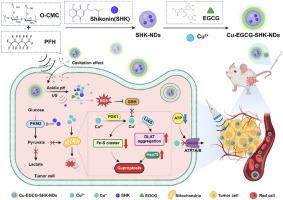
超声活化金属多酚纳米液滴用于肿瘤铜增生
铜增生是一种依赖于线粒体代谢的新型细胞死亡形式,为肿瘤治疗开辟了新的途径。然而,肿瘤对铜沉淀的抵抗可能由几个因素引起,例如它们对有氧糖酵解的依赖、高谷胱甘肽(GSH)环境和低效率的铜(Cu)递送。在这项研究中,我们开发了直径约280 nm的壳核纳米液滴(NDs),命名为cu - eggcg - shk -NDs。这些ndds由液-气相变全氟己烷核和羧甲基壳聚糖壳组成,负载糖水解抑制剂紫草素(SHK),并包裹有cu络合的表没食子儿茶素没食子酸酯(Cu-EGCG),能够通过超声(US)靶向微泡破坏(UTMD)靶向递送。NDs对US和pH的双重反应性使得精确的药物释放和有效的细胞内摄取成为可能。此外,美国反应增强了对比增强的美国成像,并触发活性氧的产生,随后消耗谷胱甘肽。体外和体内实验均证实Cu-EGCG-SHK-NDs具有良好的生物相容性。与UTMD联合,它们能有效地将Cu和SHK共同递送到肿瘤细胞中,抑制糖酵解代谢,显著降低细胞内GSH水平。这种协同机制增强了铜生长诱导,实现了有效的肿瘤生长抑制。
本文章由计算机程序翻译,如有差异,请以英文原文为准。
求助全文
约1分钟内获得全文
求助全文
来源期刊
Biomaterials
工程技术-材料科学:生物材料
CiteScore
26.00
自引率
2.90%
发文量
565
审稿时长
46 days
期刊介绍:
Biomaterials is an international journal covering the science and clinical application of biomaterials. A biomaterial is now defined as a substance that has been engineered to take a form which, alone or as part of a complex system, is used to direct, by control of interactions with components of living systems, the course of any therapeutic or diagnostic procedure. It is the aim of the journal to provide a peer-reviewed forum for the publication of original papers and authoritative review and opinion papers dealing with the most important issues facing the use of biomaterials in clinical practice. The scope of the journal covers the wide range of physical, biological and chemical sciences that underpin the design of biomaterials and the clinical disciplines in which they are used. These sciences include polymer synthesis and characterization, drug and gene vector design, the biology of the host response, immunology and toxicology and self assembly at the nanoscale. Clinical applications include the therapies of medical technology and regenerative medicine in all clinical disciplines, and diagnostic systems that reply on innovative contrast and sensing agents. The journal is relevant to areas such as cancer diagnosis and therapy, implantable devices, drug delivery systems, gene vectors, bionanotechnology and tissue engineering.
 求助内容:
求助内容: 应助结果提醒方式:

 京公网安备 11010802042870号


